Kanban has become a go-to system for managing work, used by engineering teams at Google, Marine Corps units, music video producers, and regular folks with to-do lists.
At its core, a Kanban board is disarmingly simple: tasks move across columns that reflect their current state: “To Do.” “Doing.” “Done.” Seeing the work laid out like this turns it into concrete steps, bounded by deadlines, dependencies, and shared ownership.
It’s this clarity that explains why Kanban boards now appear in almost every project management platform. The catch? Choosing the right tool is rarely as simple as the board itself. Some platforms emphasize automation, time tracking, analytics, or tighter operational control. But which do you need?
This post compares different types of Kanban software to help you choose a tool that fits your operating style.
Best Kanban software at a glance
To create our list of recommendations, we’ve hand-picked a roster of tools with generous free plans for teams and individuals. Each offers its own take on Kanban, while some also offer comprehensive project and workflow management features for larger teams.
| Tool | Best for | Free plan? | Paid pricing starts at … |
| Toggl | Built-in time tracking | Yes (up to 5 users) | $9/user/month |
| Trello | Gentle learning curve | Yes (up to 10 collaborators) | $5/user/month |
| Jira | Software development teams | Yes (up to 10 users) | $7.91/user/month |
| Teamhood | Mid-sized non-technical teams | Yes (up to 10 users) | €9/user/month |
| Leantime | Neurodiverse teams | Yes (open source) | $10/user/month |
| Ticky | Open-source Kanban functionality | Yes (self-hosted) | Free |
| Asana | Task management for larger teams | Yes (for 2 users) | $10.99/user/month |
| ClickUp | All-in-one work OS | Yes (5 spaces) | $7/user/month |
What is Kanban board software?
Kanban board software is a visual system for managing work in motion using cards and columns. As work progresses, cards move across columns and work status becomes something you see instantly rather than infer from a spreadsheet.
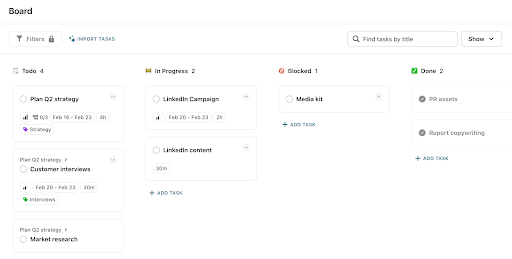
The concept traces back to Taiichi Ohno at Toyota in the late 1940s. “Kanban” translates roughly to “signboard.” The metaphor still holds — the board signals where work sits at any given moment.
Digital tools have added a few more “extras” to the original Kanban methods such as:
- Swimlanes. These add a second axis of clarity through horizontal categorization. You can map work by owner, client, or priority, and immediately see where imbalances may happen.
- Custom metadata on cards. Tags, cost centers, or story points act as a proxy for your internal logic. Filtering by these fields reveals patterns that raw columns can’t. Over time, metadata becomes a conduit of decision-making over guesswork.
- Assignees, comments, and attachments. Each card should function as a contained workspace with visible ownership and related conversations to prevent tasks from drifting across tools and inboxes.
- Built-in time tracking. Visual flow shows movement while time data shows friction. When you layer duration over stages, forecasting improves, and capacity planning becomes binding. Without time data, Kanban remains directional. With it, you get actionable insights.
- Work-in-progress limits. WIP limits expose bottlenecks early and force prioritization instead of multitasking theatre.
- Reporting and analytics. Cycle time and throughput act as lagging indicators of process health. Trend shifts are often subtle before they become painful. Analytics let you intervene before the slowdown compounds.
- Custom workflows. Out-of-the-box templates rarely mirror how teams operate. Instead, customizations let your board reflect a lived process rather than an idealized one.
- Workflow automation. Status updates and handoffs tend to consume attention without adding value. Light automation chips away at overhead and reduces human error without turning the board into a black box.
- Collaboration tools. Mentions, notifications, and shared views reduce the need for parallel status meetings, so stakeholders see movement in context.
- Integrations. A Kanban tool works best when it fits into your existing stack. Calendar sync and chat integration minimize context switching. When the fit is tight, the board becomes the key destination, rather than another detour.
All of the above are now standard features in Kanban software. You can test many of them on a free plan — and we really encourage you to do so!
A generous tier gives you a preview of the core mechanics and reporting depth before you commit. Does the app feel intuitive? Does the reporting function locate useful data? Can you customize it to match your workflows? Your personal experience with a tool often gives you more data than any pricing table.
In some cases, a Kanban tool with a good free plan is all a team with standard processes will ever need.
8 best Kanban board software
The following Kanban software options include free and paid versions to suit any budget.
Toggl: Best Kanban tool with built-in time tracking
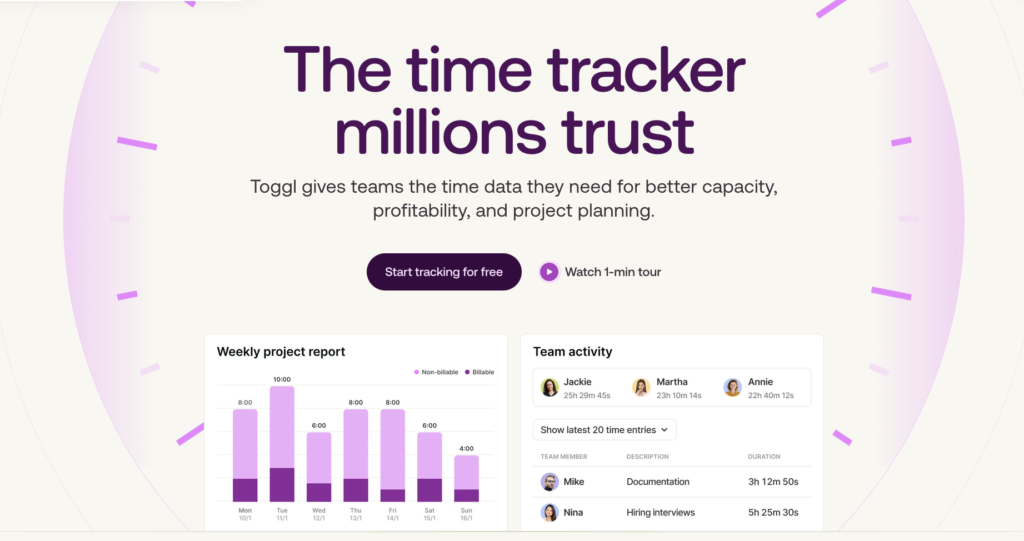
Toggl is a project management system with time tracking at its core. It captures exactly how long every task takes, allows you to plan current and future projects, and gives you absolute clarity into capacity and resource management.
For task management, Toggl offers an intuitive user experience — simply create a task, drag it across columns, and update status.
This simplicity holds up as you plan bigger workloads.
You can rename existing statuses or create entirely new ones for the board to mirror how your team does the work. For example, you can create “Briefed” to “In Production” to “Client Review” to “Approved” columns for client work. This lets you reflect the nuance of your work without bending your process to fit a template.
Each task also carries structured metadata:
- Description, notes, and attachments for context
- Project association for portfolio visibility
- Assignee and priority markers
- Custom tags for filtering
- Customizable execution periods and time estimates
Going deeper, subtasks allow you to break larger deliverables into nested components. For example, a PR campaign launch becomes target media research, PR kit preparation, asset design, and media coverage monitoring. To reduce cognitive clutter, you can use filters to see only what’s relevant to you.
When a Kanban board integrates structured metadata, time allocation, and personal filtering, it becomes a coordination layer.
- Account managers can see campaign progress by status.
- Team leads can track whether execution periods align with capacity.
- Individual contributors focus on their own filtered view without losing connection to the broader project.
The result is less friction between planning, delivery, and reporting.
Combining task management with capacity planning
You can track time manually or use real-time timers directly from assigned tasks on the Kanban board.
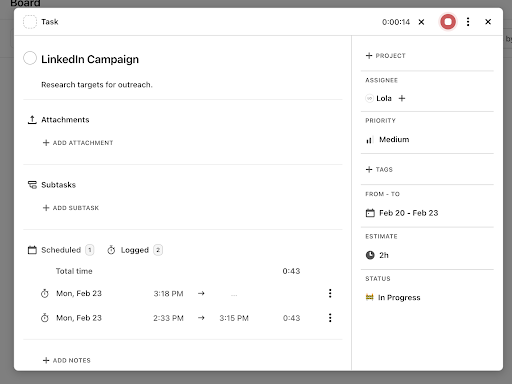
Calendar sync automatically pulls in meetings and events, so logged hours reflect how workdays unfold in practice. This integration replaces guesswork with real time data.
Scheduled effort becomes logged effort, while you can compare task estimates against actuals without exporting the data elsewhere. Over time, this creates tighter scoping conversations with clients and more accurate resource allocation internally.
On the Starter plan, teams also gain multiple assignees per task and milestone tracking, which helps coordinate cross-functional deliverables. More importantly, you can assign different billable rates per task, project, or client. This way, revenue and profitability tracking becomes embedded in day-to-day execution rather than exported into spreadsheets later.
Capacity planning is also available at this level, which is pretty unusual as many tools reserve it for higher tiers. With Toggl, managers can plan around PTO, holidays, and working hours, and see individual capacity in real time. Any hint of over- and under-utilization stops being a surprise at month-end.
Reporting that links everything together
The reporting layer focuses on operational insights.
- Bar status charts show task breakdowns by client or team member, which identifies stalled work.
- Pie charts reveal where time actually flows across projects and accounts.
These clarify which clients or tasks consume disproportionate effort relative to revenue.
Premium users gain access to Workload and Utilization reports. The Utilization Report tracks available hours against logged work and compares that figure to a defined target. You see total capacity, logged time, and overall utilization percentage for a given period. Color coding flags under-utilization, making gaps visible before they affect profitability. It’s also possible to exceed 100%, which often signals overtime pressure rather than efficiency.
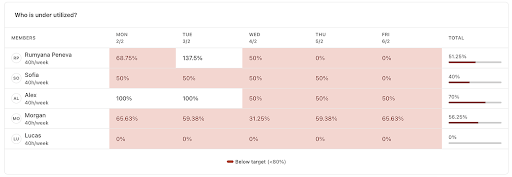
The Workload Report offers a high-level snapshot of total available hours, logged time, and remaining capacity. Managers can quickly see who has room to take on new work and who’s in the overtime zone.
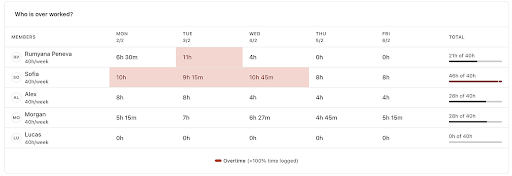
Along with recapping activity, these reports also shape hiring, pricing, and client strategy, while exposing scoping or staffing gaps.
| Main features | Use cases |
| – Manual and real-time timers, Pomodoro, and countdown focus mode sessions – Integration with Google or Outlook calendars to link meetings and blocks with tracked time – Boards, calendars, and timeline views for task planning – Task estimates and milestones for long-term visibility – Capacity and workload reports to track availability, manage PTO, and flexible hours – Team-filtered timelines and visual reports – Supported platforms: Web, Android, iOS, Windows, Mac. | – Visual project planning to align teams around what’s next – Client billing and professional services planning – Capacity and resource planning, based on real availability data – Focus and deep work support for individual contributors |
Pros
- Generous free plan with full access to core features, so you can properly test the product before upgrading.
- Kanban board remains intuitive while offering more precision than many lightweight boards: subtasks, recurring tasks, and estimates.
- Time tracking is deeply integrated, improving forecasting and billing accuracy.
- Capacity and utilization visibility are built into the workflow. Managers can see who’s over- or under-allocated and adjust before profitability drifts.
Cons
- No advanced Jira-style controls like WIP limits, dependency management, or swimlanes.
- Limited automation beyond the AI task creation assistant.
Pricing plans
| Forever free plan | Starter | Premium | Enterprise |
| Free up to five users | From $9/user per month | From $16/user per month | On-demand |
| Unlimited projects and tags | Everything in Free plus: | Everything in Starter, plus: | Everything in Premium, plus: |
| – Manual and automated time trackers – Calendar integrations – Focus mode – Task and board views – Timeblocking – Task estimates and recurring tasks – AI task creator – Personal reports | – Timeline view – Multiple assignees per task – Milestones – Guest access – Team-level reports, with filters and billable rates – Capacity planning tools | – Utilization and workload reports | – Personalized onboarding & dedicated customer success manager – Custom setup, integration, or reporting solutions – Multiple workspaces under one organization |
Trello: Best free Kanban app with a gentle learning curve
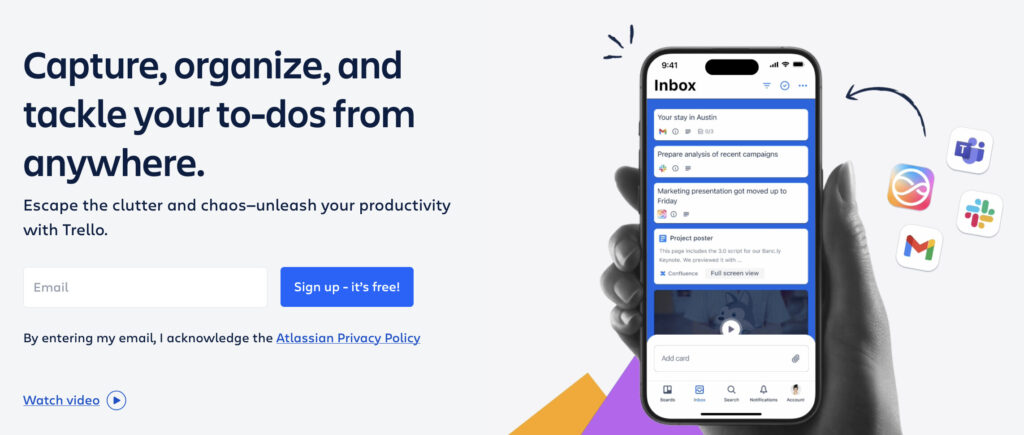
Trello offers an easy entry point into Kanban. The app mechanics are hard to overthink:
- Boards contain lists
- Lists contain cards
- Cards contain tasks, due dates, comments, owners, and checklists
Trello’s simplicity is a strong selling point for smaller teams. You’ve got everything visible at a glance, without the need to hunt or context switch. Built-in templates do some heavy lifting, too, by allowing first-time users to experience the products without designing their own workflows.
What I like is how Trello manages to stay flexible without advertising the fact. At face value, it works just fine as a personal to-do board. In fact, a Trello Support user has recently confirmed that personal productivity is now its main use case.
That said, the same structure can easily stretch to accommodate teamwork, largely because advanced features stay out of the way until you need them. Trello’s Power-Ups allow you to add WIP limits to identify bottlenecks, or swimlanes to slice different work tasks by owner or priority without duplicating cards.
With Trello, your workspace stays visual, stays readable, and grows with the workflow instead of sitting on top of it.
| Main features | Use cases |
| – Visual boards, lists, and cards – Drag-and-drop planning – Custom labels, fields, and due dates – Task and event sync from the calendar – Task capture from email, Slack, or other comms services – Integrations and power-ups for extended functionality – Supported platforms: Web, Android, iOS, Windows, Mac, Linux | – Project management for non-technical teams – Content planning and editorial calendars – Meeting and event planning – Public product roadmaps with updates on release statuses – Personal productivity hub and to-do lists |
Pros
- The straightforward design of cards, lists, and boards remains unmatched by competitors, according to a current user.
- The collective consensus also says it’s great for tracking and reviewing multiple tasks without constant check-ins.
- The new automation features (also available on a free plan) get some raving reviews. For example, “Resolution Board Builder” is great for brainstorming and breaking down complex goals into smaller steps.
Cons
- Collapsible lists and list color coding are paid plan features.
- Detailed reporting or more advanced dependency management requires Power-Ups or other additional tooling.
- Limited admin controls and user restrictions on a free plan. Only Premium or Enterprise users can disable commands (e.g., add tasks) on behalf of other users,
Pricing plans
- Free trial available
- Free forever plan for up to 10 collaborators
- 3 paid plans: Standard, Premium, and Enterprise
- Paid pricing starts at $5/user/mo
Jira: Best Kanban for software development teams
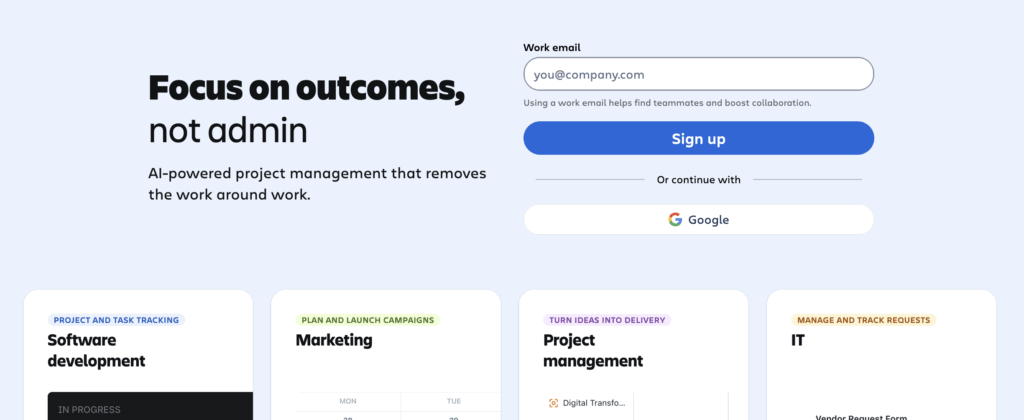
Atlassian’s Jira approaches Kanban as an operational discipline, not a visual planning shortcut. This is a purpose-built system for Agile teams that care deeply about process definition, measurement, repeatability, and accountability. Where lighter tools prioritize quick start, Jira prioritizes control — and does so unapologetically.
The default settings on boards have loads of controls: Swimlanes for work segmentation, WIP limits by issue type, member, or custom parameter, and deep issue linking to indicate dependencies between tasks. Automations take over the mechanical parts of delivery: closing parent issues when sub-tasks resolve or advancing tickets that meet certain conditions. Filters add another layer of leverage. You can shift between precise views for high-priority work, individual workloads, or cross-team dependencies without touching the underlying board.
Jira’s flexibility becomes even more valuable once it’s wired into the rest of the stack. Time-tracking tools such as Planyway add cost and effort visibility. Slack and Microsoft Teams integrations pull updates and feedback as delivery progresses. You also get deep analytics, including burndowns, velocity, epic tracking, and cumulative flow views that turn everyday issue data into something closer to operational telemetry, especially once you start building custom dashboards.
The tradeoff is complexity. Default templates encourage more statuses and fields than most teams need, and undocumented customizations quickly create more mess. Jira supports mature delivery teams, but it doesn’t supply the maturity itself. Without discipline, the system starts managing the team instead of the other way around.
| Main features | Use cases |
| – Configurable Scrum and Kanban boards – Issue tracking and management – Custom issue types and fields – Backlog and sprint planning tools – Automation engine with custom triggers, conditions, and actions – Built-in charts and reports for velocity, cycle time, burndown, and more – Granular user roles and team security settings – Supported platforms: Web, Windows, Linux, MacOS, other OS via Java JVM, Android, iOS | – Agile project management with Scrum, Kanban, or mixed methodologies – Ticket management and issue resolution for IT service desks – Product backlog and release management – Bug tracking and test integration to support quality assurance |
Pros
- The consensus is that Jira is the best project management tool for larger software engineering teams seeking flexibility in board controls, graphs, and metrics.
- Reduces context switching thanks to deep integrations with other apps like Microsoft Teams, Confluence, GitHub, and CI/CD tools.
- New natural-language search streamlines search across tasks and resolved tickets without using filters or specialized queries.
Cons
- Steep learning curve for beginners. Even simpler tasks may require more configuration than expected, per adopters.
- Boards can get cluttered fast due to excessive controls. Some users find the hierarchy of Jira cards confusing. Others mention the notifications are too noisy.
- Larger boards (e.g., with 200+ issues) can take too long to load, disrupting workflows.
Pricing plans
- Free trial available
- Free forever plan for up to 10 users
- 3 paid plans available: Standard, Premium, and Enterprise
- Paid pricing starts at $7.91/user/mo
Teamhood: Best for mid-sized non-technical teams
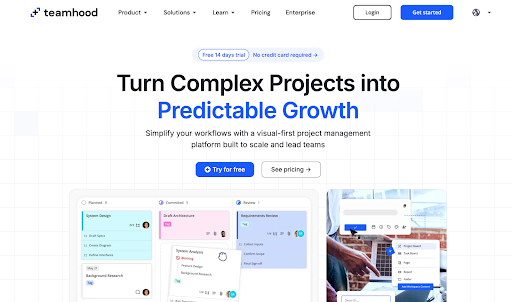
Teamhood sits comfortably in the middle of the Kanban spectrum — it’s more capable than Trello-style tools, and far less ceremonious than Jira.
At first glance, Teamhood feels clean and controlled. Kanban boards are the anchor, but they’re supported by timelines, Gantt charts, and other planning views. Customization runs quite deep: color grading, WIP limits, sub-statuses, and status groups let teams model flow without turning the board into a schema exercise. Unlimited sub-items give you room to add detail when it matters, and ignore it when it doesn’t.
Task modeling is where Teamhood starts to differentiate. Items support assignees, watchers, tags, and execution schedules that can automatically validate dependencies. Estimation works on two tracks —hours and story points. This makes it suitable for both tech and business units. Budgets add another layer: time spent rolls up against cost, calculated using team rates across multiple currencies. The built-in time tracker reinforces that loop, sitting unobtrusively in the board itself, with manual entry also available.
Dependencies are kept deliberately simple. You can model them clearly in Timeline and Gantt views, where sequencing and constraints matter most. Kanban stays focused on flow, limiting relationships to parent-child structures. Most teams will find that trade-off sensible, even if Jira users notice it immediately.
Reporting lands in a pragmatic middle ground. Custom dashboards cover the essentials, such as progress, burn-up, and cumulative flow. Prebuilt reports handle the operational questions teams actually ask: lead time, cycle time, on-time completion, throughput, and work aging. You can also add a custom formula to calculate other metrics.
Overall, Teamhood works best for teams that want structure without more rituals. It combines work planning, tracking, and budgeting in one place, without adding too many bells and whistles.
| Main features | Use cases |
| – Kanban boards with customizable status columns and swimlanes – Extra Gantt chart, timeline, list, and calendar views – Unlimited subtasks and task dependencies – Estimation tracking across time, cost, and effort – Workload and resource management views – Dashboards and reports: time sheets, agile metrics like age in progress, time to complete – Supported platforms: Web, Windows, Linux, macOS, mobile web. | – IT project management for smaller teams – Architecture and engineering project management – Portfolio and project management office management – Resource allocation and workload management |
Pros
- No feature bloat. Users comment there is much “never to be used” functionality.
- The app is EU-based, making it GDPR-compliant and not subject to the US Cloud Act, which is an advantage for privacy-conscious users.
- Combined Gantt and Kanban views track what’s in progress now with an option to zoom in on dependencies, upcoming workload, and available capacity.
Cons
- Some users miss having a better selection of keyboard shortcuts and commands.
- All integrations, even the calendar, are locked on a premium plan, unlike other project management tools.
- You can’t attach files in comments, only to tasks on cards, which limits the context in discussion threads.
Pricing plans
- Free trial available
- Free personal plan available for up to 10 users
- 3 paid plans: Team, Business, and Enterprise
- Paid pricing starts at €9 per user/mo
Leantime: Best Kanban tool for neurodiverse team members
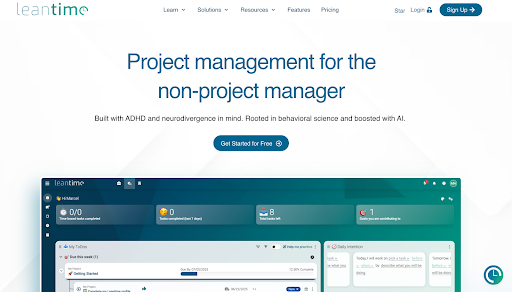
Leantime started as an open-source alternative to Asana, ClickUp, and Trello, built by a
neurodivergent founder. From the outset, the goal was to rethink how people actually manage their work, rather than replicate standard process templates.
Where most project tools assume uniform attention and linear focus, Leantime designs for variance. This philosophy shows up most clearly in the “My Work” dashboard which is fully customizable, giving users control over how they structure their own operating view. AI-driven task prioritization and contextual reminders sharpen the focus. Emoji-based tagging better conveys the emotional context. Time-blocking calendars, personal notes, and progress counters shift the focus from abstract deliverables to precise actions.
Beyond individual planning, Leantime offers team collaboration features. Idea boards support brainstorming, while pre-made blueprints guide teams through customer framing, risk analysis, and solution definition. Retrospective boards create a structured space to reflect on what worked and what didn’t.
The task management experience is straightforward. Kanban boards support sprint planning, while table and list views give alternative angles on the same work. Tasks allow due dates, assignments, comments, time tracking, milestones, and sprint alignment. All the tools stay visually simple.
Leantime feels less like a process enforcement tool and more like a cognitive support system. It won’t supplant heavyweight project management platforms for compliance-driven organizations. But for teams that want structure shaped around human attention — and are open to a bit of personality in their workflow — it offers a thoughtful, well-considered alternative.
| Main features | Use cases |
| – Personal organization dashboard – Time blocking on a personal calendar – AI task prioritization and subtask breakdown – Kanban boards and whiteboards – SWOT, Empathy map, Lean Canvas+ – Gantt charts and milestones – Strategy boards – Supported platforms: Web, self-hosted. | – Program management – Team retrospectives – Personal productivity – Cross-functional collaboration – Agile software delivery – Sprints and backlog management |
Pros
- Great mix of beginner-friendly and more advanced functionality for managing more complex projects sans the overwhelm factor.
- Well-documented installation and configuration guide for self-hosted software, plus “user administration, like all other functions, that’s easy to understand and logical to use”, according to an adopter.
- Leantime has no data storage limits and gives a lavish 32MB per-file upload cap, adjustable per customer.
Cons
- Has fewer native integrations out of the box, compared to other tools. Paid plan users can request custom integrations.
- Kanban boards don’t have the option to limit work in progress, unlike other tools.
- Reporting dashboards lack budget or capacity insights.
Pricing plans
- Leantime Open Source is a free self-hosted plan
- Leantime Pro costs $10/user/mo
Ticky: Best for open-source Kanban functionality
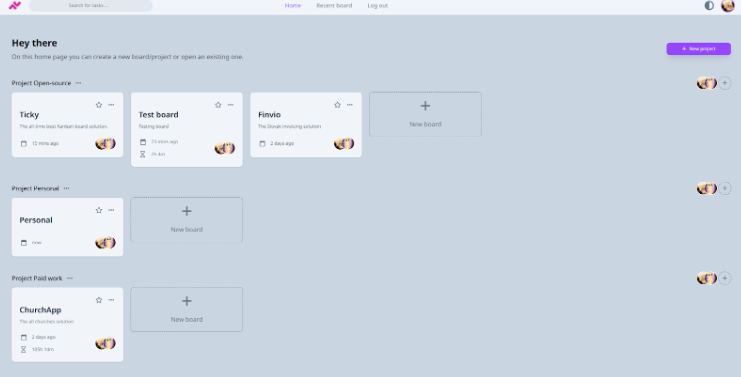
If you love being an early adopter, Ticky — a fully open-source, self-hosted Kanban tool — just hit the GitHub repo eight months ago.
The origin story feels familiar to anyone who’s bounced between Trello for personal planning and Jira at work. The creator describes the frustration of chasing power-ups that morph into paid features, or testing open-source alternatives that never quite felt complete. Ticky is a response to that gap: comprehensive, intuitive, and permanently accessible.
Once installed on your machine, Ticky greets you with a clean white canvas (or black if you prefer a dark mode), colorful cards, and surprisingly rich task metadata. There aren’t any pre-built templates, but you can clone boards in a click to keep setup flexible. Columns are unlimited and collapsible. You can set maximum card limits, auto-complete cards within a column, and control ordering behavior.
Ticky covers the fundamentals without feature clutter. Cards support subtasks with completion tracking, deadlines, built-in time tracking, and customizable labels and priorities. Progress tracking gives you a quick sense of board momentum, while app-wide search lets you jump to specific cards across boards.
That said, it’s still early days, and you may encounter occasional bugs. The roadmap is public, with features like card snoozing, repeating tasks, and a mobile version already in progress. Naturally, Ticky lacks some features to cover more specific needs like budget management or advanced automation. But it can be a good option for small teams (or individuals) that want essential Kanban mechanics without feature gating.
| Main features | Use cases |
| – Projects and Kanban boards – Unlimited, collapsible columns – Card subtasks with completion tracking – Built-in timer functionality – Card linking for swimlanes – Filtering and app-wide search – Supported platforms: Desktop | – Personal productivity and to-dos – Team workload management |
Pros
- Ticky is fully open-source under the MIT license and “always intended to stay forever free”, according to the creator.
- Clean, non-cluttered interface with all the essentials for visualizing and tracking progress across to-dos.
- Can run fully offline, without SMTP or internet connectivity.
Cons
- Lacks commercial polish compared to more mature SaaS boards. Occasional experience glitches can happen.
- Lacks more advanced features like WIP limits, critical path mapping, or deep reporting.
- Setup requires self-hosting skills. Updates and post-installation troubleshooting are on you, too.
Pricing
Forever free, self-hosted app.
Asana: Best task management tool for larger teams
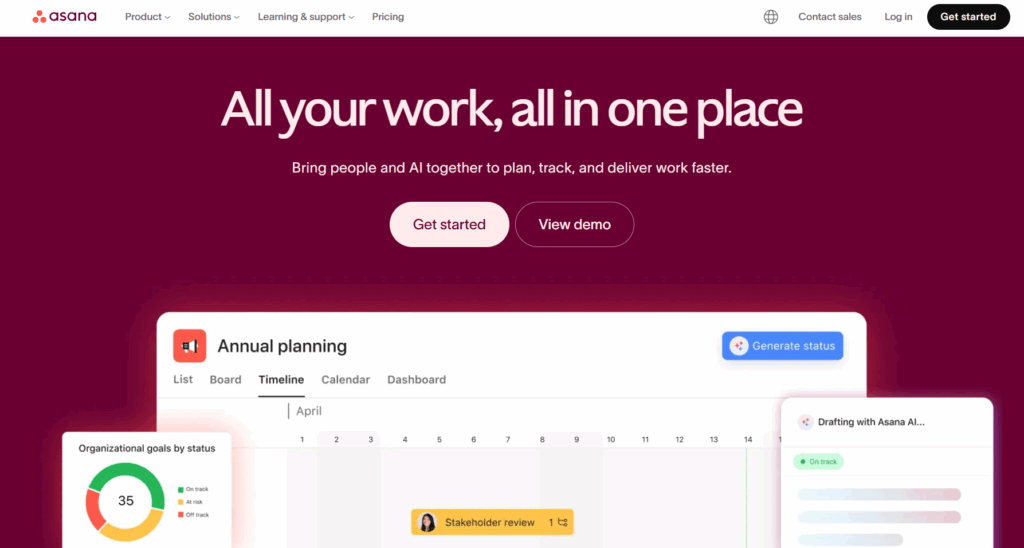
Asana grew out of a familiar frustration: too much time spent managing work instead of doing it. What started as an internal task tracker became a feature-rich project management platform, with the focus on cutting “work about work.”
Task management is a central feature of the platform, but you can take different approaches to handling it, including Kanban, Gantt charts, lists, and timelines. Some teams structure projects with top-level tasks and subtasks for execution detail. Others build board views where columns reflect stages or even entire projects, moving cards across as work progresses. However you configure it, tasks sync to individual to-do lists, keeping personal accountability tightly linked to shared goals.
The board view grouped by priority — high, medium, and low — makes the next to-do clearly visible at all times. Each task can also carry substantial metadata, such as descriptions, attachments, deadlines, and start dates, which support more deliberate scheduling. Paid plans add an AI layer that generates task types for repeatable workflows.
Where Asana draws a line is its approach to visual flow. Planning still revolves around tasks and their movement, more than system-level throughput. Kanban boards lack some of the pro-grade mechanics found in more process-heavy tools. There aren’t any WIP controls or swimlanes. Workflow analytics is limited too — you won’t find cycle-time dashboards or burnout indicators built into the core experience.
Asana keeps its center of gravity on clear task coordination rather than heavy operational metrics. For teams requiring alignment without treating their workflow like a production line, that’s usually enough. But if you’re chasing granular flow control and system-level analytics, you may want another tool.
| Main features | Use cases |
| – Task, project, and portfolio management – Recurring tasks and task dependency management – Multiple project views, Kanban, Gantt, list, timeline. – Reporting against individual and company-level goals – Workflow automation and AI-powered assists – Project dashboards and customizable charts – Supported platforms: Web, Windows, macOS, Android, iOS | – Creative campaign management – Cross-functional workflow management – Task and workload tracking – Project intake capture and management – Goal tracking and strategic planning |
Pros
- Most users appreciate the convenient task management interface and real-time communication features.
- Larger teams also praise portfolio management capabilities and the lack of guest access limits on the Advanced plan.
- Others like its flexibility for building custom operational workflows that establish clear ownership, dependencies, and standardized tasks.
Cons
- Asana doesn’t offer any Kanban-specific flow metrics reporting. Also, tracking actual hours utilized on each task can be tricky, according to users.
- No straightforward way to assign the same task to multiple people for effective collaboration.
- No rules to prioritize tasks by deadline on a personal to-do list to cherry-pick urgent work from the “Recently Assigned” section.
Pricing plans
- Free trial available
- Free personal plan for up to 2 users
- 4 paid plans: Starter, Advanced, Enterprise, and Enterprise +
- Paid pricing starts at $10.99/user/mo
ClickUp: Best all-in-one platform with Kanban features
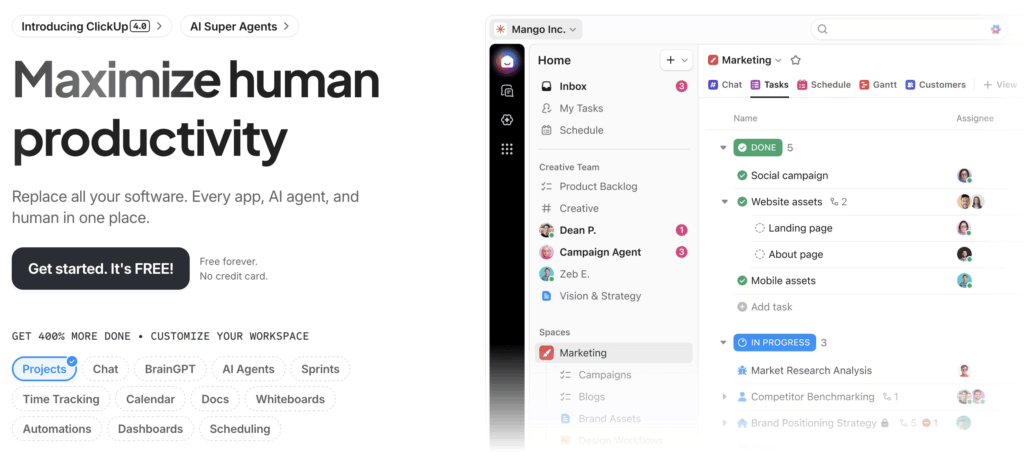
ClickUp doesn’t position itself as a pure Kanban tool. Instead it markets itself as “one app to replace them all.” Like Asana, its core experience revolves around lists. Kanban is one of the many available views (along with tables, lists, timelines, calendar, workload, and more).
You can start quickly with a prebuilt Kanban template and adjust it from there. Card covers can include images or task descriptions. Statuses are fully customizable — Open, Review, Blocked, Closed, or whatever your process requires. Custom fields add structure, while multiple views let you keep onboarding guidance open alongside a live board. Under the hood, tagging, nested subtasks, multiple assignees, dependencies, and priority labels give your boards real depth.
Boards are populated through filters. You can pull in tasks based on status, due date, tag, or location in the workspace. From there, display controls become granular. You decide whether to show property icons, breadcrumbs, parent task names, column colors, closed tasks, or items from other lists. The configuration options are extensive. For teams that like to tune their workspace, this flexibility feels empowering.
Overall, ClickUp gives you latitude to shape the system almost endlessly. And this adaptability can feel powerful — or overwhelming — depending on how disciplined the team is about defining its workflow. Used thoughtfully, it supports structured Kanban execution within a broader productivity platform. Left unchecked, it risks turning configuration into a project of its own.
| Main features | Use cases |
| – Rich task management experience – The highest total number of available work views – Over 35 modular features for no-code app customization – In-app chat, comments, whiteboards, and shared documents – Real-time dashboards, custom reports, workload views, and visual metrics to track progress – 50+ native integrations – Supported platforms: Web, Windows, macOS, Android, iOS | – Project management for non-technical teams – Cross-functional project tracking & coordination – Resource and workload management – Campaign and marketing project coordination |
Pros
- Adopters largely agree that Clickup provides a highly customizable work OS, which can accommodate any type of team or project.
- Most also praise the continuity in features, which allows creating an entire process from an SOP to a set of tasks, with automated steps in between, without switching apps.
- Integrated AI also gets high acclaim as it works seamlessly in the background to simplify processes and reduce manual inputs.
Cons
- With limitless ways to organize your workspace, you can easily make wrong choices until you really learn the product.
- Product depth translates to longer onboarding, according to adopters.
- Bigger teams comment on certain slow-loading views and syncing issues across devices.
Pricing plans
- Free trial available
- Free forever plan for unlimited users
- 3 paid plans: Unlimited, Business, and Enterprise
- Paid pricing starts at $7/user/mo
Runner-ups
Here are several more Kanban apps that deserve a shout-out.
- Businessmap pushes Kanban into enterprise territory. Its smart canvases let you model everything from product backlogs to dependency maps, with interlinked boards connecting team-level execution to management oversight. The appeal here is visibility and coordination across workflows and business units.
- monday.com treats Kanban as one of several interchangeable views. Any list or database-style board can become a Kanban board, grouped by status, assignee, or custom field. For larger teams already operating inside monday.com, the board view is a practical, well-integrated option.
- Sortd layers Kanban directly into Gmail, turning emails into actionable cards. Boards sit alongside your folders in the left-hand menu, which makes task management feel native to your inbox. For anyone living in their email, that’s a keeper.
How to choose Kanban software
Kanban tools are anything but scarce, and the breadth of choice can feel overwhelming. To narrow down your options, think about the problem you’d like to solve:
- Work visibility. If scattered tasks and unclear ownership ruin your day, a simple drag-and-drop Kanban board should help you stay organized.
- Growing coordination needs. When tasks stall in review or priorities shift constantly, then automation, custom statuses, and structured workflows will improve your collaboration and re-prioritization.
- Workflow optimization. If bottlenecks repeat or deadlines slip despite clear boards, analytics becomes critical. Cycle time, workload visibility, and capacity data can help optimize a dev backlog or a high-volume content engine.
- Revenue and capacity pressure. Agencies or delivery teams juggling billable client work should consider tools with integrated time tracking and utilization reporting. Manual tracking creates blind spots as volume grows.
Ultimately, the best Kanban tool is one that matches your team’s workflows today, while scaling with you over time.
Implement a data-driven Kanban method with Toggl
Kanban software has evolved far beyond sticky notes on a whiteboard. Today, you’ve got everything from simple visual boards for personal to-dos to virtual workplaces with advanced automation features.
As this comparison shows, the right tool depends on what problem you’re solving: visibility, coordination, optimization, or revenue control.
Some platforms prioritize ease of entry. Others double down on process discipline. A few try to be everything at once. The key is matching tool complexity to workflow maturity. If your team is managing growing workloads, juggling billable time, or struggling with capacity blind spots, surface-level visualization stops being enough.
That’s where Toggl stands out. It pairs an intuitive Kanban experience with deeply integrated time tracking, capacity planning, and utilization reporting. Tasks move across columns, but time flows through the entire system. Estimates compared to actuals. Capacity aligns with availability. Revenue connects to effort.
If you want a Kanban tool that goes beyond organizing cards and actually informs how you plan, price, and scale, sign up for a free Toggl account.
Frequently asked questions (FAQs) about Kanban software
What is Kanban software and how does it work?
Kanban software is a visual way to manage work by moving it through defined stages, usually from “to do” to “in progress” to “done.” Software users capture stages as columns, containing cards for individual tasks. Board analytics show work in progress and provide more granular data on workload allocation, utilization rates, and project progress.
What features should I look for in Kanban software?
When choosing Kanban software, choose the following core features:
- Custom columns and statuses that reflect how your team actually works
- WIP limits to prevent overload
- Clear task details like due dates, assignees, and priorities
- Card filtering and search once the volume grows
- Basic reporting or flow insights to spot bottlenecks
- Integrations with the tools you already use
If tweaking the board takes more energy than actually shipping work, the tool’s probably not right for you.
What is the difference between Kanban software and project management software?
The difference between Kanban software and project management software is that Kanban software focuses on visual workflow management, while project management platforms typically include timelines, budgets, resource planning, and executive reporting.
Kanban boards often sit inside project management systems, but the mandate is broader: oversee the entire delivery engine, not just the movement of cards.
Which Kanban software is best for small teams or individuals?
The best Kanban software for small teams or solo users should feel effortless to use. You need clear workload visibility and a light structure, not endless configuration. Some top options include:
- Toggl for smaller, non-technical teams that want capacity and priorities grounded in real-time data
- Sortd which works well if your inbox already runs your day
- Trello as a simple, flexible choice that scales without much friction
Can Kanban software integrate with other business tools?
Yes, most Kanban software integrates well with other tools. Work rarely lives in one place, so the best Kanban apps interface with calendars, communication platforms, cloud storage, and task managers, among other business tools. When Kanban software is configured correctly, it becomes a coordination hub, aggregating key information about operational workflows.

Elena is a senior content strategist and writer specializing in technology, finance, and people management. With over a decade of experience, she has helped shape the narratives of industry leaders like Xendit, UXCam, and Intellias. Her bylines appear in Tech.Co, The Next Web, and The Huffington Post, while her ghostwritten thought leadership pieces have been featured in Forbes, Smashing Magazine, and VentureBeat. As the lead writer behind HLB Global’s Annual Business Leader Survey, she translates complex data and economic trends into actionable insights for executives in 150+ countries. Armed with a Master’s in Political Science, Elena blends analytical depth with sharp storytelling to create content that matters.