Paymo gets a lot right. It combines task management and client invoicing into a single workspace, which is genuinely useful for freelancers and smaller agencies.
But it also has some limitations — for example, core planning features like Gantt chart and task dependencies are only available on the platform’s most expensive tier, priced at $16.90/user/mo. Paymo’s reporting doesn’t offer any insights into financial performance or team capacity, while its interface can quickly become cluttered if you work cross-functionally. You can also expect a pretty laggy mobile product experience.
This guide spotlights the best Paymo alternatives for 2026 — tools that go deeper on planning, execution, scalability, and invoicing, depending on what your team needs next.
12 best Paymo alternatives at a glance
| Tool | Best for | Free plan/ free trial | Starting price | Advantages over Paymo |
| Toggl | Teams that want planning driven by real time and workload data | Free plan up to five users | $9/user/mo | Drag-and-drop timelines and calendars Capacity tracking and workload visibility Cleaner UX |
| Productive | Agencies optimizing profitability and operations | 14-day trial | $10/user/mo | Built-in budgeting Revenue forecasting CRM features |
| Teamwork | End-to-end client work management | Free plan + trial | €9.99/user/mo | Full client lifecycle support Better resource planning Greater billing flexibility |
| Harvest | Simple client invoicing | Free plan + trial | $9/user/mo | Faster invoicing workflows Automatic data sync to accounting apps Expense management |
| FreshBooks | Teams with accounting-heavy workflows | 30-day trial | $9.20/mo | Full accounting suite (expenses, tax reports, payments) Stronger financial admin layer |
| Avaza | Ops-heavy teams needing invoicing and reporting | Free plan + trial | $11.95/user/mo | Advanced invoicing (retainers, split payments) Deeper reporting views Multi-currency support |
| ClickUp | Custom workflows and automation | Free plan + trial | $7/user/mo | Highly customizable workflows Automation and AI features Broader collaboration tools |
| Wrike | Large teams needing governance and reporting | Free plan + trial | $10/user/mo | Enterprise-grade reporting and access permissions Workflow automation |
| Asana | Structured project management (Agile-friendly) | Free plan + trial | $10.99/user/mo | Strong task dependencies Company-wide goal tracking Better collaboration at scale |
| Clockify | Budget-friendly time tracking | Free plan + trial | $3.99/user/mo | Unlimited tracking for free More time tracking features (GPS, kiosk, reminders) |
| Zoho Projects | Cost-effective project management | Free plan + trial | $4/user/mo | More PM features at lower cost (Gantt, automation, ecosystem integrations) |
| GanttPRO | Advanced timeline and dependency planning | 14-day trial | $7/user/mo | True Gantt depth (critical path, baselines, auto-scheduling) |
What makes Paymo good (and where it falls short)
Paymo occupies a ‘middle lane’ between pure time trackers and in-depth project management suites. It bundles project management, time tracking, invoicing, and file proofing into one workspace, which minimizes software sprawl for freelancers and small client services teams.
The platform scores well with the G2 software community, especially given how easy it makes converting logged hours into invoices.
Even so, users often mention that features such as Gantt charts and certain reports sit behind higher-tier plans, which can feel limiting for small teams on entry pricing.
Even more issues appear when teams scale. Some adopters already wonder if the app would make sense if they have more than 20 people on the team. Lack of customization, workflow flexibility, and somewhat dated reporting UI often push users to consider Paymo alternatives instead.
Key features to look for in a Paymo alternative
Switching tools is only worth it if the new one solves the right problems. Before you start comparing vendors, get clear on which capabilities matter most for your team. The best alternative isn’t necessarily the most feature-rich option, but the one that fixes your specific bottlenecks. Here are the features to focus on as you research different vendors and tools.
- Flexible time tracking. Look for tools that support automatic, manual, and timer-based tracking (online and offline), so your people use the platform consistently. The best tools also integrate with calendars and other apps to reduce data entry and improve data quality.
- Invoicing connected directly to tracked time. Billing should reflect reality. A strong alternative either includes native invoicing (like Paymo) or integrates cleanly with accounting tools, so tracked hours translate directly into client invoices.
- Project management features (without feature-gating). As a minimum, you should have multiple task views, task estimates, milestones, and Gantt-style timelines that are available out of the box, not locked behind top-tier plans.
- Analytics that go beyond attendance. Look for reporting that covers billable vs non-billable hours, income tracking, workload management, and utilization rates, so you can see how work distributes across your team.
- A strong integration ecosystem. Paymo only has 11 native integrations. Other tools offer better syncs with accounting, communication, project management, and other business software to keep your workflows connected.
- Free plan or trial availability. Both help you validate fit and test out the workflows before migrating all the data and users.
12 best Paymo alternatives: A detailed comparison
Best Paymo alternatives for project management and time tracking
Most tools pick a side, choosing either to handle project management well or track time accurately. Toggl does both.
Toggl
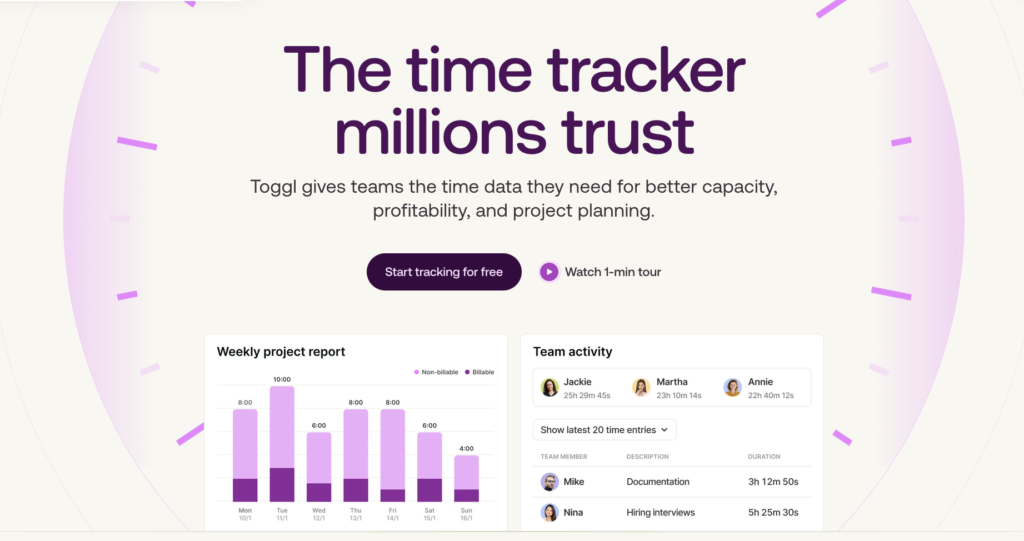
Toggl uses time as the foundation of planning and task management to help teams understand if the workload is realistic. You can instantly see how long things take, who’s available to pick up the slack, and whether your deadlines will hold.
You can log billable and non-billable time by project, task, or client, using manual time entry and real-time timers. Both options are available on a free plan. Calendar integrations also pre-populate the My Time view with synced events, so there’s no double-entry or scheduling conflicts.
With Toggl, you can track time directly against assigned work, with all data flowing into reports and planning views. Paymo connects time tracking to billing. Toggl connects it to planning accuracy and team performance.
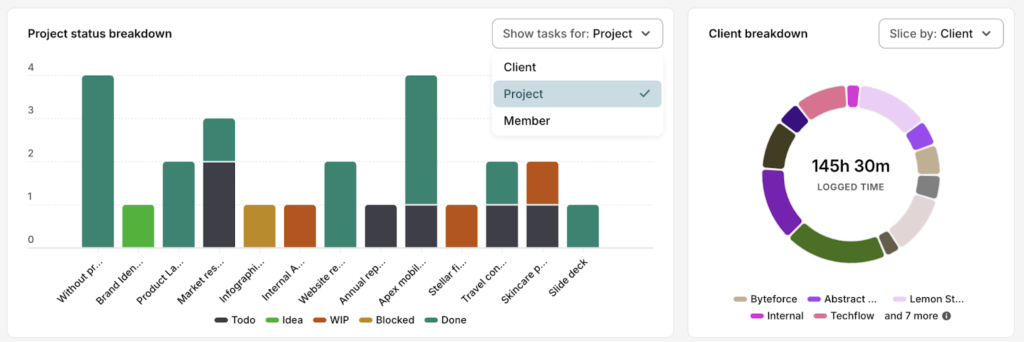
Visual task management
Toggl is deliberately lean and doesn’t try to compete with specialized project management tools. But it offers all the core features agencies need to execute work efficiently.
You get:
- Task lists with estimates, due dates, attachments, tags, and priorities
- Multiple views, including list, calendar, and Kanban boards (free) and timeline (premium)
- Create tasks instantly from a photo, text note, or an AI prompt
- Option to schedule recurring tasks with one or multiple assignees
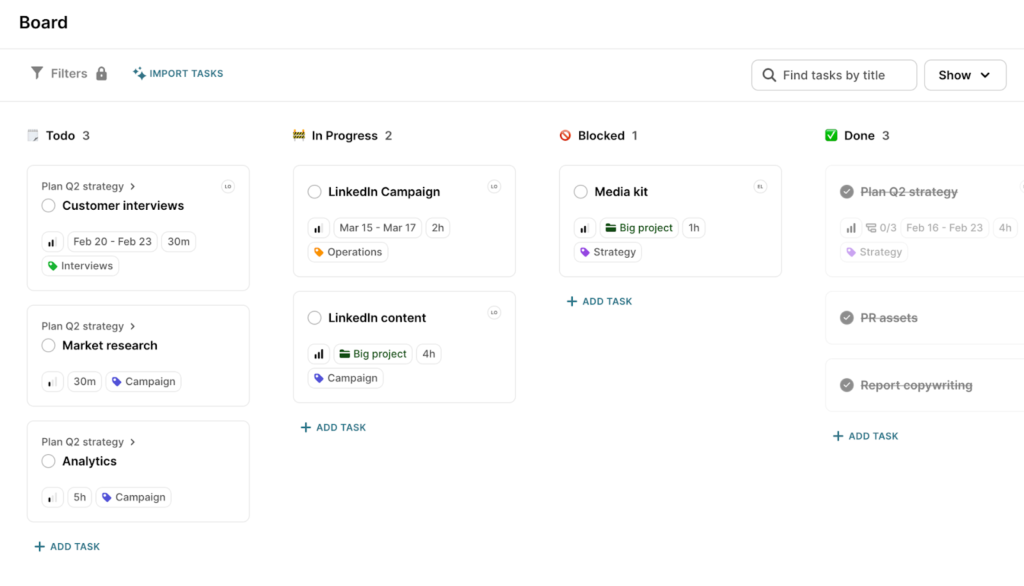
Instead of a traditional Gantt chart, Toggl offers a drag-and-drop timeline view to visually schedule work across days, weeks, or months. You can add milestones and estimated hours directly on the timeline, then filter by team member or project to better understand work distribution.
For example, a marketing team can plan campaigns on a timeline, execute daily work in a Kanban board, and log billable hours without switching screens (or paying for extra tools).
Compared to Paymo, task management is lighter. You won’t get complex task dependencies or automatic ghost-bookings. But Toggl is also faster to use and easier to adopt.
Resource planning and workload management
Time data sits in the center of Toggl for a deeper reporting experience. A Starter plan provides access to real-time team availability tracking, with working hours, holidays, and PTO built into schedules in a few clicks. You’ll see who’s over or under capacity, and rebalance work with a simple drag-and-drop.
A Premium plan (or above) also gives access to:
- Utilization reports that keep track of how much capacity is allocated to billable work. Without this, you’re speculating on profitability.
- Workload reports that provide an at-a-glance overview of your team’s progress toward weekly targets, so you can see who’s working overtime or available to handle extra tasks.
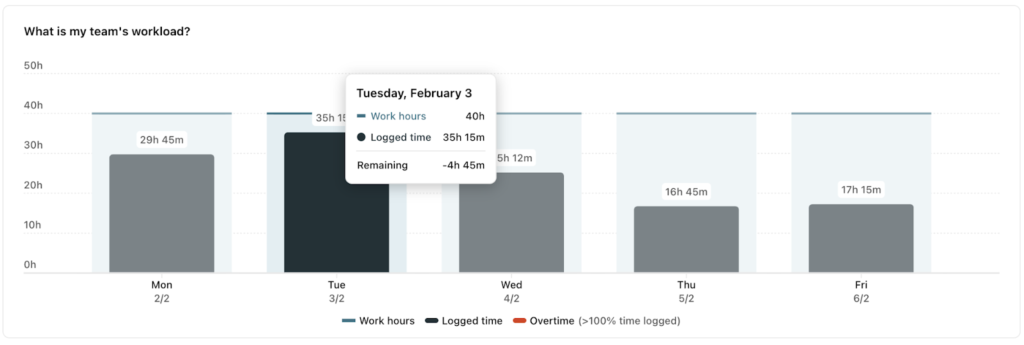
Reports in Toggl are all based on historical time tracking data. When you plan new projects, this feature allows you to reliably estimate how long similar workloads usually take, without running some complex maths in spreadsheets.
| Key features | Top use cases |
| Time tracking (manual, real-time, Pomodoro, and Focus mode) Simple timeline planning Task management (lists + Kanban boards) Resource planning and workload management Utilization and productivity insights Supported platforms: Web, Browser, Android, iOS, Windows, Mac. | Project planning, based on accurate time and capacity estimates Workload rebalancing across different clients Ensuring clarity and coordination in task management Reducing task overlaps and resource overbookings |
Pros
- Timelines. Gantt-style planning, milestones, and resource scheduling are available on a Starter plan.
- Capacity planning. PTO, working hours, and team availability functionality are built into planning, which is rare at this price point.
- Clean, low-friction UX. The product is very intuitive and doesn’t have a feature bloat problem. Paid plans add sophistication (utilization, reporting), not bolt-on functionality.
Cons
- No native invoicing or billing layer yet.
- No complex workflow automation features.
Pricing
| Forever free plan | Starter | Premium | Enterprise |
| Free for up to five users | From $9/user/mo | From $20/user/mo | On-demand |
| Unlimited projects and tags Manual and automated time trackers Calendar integrations Focus mode Task and Kanban board views Timeblocking Task estimates and recurring tasks AI task creator | Everything in Free plus: Timeline view Multiple assignees per task Milestones Guest access Team-level reports, with filters and billable rates Capacity planning tools | Everything in Starter, plus: Utilization and workload reports | Everything in Premium, plus: Personalized onboarding and a dedicated customer success manager Custom setup, integration, or reporting solutions Multiple workspaces under one organization |
Best all-in-one project management tools for professional services and agencies
If you’re juggling retainer clients, team capacity, and project margins, things get messy with Paymo. The following project management platforms are better suited to handle larger workflows.
Productive
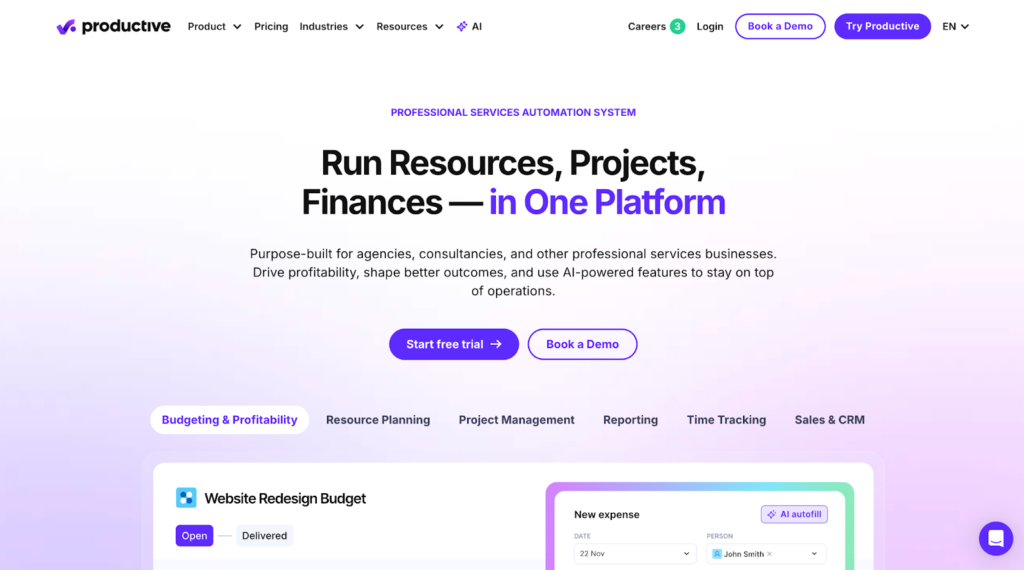
Productive is an agency ops platform that combines project planning, CRM, resource planning, and profitability tracking into one neat workspace. Purpose-built for agencies, it helps you track project progress alongside revenue, employee salaries, and operational overheads. This gives you a full picture of your company’s financials, staffing levels, and operational efficiency without checking multiple tools.
| Key features | Top use cases |
| Time tracking and timesheets Task boards and task lists with estimated time List, table, timeline, workload, and Gantt layouts Budgets, expenses, and invoicing CRM functionality Resource and people management Supported platforms: Web, Windows, macOS, Android, iOS. | Automated project intake and client onboarding Revenue forecasting and cost optimization Cross-team performance reporting Resource allocation and capacity planning |
How Productive compares to Paymo
Compared to Paymo’s simpler setup, Productive is built for agencies that need deeper control over profitability, resourcing, and operations. Optimizing margins and resourcing across multiple clients is easier with Productive. You can schedule resources based on occupancy views and forecast profitability, expected revenue, and project execution costs.
The app allows you to set different revenue criteria to better reflect your money flows. Reporting also goes deeper, with 50 pre-made reporting templates for agencies and filters to track your key metrics.
Pros
- Unified experience. Many users appreciate how the app covers operations, finances, resource planning, and forecasting.
- Budgeting alerts. Agency owners value being notified before they go over budget, alongside visual tracking of other financial metrics.
- Reporting. Being able to “pull a report for just about anything” is another selling point.
Cons
- No reports templates. Some users are frustrated that you can’t create a stack of pre-configured, reusable reporting views.
- Clunky subtasks. Users point out that after deleting a parent task, you have orphaned child tasks still sitting on your to-do list.
Pricing
- No free or solo plans
- Free 14-day trial
- Paid plans start from $10/user/mo
⚠️Gated features (on higher-tier plans): Automatic time tracking, timesheet approvals, task dependencies, recurring tasks, retainer invoicing, and expense approvals.
Teamwork.com
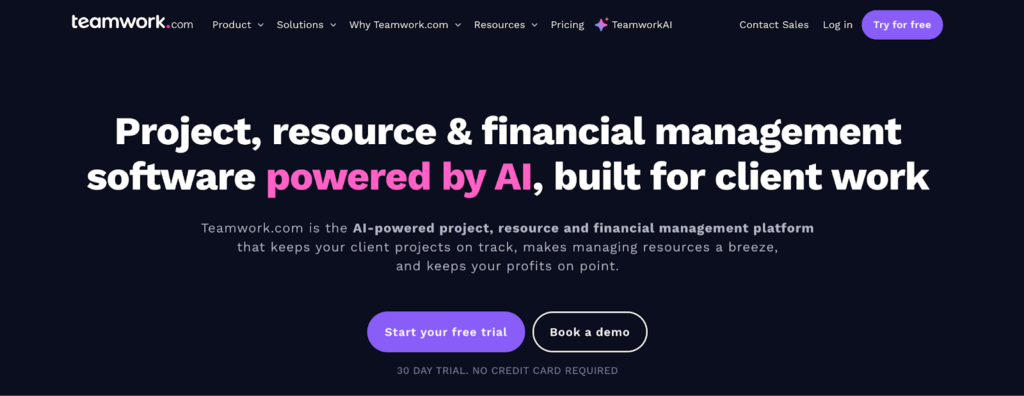
Teamwork.com is a project and resource management platform for client work. It’s densely packed with (sometimes AI-powered) functionality for project delivery, resource allocation, and profitability management. This includes features like billable time, budgets, utilization, and custom report charts, all tightly linked together into one continuous experience. It combines strong task management with collaboration features, plus well-integrated time tracking that shows exactly how work progresses and how much it costs to deliver.
| Key features | Top use cases |
| Time tracking and timesheets management Invoicing and retainer management Workload capacity view List, Table, Boards, Gantt views Intake forms Time, utilization, profitability, and custom reports Supported platforms: Web, Windows, macOS, Android, iOS. | Retainer and multi-project management Campaign and content production pipelines Resource planning and utilization tracking Revenue and profit margin optimization |
How Teamwork.com compares to Paymo
Unlike Paymo, Teamwork.com covers the entire client lifecycle management, from streamlined intake and onboarding to resource allocation, execution, proofing, and invoicing. You can configure intake forms to auto-create new projects and assign work, using automations. And you can save recurring projects as templates.
For day-to-day oversight, you get a wider set of PM controls, including Portfolio Gantt with critical path mapping and Workload view showing real-time capacity risks. In terms of billing, there are more controls compared to Paymo, including multi-currency support, shared role rates, retrospective user rates, and task list budgets, among higher-level budget trackers.
Pros
- Visual clarity. Users appreciate how the app provides instant visibility into workload, timelines, progress, budgets, and overall financial performance.
- Convenient billing process. Managers like how time tracking works in tandem with budgets for a flexible billing process.
- Workload planner view gets rated as “invaluable” as it helps accurately plan capacity and track work in progress.
Cons
- Learning curve. New users may find the product overwhelming at first, as the interface takes time to learn and there are multiple configurations.
- No email integration. Some users would prefer to communicate with clients directly through email or chat from the current project.
Pricing
- Forever free plan
- Free 30-day trial
- Paid plans start from €9.99/user/mo
⚠️Gated features: Company timesheets, multi-currency rates, project expenses, retainer management, resource scheduling, calendar event sync.
Best options for billing-heavy workflows
If your top grievance with Paymo is the payment experience (like rigid layouts or the number of clicks the “add outstanding time/costs” flow takes), the next three apps offer more flexible invoicing controls and extra accounting features.
Harvest
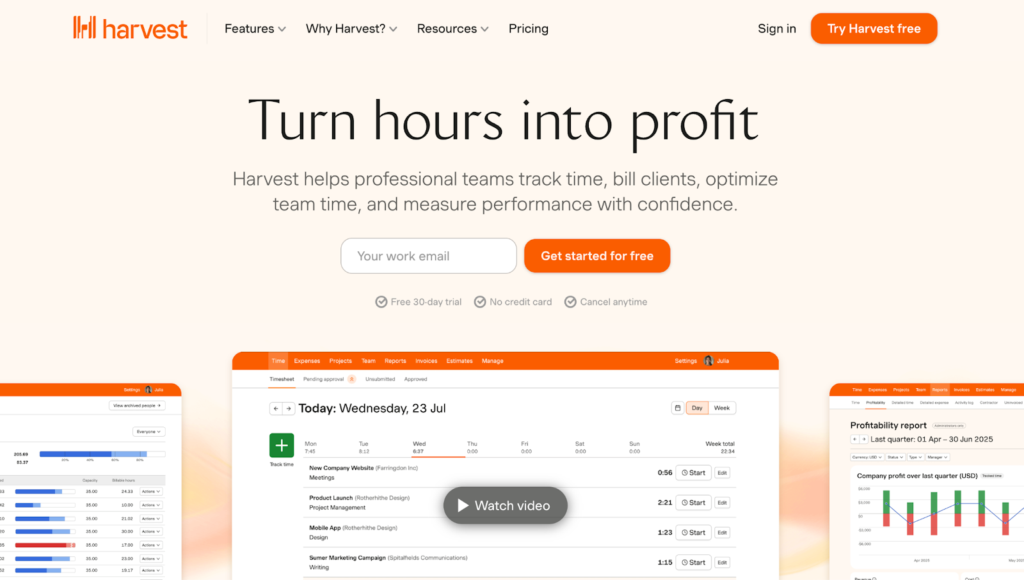
Harvest is a popular app for logging billable time and getting paid for it from the same interface. You get flexible timekeeping, clean reports that show where the hours went, and what they cost, plus a sleek invoice generator.
Harvest doesn’t include any project management features, but integrates with popular tools like Basecamp, ClickUp, monday work management, Jira, and others. Still, users enjoy Harvest’s simple UX, quick data entry, and built‑in billing functionality.
| Key features | Top use cases |
| Automated and manual time entry Timesheet approvals and tracking reminders Simple cost and budget tracking Invoicing and payment processing (via integrations) Automatic data sync to accounting apps Supported platforms: Web, Windows, macOS, Android, iOS. | Billable hour tracking for freelancers and consultants Client invoicing based on tracked time and expenses Project budget monitoring to prevent scope creep Expense capture for reimbursable project costs |
How Harvest compares to Paymo
Harvest strips things back to focus entirely on time tracking, expenses, and invoicing, avoiding task management altogether. Many teams pair Harvest with apps like Trello or Notion to keep planning and billing workflows separate and easier to maintain. Both apps integrate with the same accounting apps (Xero and QuickBooks) and payment processors (PayPal and Stripe).
Pros
- Zero learning curve. The product is so “straightforward that even a 3-year-old could manage it,” according to a small business owner.
- Smooth product experience. Most users agree the product runs well with little to no performance issues.
- Well-documented API that allows teams to build extra integrations with other automation tools.
Cons
- Limited number of native integrations. Some users would love more native integrations with other accounting platforms like PandaDoc.
- Limited multi-currency support. You can only use one currency per client, project, invoice, or submitted expense, which is inconvenient for some distributed teams.
Pricing
- Forever free plan
- Free 30-day trial
- Paid plans start from $9/seat/mo
⚠️Gated features: Billable and cost rates for teams, accounting and payment integrations, timesheet approvals, team reports, and custom data exports.
FreshBooks
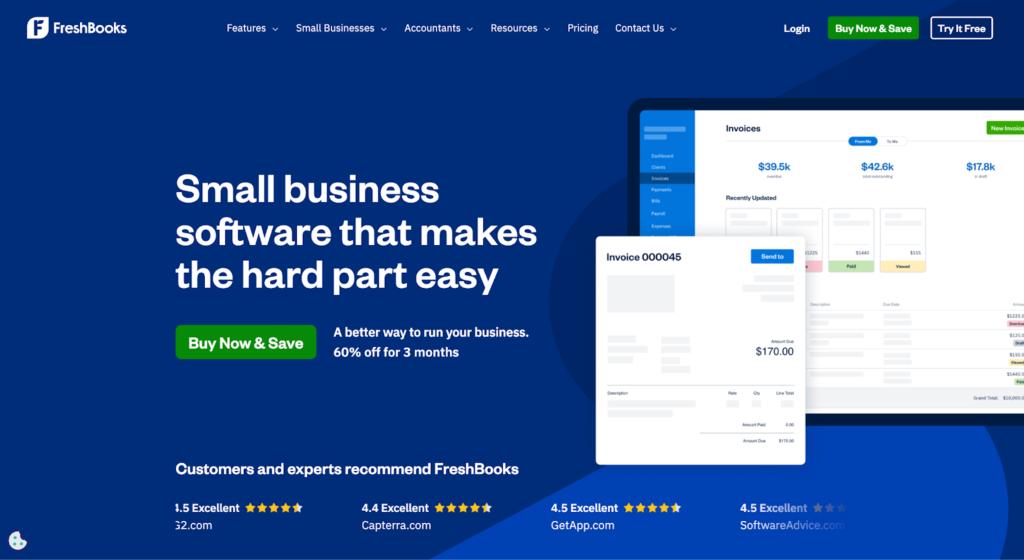
FreshBooks is one of the most popular accounting platforms among small business owners. Similar to Harvest, it helps you effortlessly invoice clients and run the books to avoid panic during tax season. To boot, you get a couple of simple project tracking features, along with a built-in proposal and project estimates tool.
| Key features | Top use cases |
| Customizable invoices, which clients can pay with card, ACH, Apple Pay, Google Pay, and more Scheduled late fees and auto late payment reminders Client portals to review proposals, check estimates, and pay invoices Time tracking and tax time reports (for US) Real-time data on profits, expenses, outstanding invoices, and incoming revenue Supported platforms: Web, Windows, macOS, Android, iOS. | Online payment collection for freelancers and service businesses Expense tracking and receipt capture for accurate bookkeeping Small business accounting and tax prep Ongoing business cash-flow monitoring |
How FreshBooks compares to Paymo
Unlike Paymo, FreshBooks is primarily an accounting and invoicing platform with a stronger focus on financial administration — sending invoices, tracking expenses, collecting payments, and generating tax/accounting reports.
FreshBooks offers handy features like receipt capture, mobile mileage tracking, bank statement reconciliation, and cash advances to qualified users against unpaid accounts payable. It can be a great add-on to a project management app.
Pros
- Intuitive interface. Users rate it as “extremely easy to use, even for someone without an accounting background.”
- Streamlined accounting. The app turns bookkeeping from a daunting chore to a set-it-and-forget-it experience, with most work done automatically.
- Automated payment reminders take the ick out of endless client follow-ups on overdue invoices.
Cons
- No contract management. Some users would love a workspace to store and sign client contracts.
- Higher pricing. Multiple users note that costs can add up between transaction fees for payment processing and upgrades to access extra features.
Pricing
- No free plan
- 30-day free trial
- Paid plans start from $9.20/user/mo
⚠️Gated features on Plus and Premium Plans: Higher number of clients, e-Signatures, unlimited proposals, client retainers, double-entry accounting reports, and bank reconciliation.
Avaza
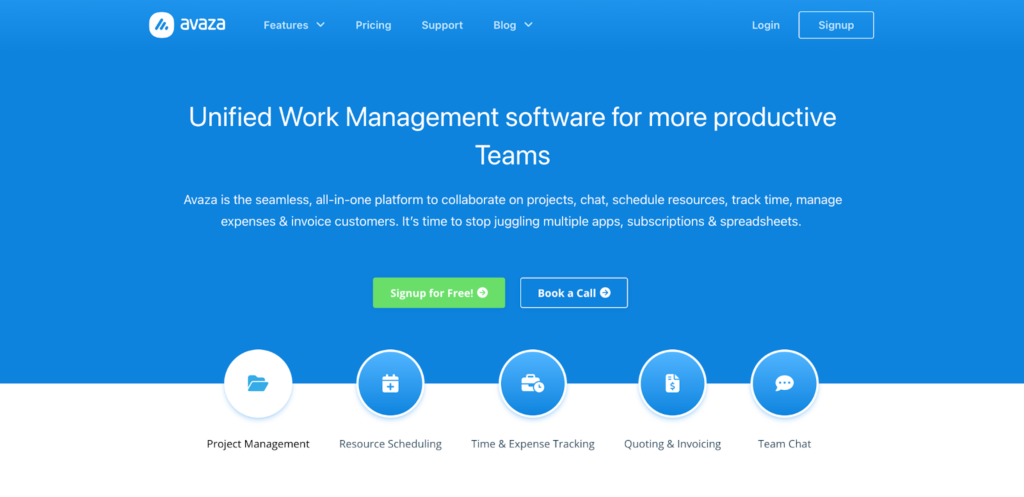
Avaza offers a cloud-based operations and billing suite for larger service businesses. It combines project management, resource scheduling, time tracking, expenses, and invoicing into a single workspace, with deeper reporting and more advanced budgeting controls.
You can plan work around available capacity, add time estimates, and have people log billable hours across assigned work. When payday comes, you can easily add any timesheet entry (standalone or grounded by user, project, or task) as an invoice line and capture payments.
| Key features | Top use cases |
| Project management with integrated time tracking and multiple views Recurring and retainer multi-currency invoices Client invites to collaborate on projects and review timesheets Streamlined expense approval workflows Profitability, staff utilization, task progress, revenue, and project summary reports Supported platforms: Web, Windows (Timesheet app only), macOS (Timesheet app only), Android, iOS | End-to-end project delivery for agencies and consulting teams Resource scheduling and workload balancing across multiple initiatives Recurring billing for service engagements Quotes and estimates that convert directly into project work |
How Avaza compares to Paymo
Avaza goes deeper on reporting, budgeting, and financial control, covering team members’ workload, utilization rates, company revenue, and outstanding invoicing. You can build custom reports, using available filters, to drill down further into your data. Reports can be scheduled for auto-re-run and sent automatically as exported PDF and Excel files to others.
Avaza also boasts more advanced features for invoicing: You can accept split payments, set up retainer invoices, request advance payments, add credit notes, accept payments from Payoneer, and direct debits from supported countries.
Pros
- Flexibility in creating timesheets. Users appreciate the option to set notifications for upcoming tasks and copy over recurring times like leaves.
- Credit notes. Few other apps allow you to properly account for client overpayments.
- Top-notch customer support. Multiple users comment on how genuinely helpful and easily accessible the team is.
Cons
- Web-first app. Avazo doesn’t provide access to all product features from its desktop app.
- Sync issues. The resource scheduling interface is rated as clunky and doesn’t always sync with calendars or updated users’ time records.
Pricing
- Forever free plan
- No free trial
- Paid plans start from $11.95/user/mo.
⚠️Gated features: Unlimited customers, higher invoicing caps, extra projects, and file storage.
Best for scaling teams that want to automate work management
For teams outgrowing Paymo, the following work management platforms offer better automation functionality, deeper reporting, and more governance controls.
ClickUp
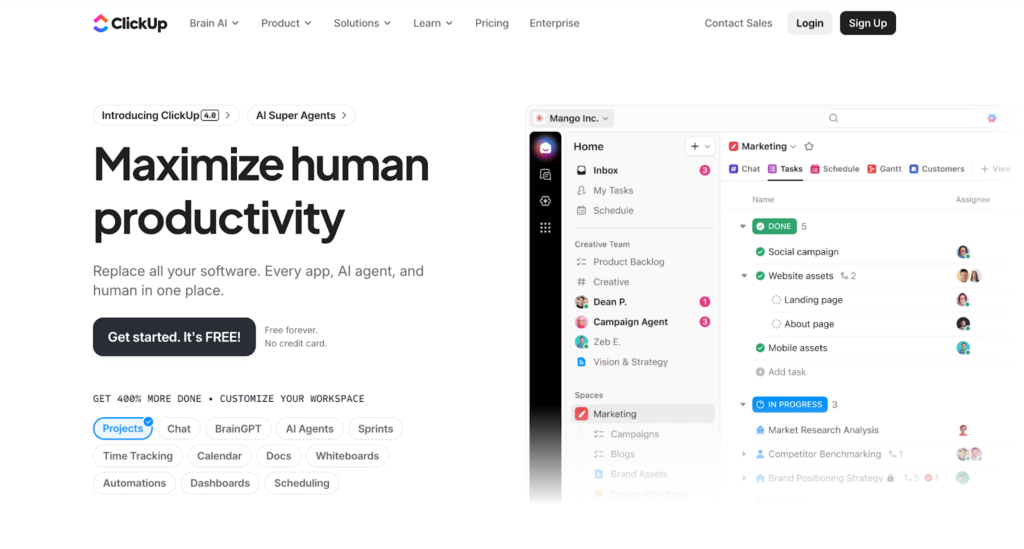
ClickUp is an all-in-one work management platform with multiple project views (task lists, boards, timelines, mind maps, Gantt charts), and handy automation to streamline planning and resource allocation.
You’ve got features for project management, knowledge sharing, communication, and resource management — all easily configurable to match your workflows. A $9/user per month AI upgrade also nets you unlimited access to a selection of premium AI models, voice-to-text features, image generation, and custom AI agents. That comes on top of the rules-based automation the platform offers.
| Key features | Top use cases |
| Hierarchical tasks (Spaces, Folders, Lists) Multiple project views (Board, Gantt, Table, Map, Custom) Workload and resource management Advanced reporting dashboards AI & workflow automation Supported platforms: Web, Windows, macOS, Android, iOS | CRM-like client management Multi-client portfolio management Standard workflow automation Goal tracking and OKR management |
How ClickUp compares to Paymo
ClickUp gives you far more control over workflows, views, and automation. You get custom views/fields/statuses/task types, rich text editing with blocks, markdown, emojis, lists, columns, buttons, and code snippets.
It also brings a bigger set of collaboration tools, real-time docs, chat, whiteboards, and mind maps, alongside way more automation options (with or without AI). But that comes at “an expense” of invoicing features, which ClickUp doesn’t offer natively.
Pros
- Flexibility. You can easily create personalized Spaces for each client, as one email marketer does, and “shape each workspace to fit exactly how you work”.
- Automations. Team report “gaining significant time” back by streamlining repetitive process steps and data entry.
- Better visibility. Multiple reviewers say ClickUp really improves visibility and makes stakeholder reporting easier. A graphic design business, for example, embedded calendars on its website to update clients on project statuses.
Cons
- Higher upkeep. ClickUp has loads of bells and whistles to its interface, and smaller teams feel that “entering everything into ClickUp takes more time than just getting the tasks completed.”
- Steeper learning curve. The platform isn’t as user-friendly and intuitive as some simpler project management tools, which hinders company-wide adoption.
Pricing
- Forever free plan
- 15-day free trial
- Paid plans start from $7/user/mo
⚠️Gated features: Custom fields, guest access, Gantt chart, project timelines, workload view, chat, custom task types, advanced automation.
Wrike
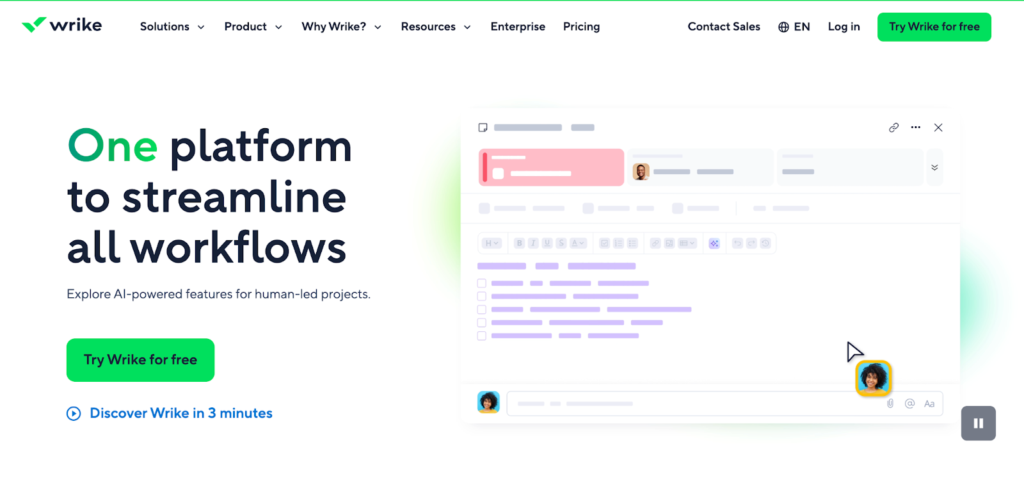
Wrike is a work management platform that appeals more to large teams. Its core strengths are scalability and deeper reporting. You’ve got a bigger choice of work views, the ability to define custom work types, add new fields, and build custom workflows for repeated processes. For example, optimize client intake with dynamic request forms or create custom sequences for new campaign production.
On the analytics side, you can track milestones, project budgets, resource bookings, workflow allocations, team utilization, billable time distribution, and more. All dashboards are multi-dimensional, allowing you to adjust data presentation using filters, widgets, custom fields, or data from external sources (e.g., Tableau, Power BI, or other analytics platforms).
| Key features | Top use cases |
| Multiple project views (Board, List, Gantt, Table, Map, Custom) Custom fields, item types, and workflows Customizable reporting dashboards Proofing, approvals, and request forms Resource booking and budgeting Supported platforms: Web, Windows, macOS, Android, iOS | Building advanced campaign roadmaps Auto‑routing requests to the right team Planning workloads by role and capacity Project and portfolio‑level reporting for stakeholders |
How Wrike compares to Paymo
Compared to Paymo’s simpler setup, Wrike is built for larger teams with more complex workflows and reporting needs. It can handle more data, bigger files, a larger number of workflows, and concurrent users. It also brings more automation planning and production flows, and also supports more in-depth reporting.
Admin features offer greater granularity. You can control access permissions for specific folders and projects, and even create fully custom user roles to selectively share access to certain data or actions.
Pros
- Unified operations layer. The combination of native features, add-ons, and supported integrations make Wrike a centralized hub for busy teams that seek greater clarity on to-dos and statuses.
- Collaboration features. “The ability to comment directly within tasks, tag teammates, and share files in context really cuts down on long email threads,” according to users.
- Templates. Blueprint functionality gets lauded a lot, especially for the ability to reschedule dates around certain tasks.
Cons
- Subpar filtering in task lists. Some users are annoyed that completed tasks aren’t automatically hidden from view, which makes the interface feel cluttered.
- No labeling for automations. There’s no easy way to quickly sort through pre-made automations to find the right ones, which can lead to redundant ones and faster exhaustion of plan limits.
Pricing
- Forever free plan
- 14-day free trial
- Paid pricing starts at $10/user/mo
⚠️Gated features: Personal work schedules, custom fields, workflows, and statuses, calendars, Gantt chart, dashboards, workflow automation.
Asana
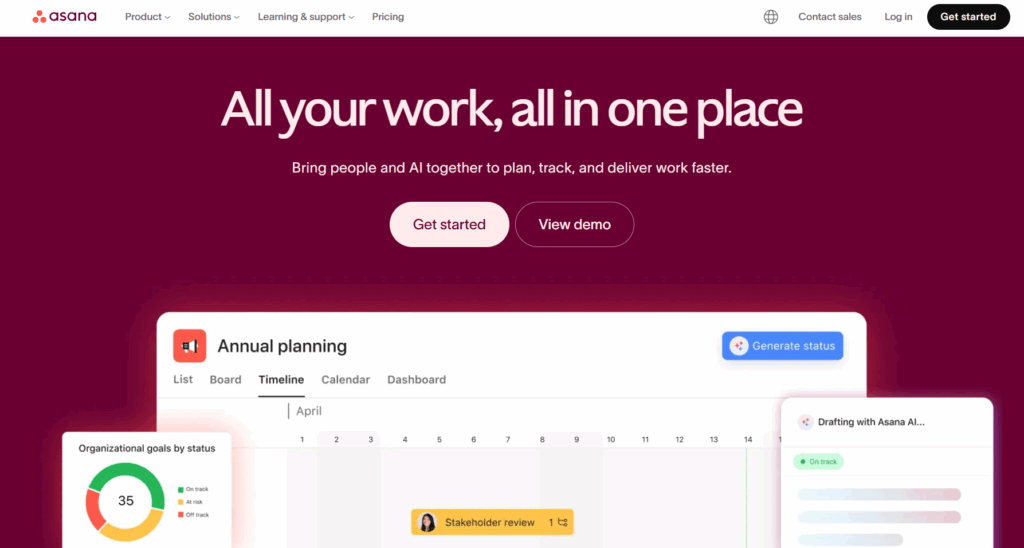
Another scalable Paymo alternative worth considering is Asana, especially if you’re a fan of Agile project management. It has Kanban as one of the primary views (along with List, Board, Calendar, Gantt, Goals, and Portfolio). Each carries rich context like deadlines, attachments, descriptions, subtasks, and task dependencies. For a broader operational view, you can switch to Goals or Portfolio. And to streamline day-to-day admin and oversight, loads of workflow automations and AI-powered features are readily available on paid plans.
| Key features | Top use cases |
| Multiple project views (List, Board, Calendar, My Tasks, Timeline, Notes, Goals) Unlimited comments, messages, and file storage Task dependencies and critical path mapping Workflow builder with unlimited rules Reporting against goals Supported platforms: Web, Windows, macOS, Android, iOS | Managing creative requests and approvals Aligning multiple projects to company goals and personal OKRs Managing capacity and workflows at a program level Running an operations layer in a regulated industry |
How Asana compares to Paymo
Asana maintains a user-friendly interface, no matter the work volume. You’ve got richer task context and more view customizations to organize key data the way you prefer. To dig through the details, you can also use advanced search or chat with a built-in AI assistant.
On the downside, resource management features like timesheets, project budgets, and user rates are sold as separate add-ons. Likewise, time tracking and capacity planning are available on the Advanced plan and above, which is more expensive than Paymo’s highest tier.
Pros
- Stellar mobile experience. The app helps teams collaborate on the go effectively, thanks to mobile features like sharing photo attachments and notes.
- Automation. Users highlight how they can automate workflows, so tasks move through project stages on autopilot, making processes easier to manage from start to finish.
- Contextual AI features. Adopters appreciate how easy it is “to integrate AI features into each of your work processes”.
Cons
- No option to track daily team progress. Users note that reporting for long-term milestones is great, but short-term projects could be reflected better.
- Confusing subtasks. Users repeatedly call out issues with subtasks not showing properly in the calendar.
Pricing
- Forever free plan
- Free 30-day trial
- Paid plans start from $10.99/seat/mo
⚠️Gated features: Asana AI, Gantt view, project portfolios, task dependencies, workflow builder, custom fields, and project templates.
Best budget-friendly Paymo alternatives
If cost is a deciding factor, here are two cheaper Paymo alternatives.
Clockify
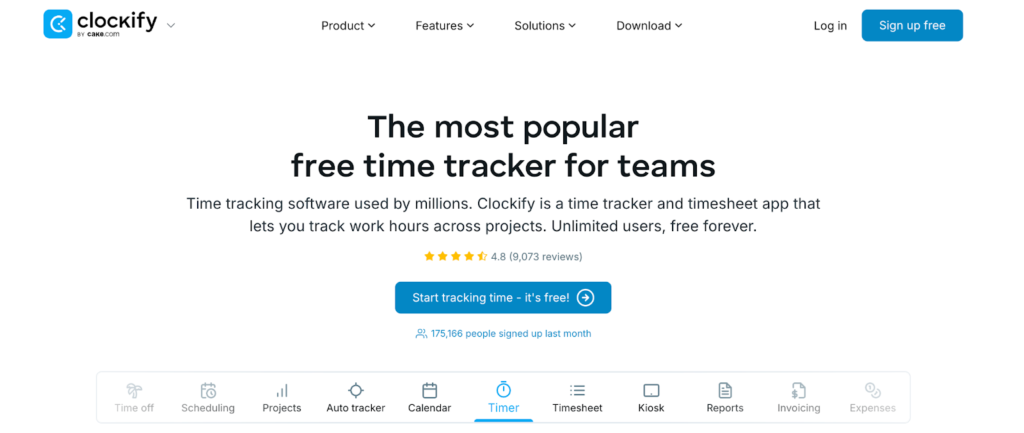
Clockify is a cheaper time tracking app than Paymo. If your primary use case is creating timesheets and managing attendance, a free plan could be a good fit. Clockify hooks you up with unlimited time tracking for unlimited projects with task-specific billable rates and automatic rounding.
If you also care about scheduling and want deeper analytics, a Pro plan (which costs a dollar more than Paymo Plus) also includes Labor cost & profit analysis reports, budgeting tools, project progress forecasting, and expense management.
| Key features | Top use cases |
| Manual and automated time logging Timesheets management Clock-in kiosks Calendar view with time-boxed activities Time, attendance, expense, and work summary reports Supported platforms: Web, Browser, Windows, Kiosk (shared devices), macOS, Android, iOS. | Employee timekeeping and attendance management Field work management Data collection for payroll processing Resource planning and work prioritization |
How Clockify compares to Paymo
Clockify focuses more on time management than project management. It doesn’t have as many project views as Paymo, but it stands out in terms of time tracking features. Similar to Toggl, you have a built-in Pomodoro timer and idle detection reminders. Teams that often work on-site may appreciate kiosk time clocks and GPS tracking while logging hours. For cleaner entries, you can also lock timesheets and disallow manual time entry edits.
That said, you’ll miss out on features like project profitability tracking, retainer projects, flat-rate projects, and recurring tasks.
Pros
- Easy setup. Non-tech users can watch a 3-minute onboarding video that walks you through all the essential features.
- Loads of integrations. Users appreciate how the tool slots with hundreds of other business apps to minimize screen switching.
- Built-in reminders. Smart notification policies for missing time entries or capacity targets are very helpful, according to project managers.
Cons
- Buggy mobile app. Data sync across devices isn’t always seamless, which frustrates users who work on the go.
- Not the best interface. Multiple users rate the app UI as “dated”, “old school”, and “cluttered” when you add more tasks.
Pricing
- Forever free plan
- Free 7-day trial
- Paid plans start from $3.99/user/mo
⚠️Gated features: Split time entries, GPS tracking, locked timesheets, rounding, time audits, task rates, overtime tracking, QuickBooks integration.
Zoho Projects
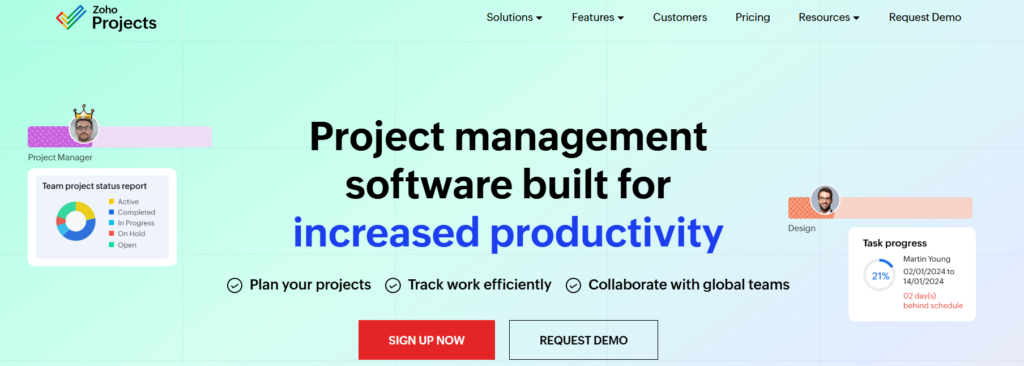
If your smaller team recently got bigger, Zoho Projects can be a cost-effective upgrade from Paymo. This project management software includes a very similar feature set: task management, time tracking, custom statuses, critical path mapping, and some fine extras like custom views, budgeting tools, issue tracking, and portfolio-level dashboards. If you need any extras for your stack, Zoho has a broader business suite of apps, covering CRM, finance, people management, procurement, and financial ops.
| Key features | Top use cases |
| Task manager with workflow automation Custom views and custom statuses Gantt chart with critical path mapping Time tracking and capacity management Team collaboration features: Chat, pages, forum, shared documents Supported platforms: Web, Windows, macOS, Android, iOS. | Managing complex projects across departments Planning software development sprints Bug tracking and customer issue resolution Resource management for multi-phase projects |
How Zoho Project compares to Paymo
With paid plans as low as $4/user per month, Zoho Projects gives you a bigger bang for your buck than Paymo. You get access to broader work management capabilities — Gantt charts with task dependencies (available only on Paymo Pro plan), a workflow automation engine, custom business calendars, and financial analytics for earned value management.
A higher Zoho Project plan (which is still more affordable than Paymo Plus) also gives you access to read-only users and a “Lite User” role who can view tasks, project statuses, and time logs. This lets you invite clients or external partners without worrying about guest limits.
Pros
- Customizable workflows. Users appreciate how effortlessly you can adapt the platform to suit different teams’ needs.
- Supports different project management methodologies, which many teams find versatile and convenient.
- Seamless external collaboration. Creative agencies appreciate how Zoho Plan streamlines sharing project updates and deliverables with clients.
Cons
- Crowded interface. Because the app is feature-rich, some people feel there are “too many clicks to get things done” and too many settings to tweak.
- Limited sorting options. Unlike other PM apps, Zoho doesn’t give an option to sort tasks into folders or workspaces to avoid clutter.
Pricing
- Forever free plan
- Free 15-day trial
- Paid plans start from $4/user/mo
⚠️Gated features: Project templates, workload reports, time tracking, custom views, budgeting, critical path mapping, and custom fields.
Best Gantt-focused planning tools
If you need more pro-level features like critical path mapping, baselines, cascade sorting, and more auto re-scheduling, based on last-moment changes, consider GanttPRO instead.
GanttPRO
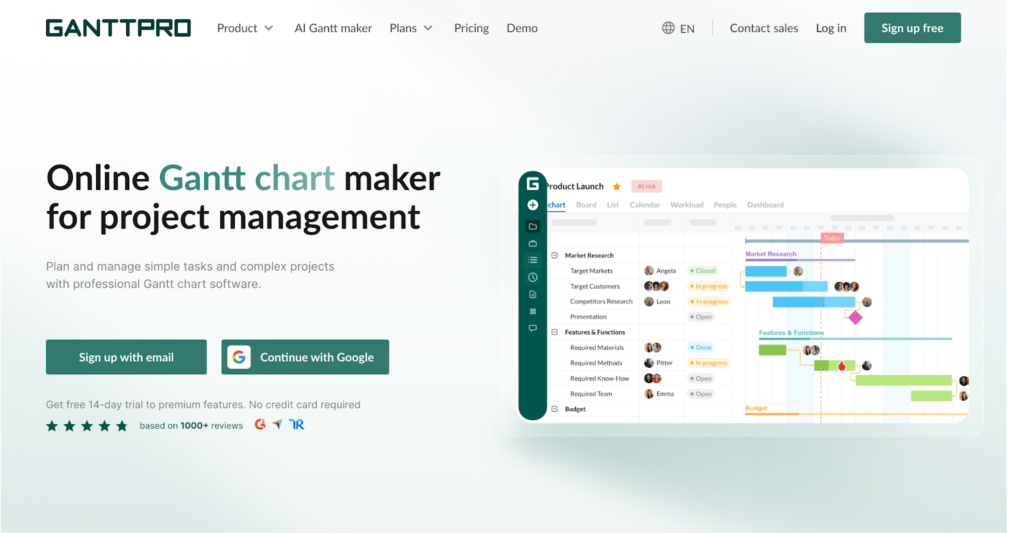
GanttPRO is one of the best Gantt chart software on the market, complete with a drag-and-drop resource scheduling view, advanced sequencing logic, critical path calculation, baselines, and cascade sorting. The smart auto-scheduling that automatically recalculates timelines when task dependencies change or new tasks are introduced. You can also configure custom filters to zoom in on the most important data and apply bulk changes manually.
The platform includes boards, lists, calendars, dashboards, portfolio overviews, and resource calendars. Time tracking, estimation, and budgeting controls are present too, but locked on higher plan tiers.
| Key features | Top use cases |
| Advanced Gantt chart with dependencies, critical path, and baselines Board, Dashboard, List, Calendar, Portfolio, and Workload views Built-in task manager Resource calendars for different resource types Budget planning and estimation Supported platforms: Web, Windows, Mac OS, Linux, Android, iOS | Managing client project roadmaps Resource and workload planning Cost and scope creep monitoring Real-time stakeholder reporting on statuses |
How GanttPRO compares to Paymo
GanttPRO gives you more room for “what-if” modeling in a Gantt view. You can estimate the downstream impact of resource reallocation or production delays. Similarly, you get more tools for optimizing resource management across people, equipment, and other virtual resources, with real-time capacity data available on each.
Another nice extra is more exporting options (PNG, PDF, XML, Excel). Paymo only lets you export Gantt to PDF/PNG, and has fewer native integrations for data imports (e.g., no data sync with JIRA or MS Teams).
Pros
- Great balance of depth vs simplicity. Multiple users call GanttPRO “pretty straightforward” to learn, while also appreciating the advanced controls available for structured project work.
- Highlights resource conflicts. Critical path, baselines, and workload views help zoom in on possible resourcing bottlenecks.
- High scalability. Thanks to automation, reallocating resources is quick and easy, even in projects with hundreds of milestones, according to users.
Cons
- Limited subtasks customization. Some users wish to have more functionality to change labels, views, or details easily for subtasks.
- Restrictive pricing plans. To access certain features like Calendar view or cascade sorting, users must purchase a 5+ person plan or sign up for a year upfront.
Pricing
- No free plan
- Free 14-day trial
- Paid plans start from $7/user/mo
⚠️Gated features (on higher-tier plans): Resource calendars, Workload view, time tracking, budget planning, estimation, bulk changes, and advanced reports.
How to choose the right Paymo alternative
The simplest way to choose the best Paymo alternative for your team is to match your biggest pain point to the tools built to solve it.
- If project management depth is the primary issue, look at Toggl, Teamwork.com, or Productive. Each offers better workload planning, task hierarchy, and delivery visibility.
- If time tracking and invoicing are the core needs, consider Toggl, Harvest, FreshBooks, or Avaza. These tools capture billable hours for simpler invoicing and deeper financial reporting. Many agencies adopt them specifically to simplify client billing workflows and reduce administrative overhead.
- If your team is actively growing (and work management risks getting chaotic), platforms like Wrike and Asana provide more flexible controls and workflow automation to effectively manage a growing operation’s layer.
- If Gantt charts are the main frustration (especially because Paymo locks them behind higher plans), Toggl, GanttPRO, and ClickUp offer access to visual timeline planning for a lower fee.
- If budget is the deciding factor, explore Clockify or Toggl (with a very generous free plan). Zoho Projects is another solid PM tool without a steep price.
Why Toggl is the natural upgrade from Paymo
Every tool has a stage where it fits best. For Paymo, that stage is early: when you need a simple way to manage work and turn hours into invoices.
But growth changes the equation. If you need more visibility into who’s doing what, how timelines shift, and whether your projects are actually on track, consider Toggl. It keeps the lightweight feel, but adds the structure teams need as complexity increases: timeline planning without feature gating, deeper workload visibility, and a tighter connection between what’s planned and what actually happens. You can try Toggl for free.
Frequently asked questions (FAQs) about Paymo alternatives
What is the best free alternative to Paymo?
The best free alternative to Paymo depends on how closely you want to match its “all-in-one” setup or whether you seek more feature depth.
- If you want the closest feature parity, Toggl combines project planning with time tracking, visual timelines, and workload reports in a way that mirrors Paymo’s, but without feature gating.
- If you want more project management controls for a lower price, consider Zoho Projects. The free plan includes task management with subtasks, basic Gantt charts with dependencies, document sharing, custom statuses, and more out-of-the-box integrations.
Toggl and Zoho Projects are both free for teams of up to five people.
Which Paymo alternative is best for freelancers?
Toggl and Clockify are strong Paymo alternatives for freelancers. If your priority is simple time tracking, Toggl offers effortless data capture for billing and scope management. If you want better task management features and visibility into your workload, Toggl also delivers both without a clunky interface.
Which Paymo alternatives include Gantt charts on lower-tier plans?
Toggl ($9/mo), GanttPRO ($7/mo), ClickUp ($7/mo), and Teamwork.com (€9.99/mo) include timeline views on their starter plans. Toggle and ClickUp offer simpler, visual drag-and-drop timeline views. GanttPRO and Teamwork.com also support more complex dependency tracking and critical path mapping.
How hard is it to migrate from Paymo to another tool?
It’s easy to migrate from Paymo, especially for small to mid-sized teams. You can export time entries, tasks, and client data in CSV format, and upload them to your new tool. The harder part is rebuilding workflows and getting your team settled into a new system, which may take a few days to a few weeks, depending on the tool and team size.

Elena is a senior content strategist and writer specializing in technology, finance, and people management. With over a decade of experience, she has helped shape the narratives of industry leaders like Xendit, UXCam, and Intellias. Her bylines appear in Tech.Co, The Next Web, and The Huffington Post, while her ghostwritten thought leadership pieces have been featured in Forbes, Smashing Magazine, and VentureBeat. As the lead writer behind HLB Global’s Annual Business Leader Survey, she translates complex data and economic trends into actionable insights for executives in 150+ countries. Armed with a Master’s in Political Science, Elena blends analytical depth with sharp storytelling to create content that matters.