Most consultants start with hourly billing because it feels fair. You work, you charge, the client sees exactly what they are paying for.
However, you quickly hit a ceiling as your income grows only as fast as you can work, which means it stops growing the moment you run out of hours.
At Toggl, we’ve worked with hundreds of consulting teams, agencies, and other professional services businesses, so we know the problem often isn’t the rate but the pricing model.
This article covers:
- The main types of consulting pricing models used by both independent practitioners and established firms.
- How to choose the right one for where your practice is right now.
- A deeper look at value-based pricing since it is what most consultants want to move toward but rarely manage well.
- The data you need to collect before making a decision on your pricing model.
The six main consulting pricing models at a glance
| Model | Best for | Billing trigger | Scope needed | Main risk |
|---|---|---|---|---|
| Hourly | Early-stage or variable-scope work | Hours logged | Low | Income ceiling and client friction |
| Fixed fee | Well-defined projects and deliverables | Deliverable | High | Scope creep absorbs margin |
| Retainer | Ongoing relationships | Monthly | Medium | Over-delivery without visibility |
| Value-based | High-impact, measurable outcomes | Outcome agreed | Low | Hard to justify without track record |
| Hybrid | Marketing, sales, biz dev consulting | Base + milestone | Medium | Needs clear attribution model |
| Productised | Mature, repeatable practice | Package purchase | High | Inflexible for unusual clients |
Why your consulting pricing model matters more than your rate
Your pricing model determines your incentives. That’s why choosing a pricing strategy is a bigger decision than setting a price point — the structure you pick shapes your value proposition to clients and your economics internally.
Each model quietly shapes what you optimize for day to day:
- Hourly billing rewards you for spending more time.
- Fixed fees reward you for going as fast as possible.
- Retainers reward you for keeping clients happy enough to renew, which is not always the same as delivering your best work.
The wrong model for your practice type can make excellent work unprofitable and mediocre work feel fine.
For example, an agency billing hourly on a project that should have been scoped as a fixed fee ends up in endless revision cycles. A consultant on a retainer without any measurement of what is being delivered starts padding meetings to justify the invoice.
A firm that moves to value-based pricing before it knows its own delivery costs ends up either undercharging or losing clients who cannot accept a price they cannot benchmark. Each of these scenarios hits your bottom line in a different way, and many consultants do not connect the cash flow problem back to the pricing structure causing it.
The main consulting pricing models in detail
1. Hourly billing
Hourly billing is the default for a reason. It is transparent, easy to explain, and straightforward to track.
You set an hourly rate, you charge for the number of hours worked, and the client pays for exactly what they get. It is also the easiest pricing model to benchmark against industry standards, since hourly rates are widely published across most consulting categories.
Hourly pricing works well in specific situations:
- With new clients where neither party knows how the engagement will develop
- Early in your practice, when you do not yet know how long your work actually takes
- Engagements with genuinely variable scope where neither party can predict the workload in advance
- Discovery phases where you are figuring out what the project is before scoping the rest of it
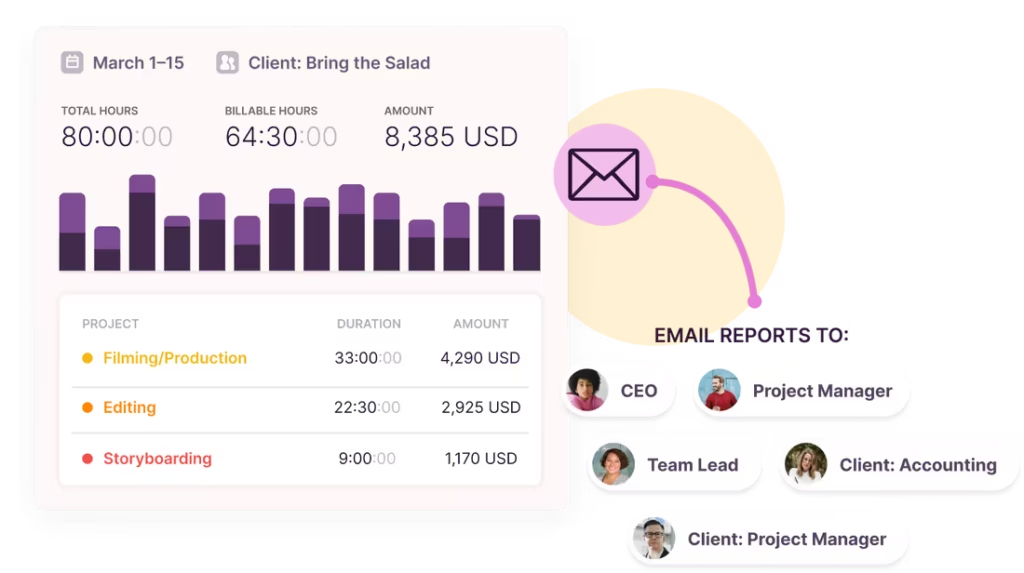
The problem with hourly billing at scale is the incentive structure. Clients who are watching the clock second-guess every decision you make.
And the model has a structural ceiling: no matter how good you get, you can only charge for the hours in the day. Your expertise isn’t appreciated. A 30-minute insight from someone with 20 years of experience may be worth far more than a three-hour analysis from someone learning on the job, but hourly billing treats them identically.
Note: Our billable hours calculator can help you figure out what your effective hourly rate actually is once you account for non-billable time, which most consultants systematically undercount.
2. Project-based (fixed-fee) pricing
With project-based pricing, you charge a flat fixed price for a defined scope of work. The client knows what they will pay upfront; you know what you need to deliver. This is often the right model when a client has a fixed budget and clear expectations about what they need.
Fixed fees work well when:
- The project scope is clear and agreed before work starts
- You have timelines and deliverables defined with enough specificity to spot scope creep early
- You have enough past experience to know what the work actually costs you
- The client’s needs are unlikely to change significantly mid-engagement
The critical dependency is that last point: your actual cost of delivery. Without it, fixed-fee pricing is a guess.
Candybox Marketing, a digital agency that uses Toggl to manage over 40 people and multiple client projects, saw this clearly thanks to their time data. When they analyzed their logged hours, they discovered they had been underquoting website projects because they had assumed all pages required roughly the same effort.
One page took two hours to build. Another took fifteen. They had priced them identically. Once they could see that pattern in their time data, they rebuilt their fixed-fee quotes from actual delivery costs.
Darrell Keezer, their CEO, describes a specific instance where Candybox quoted $120,000 on a project against competitors who had quoted $45,000 and $50,000:
“We were more than double the competition but we ended up winning that contract because they recognized that the other vendors hadn’t quoted them properly and so probably weren’t going to be able to deliver on those objectives.”
Darrell Keezer, CEO of Candybox
The practical protection for fixed-fee work is a change order clause in your contract. Any work outside the original scope should trigger a written amendment with an agreed price before work begins. Without it, clients will expand scope incrementally and you will absorb the cost.
Note: Once you know your delivery cost, our markup and margin calculator can help you build the right margin into your fixed-fee quote.
3. Retainer pricing
A retainer is a recurring fee — typically monthly — for ongoing access to your services. Retainer fees give your practice two things that project-based consulting work rarely does: predictability in revenue and the continuity that builds stronger client relationships over time, which tends to improve client satisfaction.
The model has real advantages when it works. Ongoing support arrangements let you plan your capacity and do more thoughtful work because you are not constantly starting from zero.
The risk is invisible scope creep.
In project-based work, clients usually know when they are asking for something new. In retainer work, the additions come in smaller increments: an extra call here, a quick question that becomes a half-day of research, a “just look over this” that turns into a full review. Individually, each one seems minor. Collectively, they can turn a profitable retainer into one where you are significantly over-delivering for the fee and eroding the client expectations you set at the start.
Tony Bradberry, MD of Grey Matter, describes this in our agency pricing playbook: once his agency implemented time tracking on their retainers, they discovered that certain clients were demanding far more than others for the same fee. That data prompted a client restructuring that replaced low-margin retainers with better-aligned, higher-value work.
“All revenue is not created equal. All clients are not good clients. When you do actually start tracking time… there’s some people that are just super needy. You realize that while the revenue upfront looks great, the actual time suck and the drag on the agency as a whole gets huge.”
Tony Bradberry, MD of Grey Matter
If you run retainers, track your time on them anyway. Not to bill it, but to see what your retainer actually costs to deliver each month. That number should inform every renewal conversation you have.
4. Value-based pricing
Value-based pricing is what most consultants say they want to move to and few manage to do well. The idea is that you price based on the economic value your work creates for the client rather than on the hours or deliverables involved.
Done properly, it is the most economically rational model and justifies premium pricing in a way no other structure can. A consultant who helps a company avoid a $2 million legal liability might fairly charge $200,000 for a week’s work.
A marketing agency that reliably generates six figures in new revenue within the first month of an engagement might charge $55,000 regardless of how long it takes. The value to the client is the same whether the work takes three days or three weeks, so consulting fees should not change based on effort.
This model removes the ceiling on your income, aligns your incentives with client outcomes, and positions you as an investment rather than a line item. It also makes you much harder to compete with on price, because you are no longer selling time that can be compared to someone else’s cheaper time.
The reason most consultants cannot implement it yet is that value-based pricing requires three things they often do not have:
- A specific and defensible understanding of the client’s upside
- A track record that gives them the confidence to hold the number when a client pushes back
- A clear enough picture of their own delivery costs to know where the margin is
Automation and AI are accelerating pressure toward this model because they compress delivery time without reducing outcome value. If an AI-enabled consultant can now produce in two days what used to take two weeks, billing hourly for those two days produces a fraction of the revenue the work is actually worth.
The math does not work short-term either. You win fewer engagements than you should because your hourly quotes look uncompetitive against firms that have automated more of the work.
The path from hourly to value-based pricing is not a single jump. It is a sequence: track time meticulously on every engagement to know your real delivery costs; move to fixed-fee pricing on your most repeatable work to start decoupling price from time.
Then apply value-based pricing to high-outcome engagements where you have the data and the confidence to justify a price tied to results rather than inputs.
5. Retainer plus performance hybrid
A hybrid model combines a base retainer for ongoing access with a performance component tied to agreed outcomes. You get some revenue stability; the client gets some downside protection; and both parties benefit when the work goes well.
This model is growing in professional services, particularly in marketing, sales, and strategy consulting, where outcomes can be measured and attributed with reasonable confidence. It requires:
- Clear success metrics agreed before work starts
- Payment milestones tied to measurable outcomes rather than calendar dates
- Honest scoping of what the base retainer covers, so the performance component feels like genuine upside
It is a variant on the value-based model rather than something categorically different. The base retainer is essentially a fixed fee for a predictable scope; the performance component is the value-based layer on top.
6. Tiered and productised pricing
A productised service is your expertise packaged into a defined offering with a set price, set scope, and predictable delivery process. Tiered pricing takes this further: you offer several packages at different price points, letting clients self-select based on their budget and the scope of work they need. Instead of scoping each engagement from scratch, you sell the same thing repeatedly.
This works well for mature practices that do similar work across many clients. It reduces the sales cycle, makes onboarding predictable, and largely eliminates scope negotiation. The tradeoff is flexibility. Clients with unusual needs will not fit neatly into your packages, and you will either turn them away or create custom work that undermines the efficiency the model is supposed to produce.
How to choose the right consulting pricing model
The right model depends on three things: how well you can define your scope, whether you can measure and attribute your outcomes, and where your practice is in terms of maturity.
The table below maps common situations to the right pricing model. Think of it as a starting point — your specific context will shape the final decision.
| Your situation | Recommended model |
|---|---|
| Early practice, don’t know your delivery costs yet | Hourly — build the data first |
| Clear deliverable, you know how long it takes | Fixed fee |
| Ongoing relationship, client needs regular access | Retainer (track time to protect margins) |
| Proven outcomes, can quantify client ROI | Value-based or hybrid |
| Repeatable, standardised work at volume | Productised / tiered |
| Variable scope, work evolves mid-engagement | Hourly or T&M |
Scope clarity is the first filter. If your typical engagement has a clear deliverable and a defined endpoint, fixed-fee or productised pricing will serve you well. If scope varies significantly or tends to evolve as the work progresses, hourly or retainer pricing preserves flexibility.
Management consulting and strategy consulting engagements often fall into the latter category. The scope of a strategic review is harder to pin down than the scope of a software implementation, for example.
Outcome measurability is the filter for value-based pricing. If you can quantify what you deliver in terms the client cares about, and if you can attribute your work to those outcomes with reasonable confidence, value-based pricing becomes viable. If your impact is real but hard to measure, fixed-fee or retainer pricing is more defensible.
Practice maturity matters because the data you need to price confidently comes from experience. For small businesses and solo consultants early in their consulting business, hourly billing is not so much a strategic choice as a practical one: you do not yet know how long your work takes.
Time tracking and project management discipline on hourly engagements is how you build that knowledge base. Every project you complete on hourly billing is data you can use to price your next fixed-fee engagement more accurately.
Dax Kimbrough, a business consultant who worked with Sweat+Co, describes what happens when you finally gain visibility into how time is actually being spent. His team discovered they were burning a significant number of non-billable hours in internal conversations that no one had noticed because they were not being tracked.
Once those hours were visible, they could figure out which were necessary and which were avoidable overhead. That is the kind of insight that makes a repricing decision evidence-based rather than a leap of faith. You can learn more in the Sweat+Co case study.
What consultant pricing rates actually look like in 2026
Now for the question that always comes up at this stage — what are the average consulting rates for each industry?
Here’s a quick breakdown based on data from Paperbell and Orient Software:
- Management consulting (independent): $150 to $350 per hour. Partners at major firms bill $500 to $1,000+ per hour.
- DEI and HR consulting: $150 to $250 per hour for generalist work; $200 to $500 per hour for executive compensation, labor relations, and organizational design.
- IT and technology consulting: $85 to $125 per hour entry-level; $150 to $300 per hour for mid-level practitioners; $250 to $500 per hour or more for senior specialists in cybersecurity and cloud architecture.
- Marketing consulting: $100 to $300 per hour on average; conversion and growth specialists with documented results often command $500 per hour or more for high-stakes engagements.
- AI consulting: $100 to $150 per hour for junior practitioners; $300 to $500 per hour or more for senior specialists, with niche applications in healthcare and finance commanding the highest rates.
Note that rate benchmarks are useful for orientation, not targets. Rates vary significantly by geography, specialization, and track record. The right rate for your practice depends on your track record, your market, and the model you are using.
The data you need before switching pricing models for any professional service business
Now that you have a theoretical background, let’s discuss what you need to know before making a change to your pricing model. In short:
- Before switching from hourly to fixed-fee: Know your average delivery time for each engagement type. Without that, your fixed fee is a guess, and guesses usually go wrong in the same direction.
- Before moving to retainers: Know what your average monthly delivery cost is per client. This is the number that determines whether a retainer is profitable at the fee you are proposing.
- Before value-based pricing: Understand both the value you typically create and the cost you typically incur to create it. You need to be able to tell a client what you will deliver and why it is worth what you are charging.
All of this data comes from tracking time, which is exactly why we built the reporting features in Toggl the way we did.
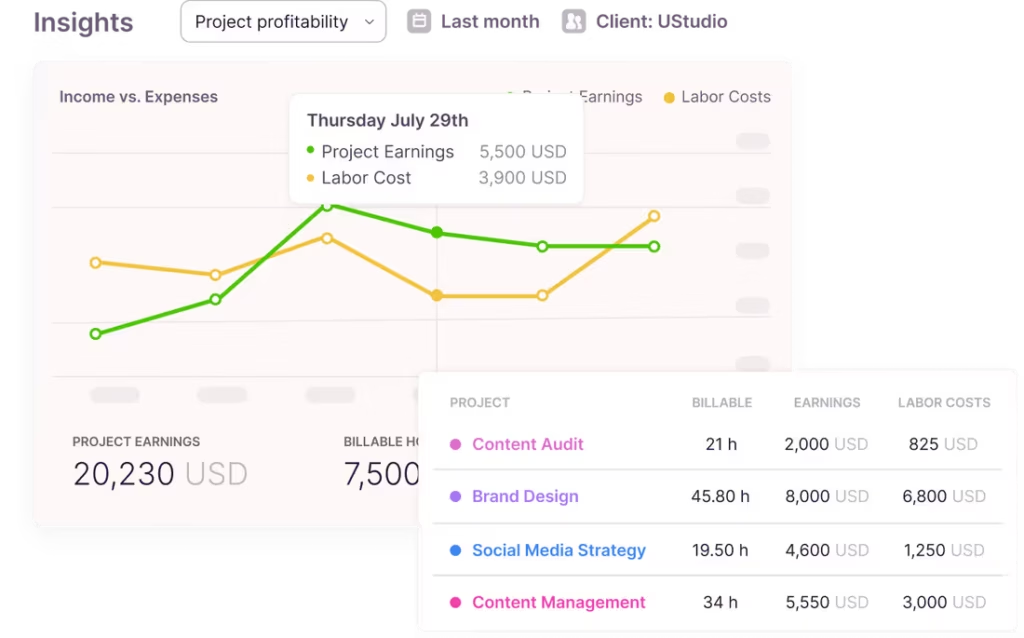
For example, consultants and agencies use our profitability reports to understand margin by client and by project type before making any pricing change. The reports calculate your actual labor costs based on tracked time and billing rates across any combination of client, project, and team.

Dax Kimbrough’s experience at Sweat+Co captures what this visibility produces in practice: “Toggl increased our profitability by at least 20%. We found out where the team was spending too much time on clients. Whether that was us being inefficient or over-serving or working too slowly, Toggl gave us the ability to restrategize, find out what’s wrong, and fix it.”
It’s a good idea to tracking time for at least 90 days before changing your pricing model, broken down by client, project, and task type. That gives you enough data to see patterns rather than noise.
An important note on contracts
Every pricing model needs contract language that reflects how it actually works. The model you choose and the contract you sign need to be consistent.
For fixed-fee work, define scope in writing before work begins. Describe deliverables specifically: how many revision rounds are included, what counts as a revision, what response times are included in the fee, and what happens if the client’s budget changes mid-engagement.
Then include a change order clause. Any work outside the original scope requires a written amendment with an agreed price before work starts.
For retainer work, the same principle applies but scope is typically expressed in terms of activities and availability rather than deliverables. What is included in the monthly fee? What is not? What happens when a month requires significantly more work than usual?
Payment schedules should align with delivery where possible. A deposit plus a completion payment is the minimum for project work; milestone payments are better for longer engagements. You can find more details in our guide to billing clients for consulting services.
Lastly, you should always have your contracts reviewed by someone qualified to give legal advice.
Frequently asked questions (FAQs) about consulting pricing models
What is the most common consulting pricing model?
Hourly billing is still the most widely used, particularly among independent consultants and smaller firms. Fixed-fee and retainer pricing are more common in established agencies and larger consulting practices.
What is value-based pricing in consulting?
Value-based pricing means setting your fee based on the economic value you create for the client rather than on the time or deliverables you provide. A consultant who saves a client $1 million might charge $100,000 regardless of whether the work took one week or one month.
How do I switch from hourly billing to a retainer model?
Start by tracking your time on your current hourly engagements to understand your average monthly delivery cost per client. Propose a retainer to an existing client based on their typical monthly hours and your hourly rate. Build in a quarterly review to adjust if the work consistently runs over or under the agreed scope. Our guide to tracking billable hours covers the setup in detail.
What is a retainer in consulting?
A retainer is a fixed monthly fee that gives a client ongoing access to your services. It is distinct from a project fee because it is not tied to a specific deliverable. It covers a defined scope of ongoing work or availability.
How do consulting firms price their services?
Larger firms typically use project-based or retainer pricing with rates set based on the seniority of the people involved and the scope of the engagement. Independent consultants use a wider range of models depending on their practice type, client mix, and stage of business development.
What is the difference between time and materials and fixed fee?
Time and materials (T&M) billing means the client pays for actual hours worked plus any direct costs — the final price varies based on how long the work takes. Fixed fee means the client pays an agreed amount regardless of the actual hours involved. T&M protects the consultant from underestimating; fixed fee protects the client from cost overruns. We cover the tradeoffs in our time and materials vs fixed fee guide.
How do I know if I’m undercharging for consulting?
The clearest signal is that you are winning every piece of work you pitch without negotiation. Some lost bids are healthy — they mean your pricing is calibrated to value rather than just what clients will accept.
Other signals include clients who consistently pay quickly and without questions, scope that regularly expands without pushback on cost, and a growing gap between what your most profitable engagements produce and what your average engagement produces.

Elizabeth is an experienced entrepreneur, writer, and content marketer. She has nine years of experience helping grow businesses, including two of her own, and shares Toggl's mission of challenging traditional beliefs about what building a successful business looks like.