ClickUp is a powerful, feature-rich project management tool that promises to be “software to replace all software.” It has a loyal user community and a generous free plan to boot.
But for many teams, the near-infinite features and customizations that make ClickUp so compelling also make it incredibly difficult to use.
This complexity often drives teams to start looking for ClickUp alternatives because they’re spending more time managing the platform than managing their work.
This article looks at the best ClickUp alternatives project managers and small teams can use to cover the same ground, but with a lot less overhead.
11 Best ClickUp alternatives: Quick overview and main considerations
| Tool Name | Best for | Free plan? | Starting price | User interface complexity | Setup difficulty |
| Toggl | Project and capacity planning with reliable time tracking | Yes | From $9 per user/mo | Low | Low |
| Asana | Clean and simple task management | Yes | From $10.99 per user/mo | Medium | Medium |
| monday work management | Complex workflows, without complexity | Yes | From $9 per seat/mo | Medium | Medium |
| Trello | Simple Kanban management | Yes | From $5 per user/mo | Low | Low |
| Notion | Docs + lightweight task management | Yes | From $8 per user/mo | Medium | High |
| Wrike | Enterprise planning and resource management | Yes | From $9.80 per user/mo | High | High |
| Smartsheet | Spreadsheet-native teams | Yes | From $7 per user/mo | High | Medium |
| Basecamp | Creative collaboration and flat pricing | Yes | $15 per user/mo | Low | Low |
| Teamwork.com | Agencies managing client projects | Yes | From $5.99 per user/mo | Medium | Medium |
| Linear | Software development teams | Yes | From $8 per user/mo | Low | Medium |
| Plane | Open-source alternative to ClickUp | Yes | Free (Self-hosted) | Low | High (if self-hosted) |
What makes ClickUp good, and where it falls short
ClickUp does many things exceptionally well. But to understand why you might need an alternative, it’s useful to consider why it consistently misses the mark for daily users.
What ClickUp does well
- Generous free plan: ClickUp offers one of the best free tiers out there, giving you unlimited users and tasks, making it highly attractive whether you’re a solo user or scaling a larger team.
- Competitive pricing: Alongside the free plan, paid tiers are reasonably priced. You can unlock additional functionality from around $7-$12/user/month for most teams.
- Ultimate customization: The sheer breadth of views, custom fields, and workspace options means you can build almost any type of workflow imaginable.
- Strong workflow automation: The Business plan provides robust automation features to streamline repetitive tasks.
- Active development: ClickUp doesn’t sit still. It regularly pushes updates and new releases to keep the platform evolving.
Where ClickUp consistently falls short
- Interface overwhelm: Reviewers’ #1 complaint is the platform’s notoriously cluttered UI. New or casual users find its steep learning curve particularly daunting, reporting that it’s confusing and time-consuming to use.
- Steep configuration curve: As there are no easy defaults to fall back on, teams face a massive setup burden before they can track projects effectively.
- Performance slowdowns: At scale (1,000+ tasks), the platform can become slow and buggy, lagging significantly when handling complex projects.
- The “everything app” trap: By trying to do everything in one platform, individual features suffer. Its docs aren’t as good as Notion, its chat isn’t Slack, and its time tracking lacks the depth of dedicated planning tools like Toggl.
- Hidden costs and billing surprises: The AI add-on costs an extra $7/user/mo, and guests can silently convert to paid seats, leading to unexpected invoice spikes.
What to look for in a ClickUp alternative
When you’re ready to make the switch, finding the right alternative depends on your team’s use cases, scale, and industry. We also recommend zooming in on a few universal features:
- Clean interface with low setup overhead: Look for a user-friendly interface with sensible defaults, so your team members can jump in and start working immediately.
- Performance that doesn’t degrade at scale: Your work management platform needs to remain fast and responsive, even when managing complex workflows and thousands of to-do lists.
- Strong mobile experience: A solid iOS and Android app helps your team collaborate and check due dates on the go without frustration.
- Honest, predictable pricing: Choose tools that offer transparent enterprise plan scaling without sneaky guest billing surprises.
- Native or deeply integrated time tracking: Built-in time tracking syncs your data perfectly, allowing you to monitor team capacity accurately.
- Core PM features on standard plans: Essential tools like Gantt charts, Kanban boards, task dependencies, and resource planning should be accessible without forcing you onto the most expensive tier.
11 Best ClickUp alternatives — in-depth comparison
To support your vendor research, we’ve carefully curated a list of the 11 best ClickUp alternatives. Having built successful project and task management tools for thousands of users over more than two decades, we know what works, and frankly, what doesn’t. For this section, we’ve looked at dozens of tools, shortlisted them down to the top 11, and divided them up into use cases to help you find the ClickUp alternative that’s best for you.
1. Toggl
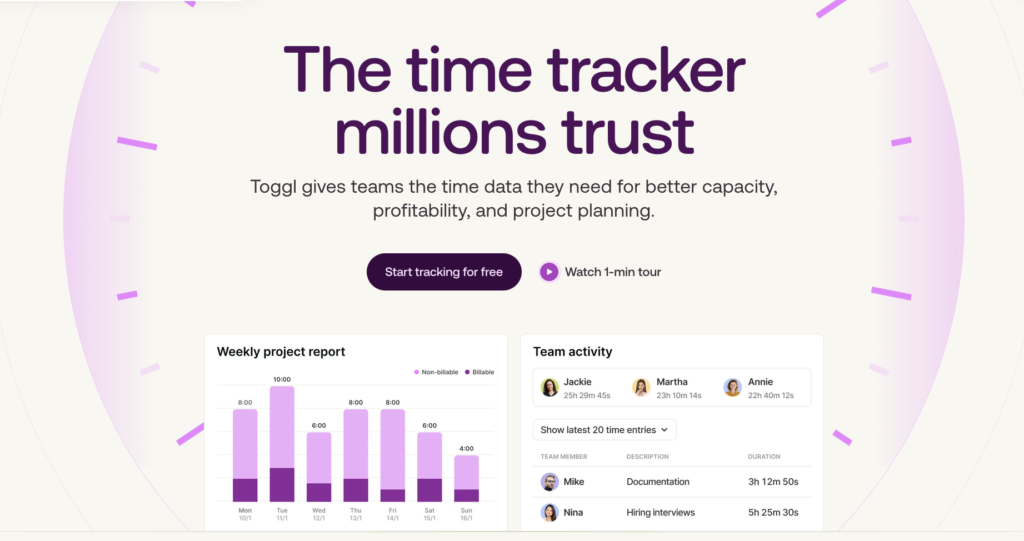
Toggl is a no-bloat time tracking and capacity planning tool that puts reliable time data at the center of your team’s workflow. The platform merges clean, simple, and easy-to-use project planning with people-focused resource and capacity planning, all with a real-time time-tracking engine at the center.
Who it’s best for
Toggl is the ultimate ClickUp alternative for small to medium-sized teams who want clean, delivery-enabling project management without the configuration burden or overwhelm of ClickUp. If you value clarity over endless customization options, this is your tool.
Effortless setup
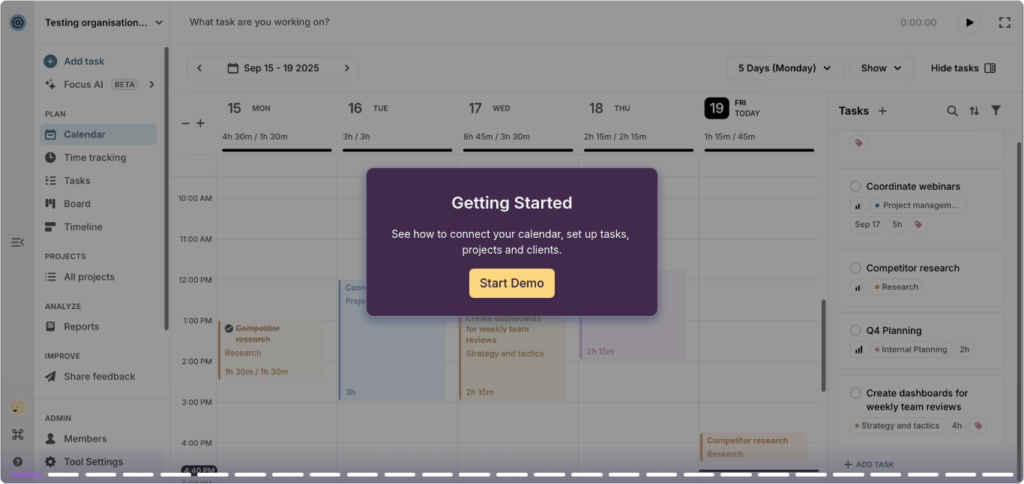
Toggl takes minutes to set up, and most teams are fully productive on day one. Most of the out-of-the-box configuration is done for you, with handy onboarding guides available to help you tweak those finishing touches. Our customer success and support teams are always on hand to help too, helping you onboard your team quickly and easily to start delivering great projects.
In contrast, you’ll need to set aside some serious time to get your team onboarded with ClickUp. In fact, even some project management experts suggest setting aside around 25-30 hours just to get going in ClickUp.
Time tracking as standard
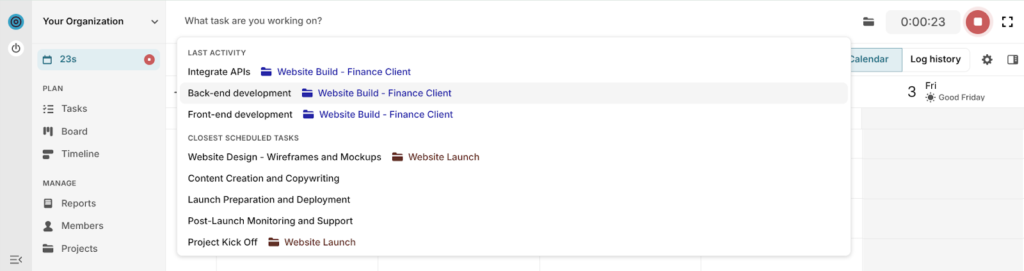
Crucially, time tracking in Toggl isn’t an afterthought bolted onto an expensive pricing tier. It’s 100% native to the platform, allowing you to instantly start a timer and log hours against a specific task, project, or client.
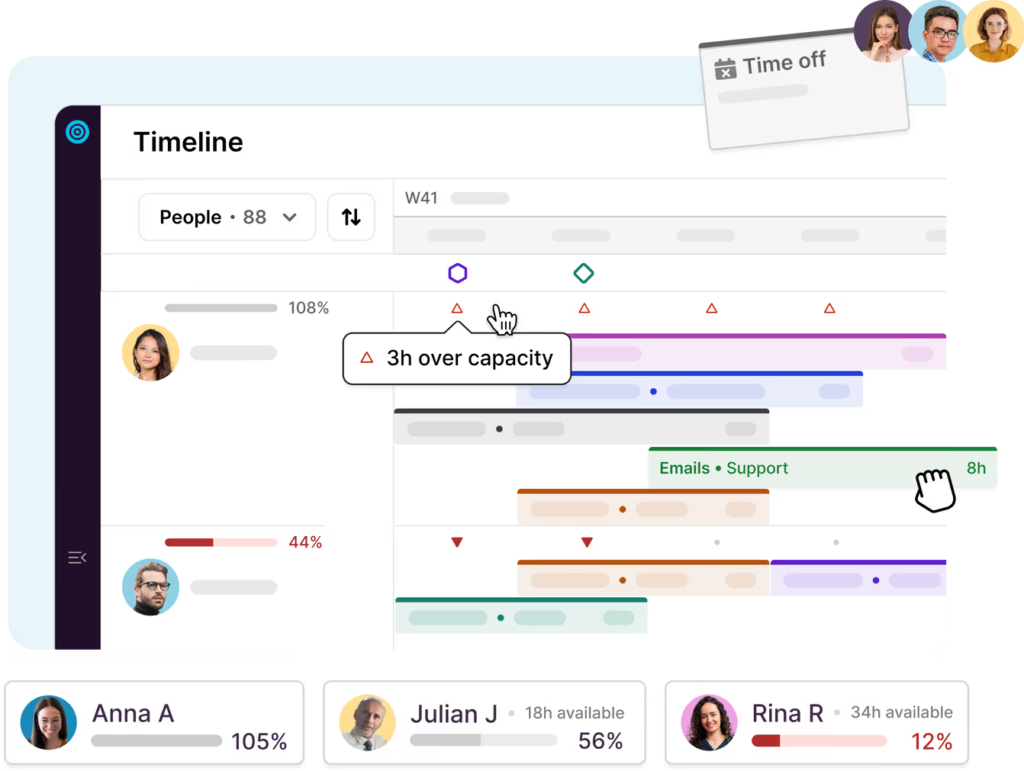
Time data provides real-time, accurate workload visibility, letting you spot burnout before it happens, with built-in capacity tools bringing together PTO, flexible working hours, and public holidays to ground your project tracking in reality.
Clean design = powerful tracking
While ClickUp tries to replace every tool in your stack, Toggl aims to do fewer things exceptionally well, such as enabling visual planning with a clean and easy-to-use interface.
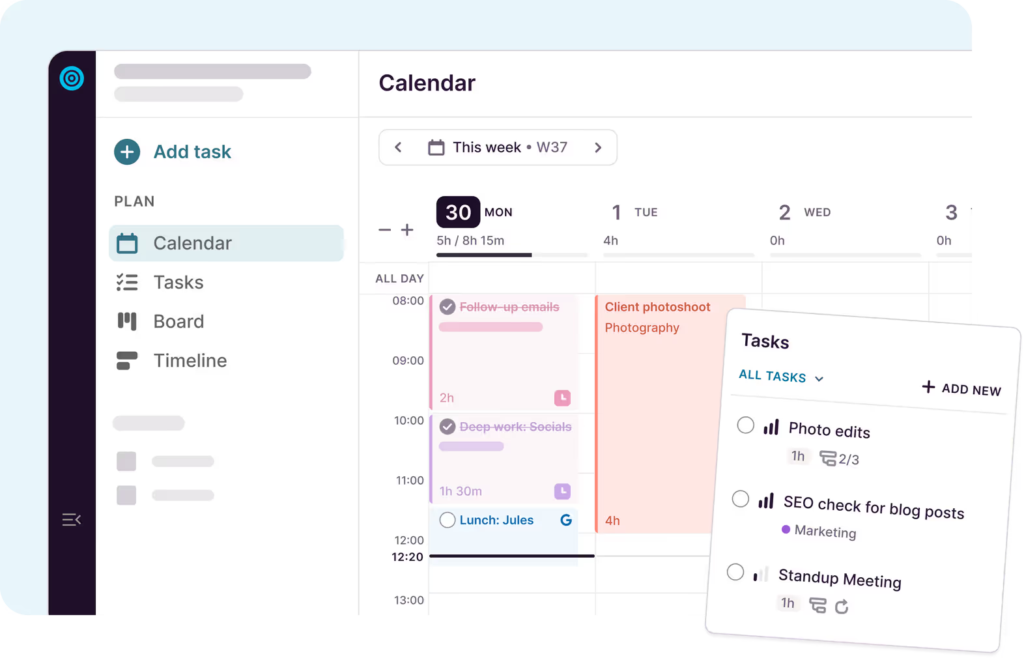
We made the deliberate decision to complement, not replace all your apps. Because of this, the intuitive interface stays wonderfully clean, and you don’t need to spend weeks mapping out a project.
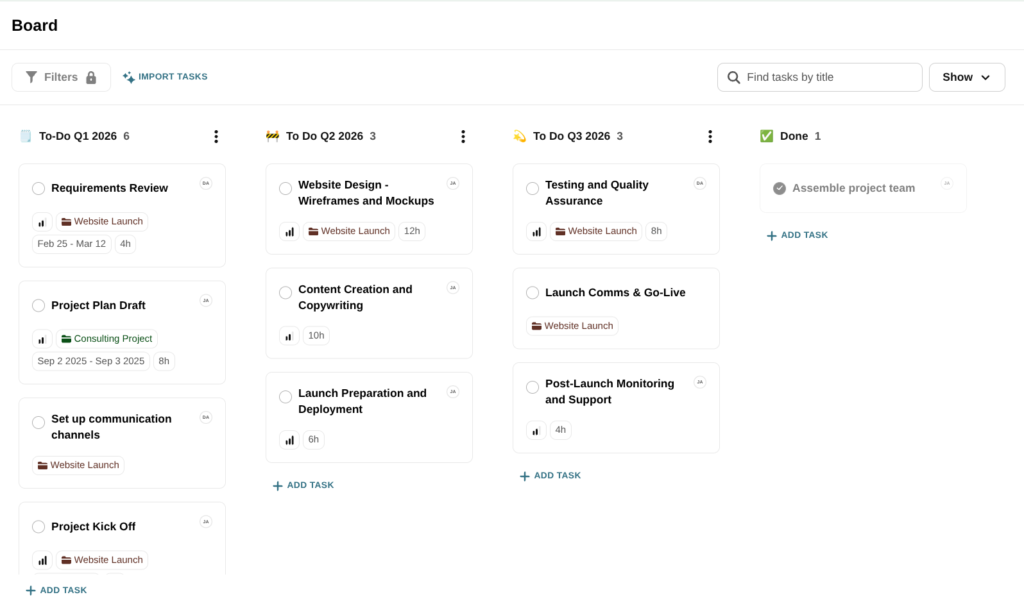
Kanban boards for instant task management
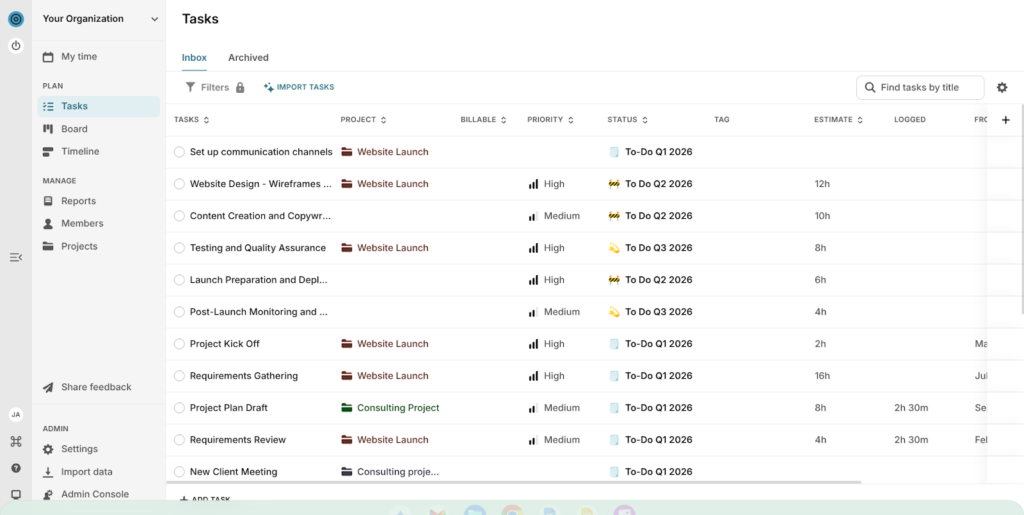
Toggl offers several ways to visualise what’s on your plate today, what’s coming up, and where your team is stuck right now. Kanban boards are one of our core views, allowing you to drag and drop tasks.
For a different outlook, you can effortlessly switch to other project views, like Gantt charts and simple task lists, to handle all your task management needs. This empowers your team to rejig tasks, set milestones, and map out task dependencies without needing a dedicated admin.
Pricing
- Free: For up to five users with time tracking, planning, and reporting.
- Starter (from $9 per user/mo): Add in milestones, timeline views, and resource planning.
- Premium (from $20 per user/mo): Upgrades to full capacity planning and workload management reporting.
- Enterprise: Custom pricing for scalable support and personalized onboarding.
Drawbacks
To deliberately fight feature bloat, Togg intentionally lacks native document creation or a built-in chat function, preferring seamless native integrations with dedicated tools instead.
2. Asana
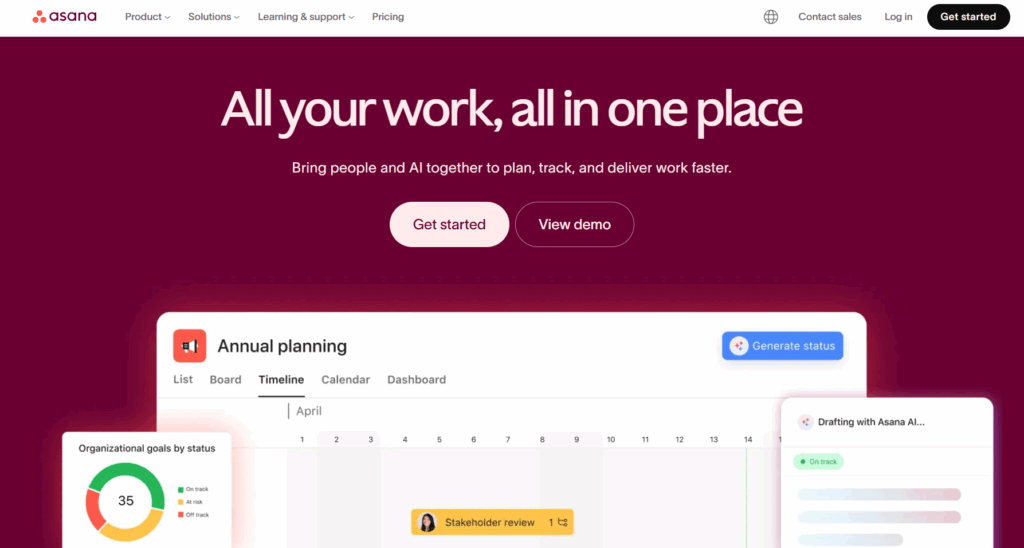
Asana is a powerhouse project management tool recognized globally for its highly visual, user-friendly interface. It organizes work into clear spaces where teams can track everything from daily to-do lists to massive strategic roadmaps.
Who it’s best for
It’s perfect for marketing teams, product squads, and mid-sized businesses that need strong team collaboration features without the daunting setup process of ClickUp.
Key features
- Task management: It excels at task tracking, offering excellent list, board, and calendar views that naturally guide your workflow. You can assign subtasks, set clear due dates, and use custom fields to organize your work.
- Goals and portfolios: Draw a line between your projects, milestones, and actual business objectives to clearly show how each project fits into your portfolio and strategic roadmap.
- Interface clarity. While Asana packs in a lot of features, the clean interface prevents overwhelm and makes onboarding a breeze for non-technical team members.
Pricing
- Personal (Free): Lists, boards, and basic project planning for up to two users.
- Starter (From $10.99 per user/mo): Unlocks timeline view and project dashboards.
- Advanced (From $24.99 per user/mo): Adds portfolio management and workload tracking for enterprise-level project planning.
Drawbacks
Asana’s free plan is quite restrictive. Essential project management features like Gantt charts (Timelines) and advanced reporting are locked behind the paid tiers, making it expensive as your team scales.
3. monday work management
monday work management, built on the monday.com Work OS, is a vibrant work management platform built around highly customizable spreadsheets and colorful dashboards. It acts as a centralized workspace where you can build virtually any workflow you can imagine using Lego-like building blocks.
Who it’s best for
monday work management is a good fit for teams who respond well to color-coded statuses, visual cues, and need a highly adaptable platform for complex workflows, marketing campaigns, or even lightweight CRM duties.
Key features
- Visual tracking: If you love visually tracking your project progress, monday work management delivers. It offers a smooth drag-and-drop experience alongside robust workflow automation.
- Integrations: The platform features fantastic native integrations, syncing effortlessly with Slack, Zapier, and Microsoft tools to streamline repetitive tasks.
- End-to-end workflows: If you’re managing complex projects, monday work management has specific templates for everything from intake requests to project closure. Pretty much everything is customizable, so can flex the tool to your preferred ways of working.
Pricing
- Free: Up to two seats with project planning templates out of the box.
- Basic (From $9 per seat/mo): Additional planning features plus document storage.
- Standard (From $12 per seat/mo): Adds timeline, Gantt charts, and calendar for different planning views.
- Pro (From $19 per seat/mo): Includes time tracking and private boards for the ultimate planning experience.
Drawbacks
In many ways, monday work management suffers from the same interface overload as ClickUp, but fewer users report it. The platform can also become expensive if you want to stack features from the Standard or Pro plans.
4. Trello
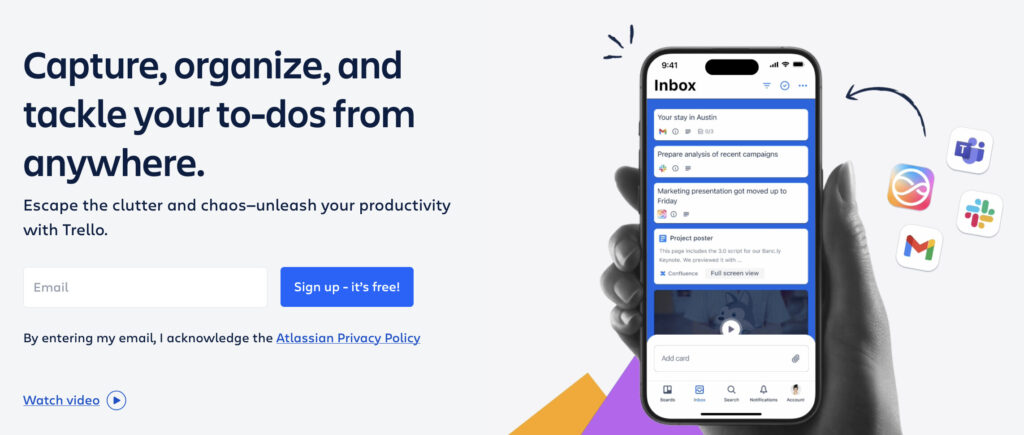
Trello is the undisputed king of digital Kanban boards. It uses a simple system of boards, lists, and cards to help teams organize tasks in a highly visual, straightforward manner. Trello’s Power-Ups are also great for automating task workflows, while built-in reports and ready-made templates help teams adopt the platform at lightning speed.
Who it’s best for
Trello usually suits small teams, freelancers, or departments that need radical simplicity and want a tool they can learn to use in under five minutes.
Key features
- Clean interface: When it comes to ease of use, Trello shines. If ClickUp feels too complex, your team will love the simplicity of Trello’s “To Do”, “Doing”, “Done” workflows.
- Apps on tap: Trello boasts brilliant iOS and Android apps for managing workloads on the go. Like the main desktop application, the mobile versions are equally simple and easy to use.
- Slick automation: Power-Ups speed up simple, day-to-day tasks with a rule-based automation engine with commands such as “When a card is delayed, push out the due date.”
Pricing
- Free: Unlimited cards and up to 10 boards. Great for starting out.
- Standard ($5/user/mo): Unlimited boards and advanced checklists.
- Premium ($10/user/mo): Adds Dashboard, Timeline, and Calendar views.
- Enterprise ($17.50/user/mo): Higher security and unlimited features for 50+ users.
Drawbacks
Trello is purposefully simple, meaning it struggles with large or complex projects. Trying to manage a massive, multi-department initiative with deep dependencies in Trello quickly turns the workspace into a chaotic mess.
5. Notion
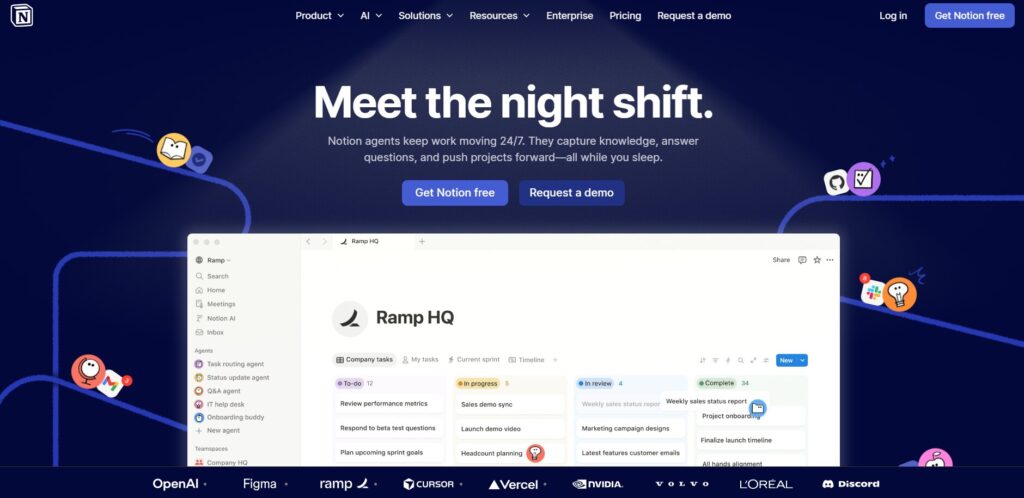
Notion isn’t a traditional project management software; it’s a remarkably flexible workspace that blends documents, wikis, and databases into one incredibly clean interface. It’s perfect for teams who want to build their own task management and can work well for project planning, so long as you have the time to invest in your setup.
Who it’s best for
Notion is suitable for teams that rely heavily on knowledge management, writing, and documentation, and want their task tracking to live right alongside their company wikis and meeting notes.
Key features
- Document dreams: If you’re leaving ClickUp because you loved their Docs feature but hated the cluttered task interface, Notion is your perfect match.
- Templates out of the box: Start with a simple to-do list and grow it into a full project portfolio, with board, timeline, and list views to match your planning style.
- Collaboration: Notion’s interface is built for collaboration, making it easy to brainstorm ideas, align on designs, or map out process flows from end-to-end.
Pricing
- Free: Great for individuals or small teams with basic needs.
- Plus (From $10 per user/mo): For small teams needing unlimited blocks for planning customization.
- Business (From $20 per user/mo): Adds private team spaces and advanced permissions for highly complex medium-sized teams.
Drawbacks
If you want to go beyond basic task and project planning, it can become very complex. Because of Notion’s ‘blank canvas’ ethos, you have to build your workflows entirely from scratch, while it lacks the advanced reporting and native resource management found in dedicated PM tools.
6. Wrike
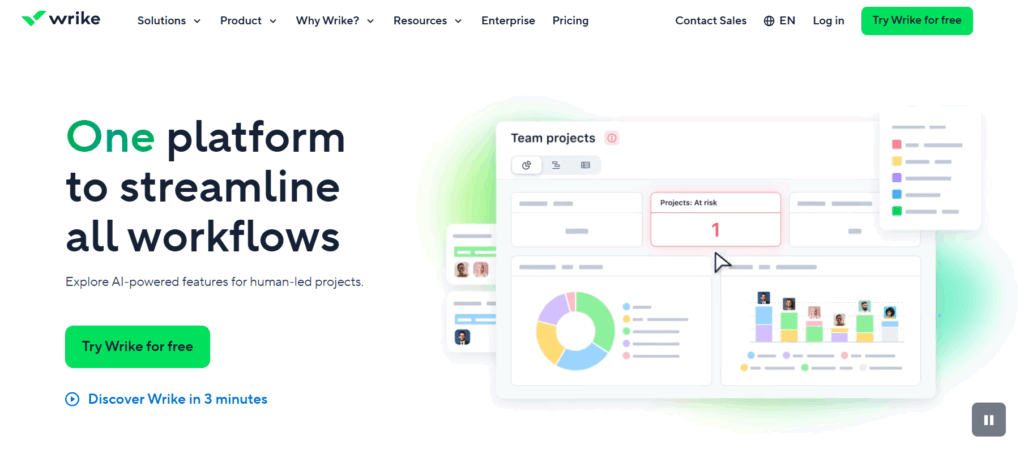
Wrike is a heavy-duty, enterprise-level project management platform engineered to handle complex workflows, massive budgets, and cross-departmental resource allocation. The broad range of features lends itself to large delivery teams managing interdependent programs and portfolios. It’s also got a super strong AI solution (Work Intelligence) to supercharge tasks and workflows of all sizes.
Who it’s best for
Wrike can be a great fit for large enterprises, traditional project managers, and organizations that juggle multiple complex projects and require deep visibility into team workload and performance.
Key features
- Deep project planning: Wrike brings serious project management muscle to the table. It handles task dependencies beautifully and offers some of the most powerful Gantt chart software capabilities on the market.
- End-to-end blueprints: Wrike’s advanced templating empowers teams to spin up complex workflows in seconds, including creative briefs, project schedules, or client proposals.
- AI intelligence: Wrike has made a big play with its Work Intelligence AI, including built-in agents, document creation, and real-time project insights.
Pricing
- Free: Essential task management for small teams.
- Team (From $10 per user/mo): Add custom fields, Gantt, and entry-level AI.
- Business (From $25 per user/mo): Elite AI features, workflow customization, and resource planning.
- Pinnacle and Apex: Enterprise plans that include budgeting, SSO, and whiteboards on a custom price basis.
Drawbacks
Like ClickUp, Wrike’s interface can feel quite dense, dated, and corporate compared to the more modern, lightweight tools. This can make team onboarding a challenge.
7. Smartsheet
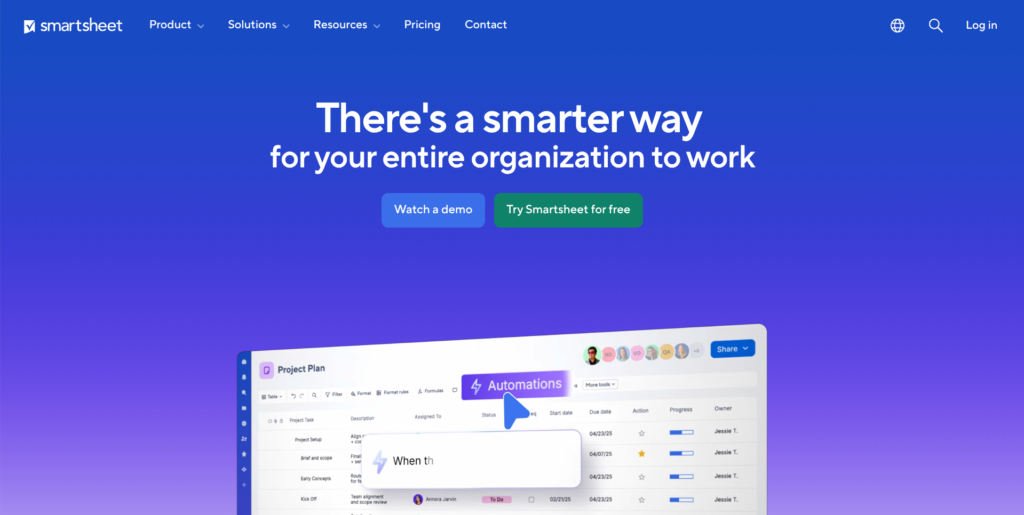
Smartsheet takes the familiar, universally-understood grid of a spreadsheet and injects it with powerful, dynamic project management functionality. It combines this ease of use with a great ability to scale, aggregating data for portfolio, resource, and capacity views that drive decision-making.
Who it’s best for
Teams that practically live in Microsoft Excel or Google Workspace are a good fit for Smartsheet, especially if they need more project management features, smart notifications, and automation.
Key features
- Data-driven project management: Smartsheet bridges the gap between raw data and actionable project tracking. You get automated workflows, complex cell-linking, and the ability to instantly flip your spreadsheet data into a Gantt chart or calendar view.
- Portfolio management: Smartsheet’s ‘Control Center’ is the perfect place to look across your projects to spot trends, aggregate updates, and build dashboards for stakeholders.
- Collaboration: Like other tools in this list, Smartsheet models itself on enabling collaboration with file libraries, proofing, sharing, and in-app conversation features.
Pricing
- Pro (From $7 per user/mo): For small teams (10 max) with limited views and automations.
- Business (From $25 per user/mo): Add timelines, resourcing, and unlimited automations.
- Enterprise and Advanced Work Management: Two additional custom pricing tiers to add AI formulas and charts and the ‘Control Center’ for portfolio management.
Drawbacks
Smartsheet doesn’t have the most visually inspiring or user-friendly interface for creative teams. Getting the absolute most out of its advanced features requires a solid understanding of spreadsheet logic and formulas, too.
8. Basecamp
Basecamp is the pioneer of keeping work simple. It actively fights against the all-in-one feature bloat by providing a structured, unchangeable format for team collaboration. Basecamp uses a project-based workspace to show you what’s coming up for a particular project, with a focus on features for creatives and agencies working with clients.
Who it’s best for
Basecamp is best for small to medium businesses that want a predictable, flat-rate pricing model and a tool that forces teams to communicate clearly without fussing over custom workflows.
Key features
- Getting stuff done: Instead of Gantt charts and deep dependencies, Basecamp gives you message boards, simple to-do lists, centralized schedules, and easy file sharing, leaning into their ethos of ‘getting stuff done.’
- Instant setup: Basecamp eliminates setup burden because you simply cannot customize it. For creative types that don’t like being forced into rigid structures, that can be quite appealing.
- Cost efficiency: What makes Basecamp truly unique among ClickUp competitors is its cost-effective pricing model. It offers a flat monthly fee for unlimited users, providing incredible scalability for growing teams.
Pricing
- Free: Run one project at a time for no cost.
- Plus: $15 per user/mo with unlimited projects and up to 500GB storage.
- Pro Unlimited: $299/month (flat fee for unlimited users, billed annually)
Drawbacks
The platform lacks supplementary features like reporting, resource management, and time tracking. You have to adapt your workflow to fit Basecamp; Basecamp will not adapt to you.
9. Teamwork.com
Teamwork.com is a comprehensive project management platform specifically built to handle the unique demands of agencies and businesses that manage client-facing work. Unlike generic tools, its features are tailor-made for agency-client relationships, with a focus on things like intake forms, retainers, and client feedback surveys.
Who it’s best for
Teamwork.com is loved by marketing agencies, consultancies, and professional services teams that need to track billable time and bring external clients securely into their project space.
Key features
- Clean UI: Teamwork.com excels where ClickUp can get messy. It offers fantastic collaboration tools that allow you to invite clients into the platform with granular permissions, keeping internal chatter hidden while showcasing project progress.
- Unlimited Client Users: Talking of collaboration, you can add client users for free, which is huge for transparency, trust, and relationship-building. It allows you to iterate design, wireframe, and communication drafts like an internal team would.
- Time Tracking: As it’s built for ‘bill-by-the-hour’ teams, the built-in time tracking is one of the best, feeding into workload management trackers across multiple client accounts.
Pricing
- Free: Free (up to 5 users) is perfect for project essentials and basic automations.
- Basics: For $10.99 per user/mo, get templates, intake forms, and 5000 automations.
- Accelerate: $19.99 per user/mo gets you budget management, resource planning, and client retainers.
- Optimize and Enterprise Speak to Teamwork.com for advanced AI and profitability reports.
Drawbacks
Teamwork.com’s interface isn’t the easiest to pick up and navigate, and some of the best agency-focused features (like advanced profitability reporting) are restricted to the higher-tier enterprise plans.
10. Linear
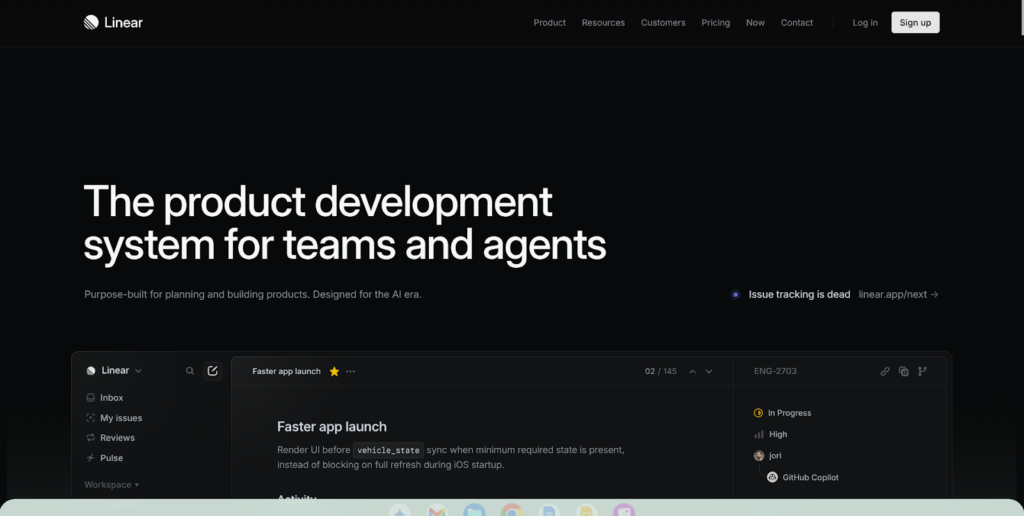
Linear is a lightning-fast, highly opinionated issue tracking tool built explicitly for modern software development teams in a product-based environment. Like Teamwork.com, it has a very specific focus, this time for product operations teams working to launch and iterate digital products.
Who it’s best for
Engineering teams, product managers, and developers who want to streamline issue tracking and sprint planning will enjoy that Linear comes without the unnecessary fluff of generic PM tools.
Key features
- Product management focused: Linear strips away generic project management templates to focus entirely on code, bugs, and product cycles.
- Simplicity: The dark-mode interface is gorgeous, and the keyboard-first navigation makes it incredibly fast to use, especially for developers used to typing day in and day out.
- Integrations: It syncs perfectly with developer tools and automates repetitive tasks, allowing engineering teams to focus on shipping products rather than updating task statuses.
Pricing
Linear features a free plan. Paid plans start at $8 per user/month.
- Free: Unlimited members and 2 teams that need issue tracking and Git integration.
- Basics: From $10 per user/mo expand team size and add file uploads.
- Accelerate: From $16 per user/mo bolt on powerful AI agents to automate tasks.
- Enterprise: Add invoicing, billing, and enterprise-grade security with custom pricing.
Drawbacks
Linear is strictly designed for software teams, so supplementary roles like PM, designers, ops, or marketing will find its use cases far too rigid and specialized for their day-to-day work.
11. Plane
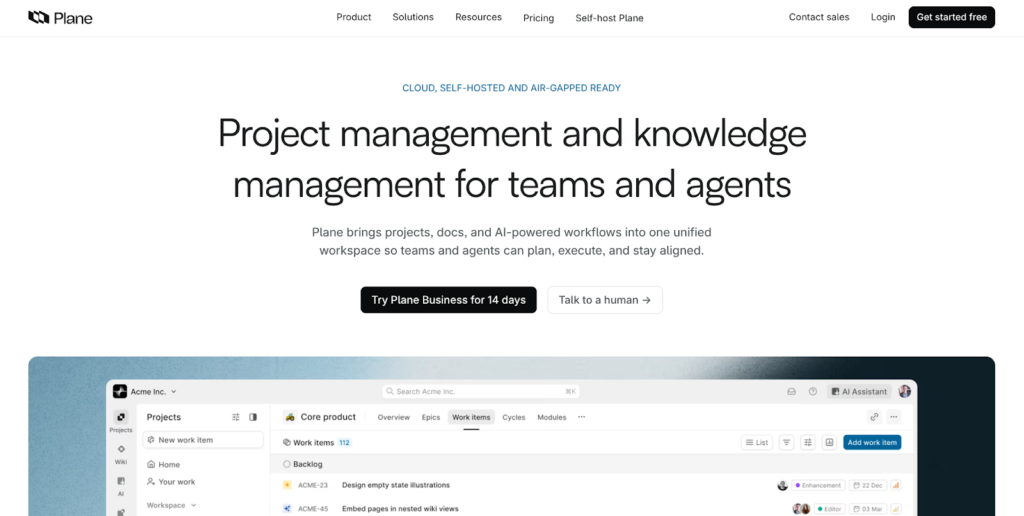
Plane is a rapidly growing work and project management platform that offers a modern, highly customizable alternative to giants like ClickUp. Similar to Linear, it’s very much focused on software development teams, but comes with the added bonus of an open-sourced, self-hosted option for teams that value security and privacy.
Who it’s best for
Plane is often right for technical teams and organizations that demand complete control over their data, prefer self-hosted solutions, and want an open-source tool without vendor lock-in.
Key features
- Simple and clean: Plane delivers a remarkably clean, user-friendly interface for an open-source platform.
- Feature-packed: It supports issues, cycles, and modules that are perfectly suited for Agile teams running complex workflows. Because it provides full API access, you can customize it heavily to fit your exact specifications.
- Integrated AI: Built in an AI-enabled world, Plane’s AI agents help teams structure work from just a prompt, get answers from live data in real-time, and assign agents that pick up work in seconds.
Pricing
- Free: Basic projects and work items for up to 12 users.
- Pro: From $6 per user/mo, add wikis, dashboards, and time tracking.
- Business: At $13 per user/mo, get ready-made templates, client management, and intake forms.
Note: These prices apply to self-hosted and cloud packages.
Drawbacks
Like Linear, Plane is quite techy-focused, so other teams may struggle to pick it up. Self-hosting requires significant technical expertise, dedicated server resources, and ongoing maintenance to keep the platform secure and operational.
How to choose the right ClickUp alternative based on your needs
Still not sure which tool to jump to? Here is a practical decision framework based on the most common reasons teams switch to a ClickUp alternative.
| Biggest pain point | Solution |
| ClickUp is too complex for my team. | Go with Toggl, Asana, or Trello, depending on your team size and project complexity. They all prioritize ease of use over endless button clicks. |
| I need better time tracking than ClickUp provides. | Choose Toggl. The seamless integration between project planning and dedicated time tracking means you’re always looking at real-world data. |
| ClickUp is slow and buggy on large workspaces. | Look at Asana or Basecamp. Both are much lighter and maintain their snappy performance at scale. |
| I need a better mobile experience. | Asana and Trello have highly polished, responsive mobile apps that make managing tasks on the go a breeze. |
| I manage client projects and need clean presentations/billing. | Teamwork.com is built specifically for this, handling external permissions and billable hours smoothly. |
| I want docs and knowledge management alongside tasks. | Notion is the undisputed leader for blending wikis and task management in one platform. |
| My team is purely software devs. | Switch to Linear for a lightning-fast, developer-centric experience. (Tip: While not covered here, we’d also recommend looking at Jira for software-developer focused teams.) |
Ready to try a ClickUp alternative?
ClickUp is an undeniably strong project management tool for teams that need many features and customization. But for most teams, the admin overhead simply isn’t worth it, with them spending more time maintaining ClickUp than actually using it.
If you’re looking for a platform that values clarity over clutter, give Toggl a try. It provides purposeful, clean project management paired with effortless team time management that makes every decision a data-driven one. You get all the visibility you need to deliver projects on time, without the setup burden or interface noise that makes other tools so tricky to sustain.
Ready to simplify your team’s workflow? Sign up for a free plan and test it out for yourself, no credit card required.
Frequently asked questions (FAQs) about ClickUp alternatives
Is ClickUp really free?
Yes, ClickUp offers a Free Forever plan that is genuinely free, but it comes with strict usage caps. While great for individuals, most growing teams hit these limits quickly and are forced to upgrade to a paid tier for relatively basic features like custom fields and Gantt charts (limited to 100 uses).
Why do people switch away from ClickUp?
The most common reasons teams leave ClickUp are interface overwhelm, usability, and performance lag on larger workspaces. Many users find they spend too much time configuring the platform rather than actually completing their work, so they opt for simpler tools, like Airtable, Trello, or Toggl, instead.
Is it easy to migrate to a ClickUp alternative?
Migrating to a ClickUp alternative isn’t as hard as you might think. Most alternatives support CSV exports and imports, and ClickUp’s basic task structure maps reasonably well to other platforms. But we always recommend running a two-week pilot with a real project before making a final migration commitment.
What is the easiest ClickUp alternative to set up?
Trello is arguably the easiest tool to set up if you only need basic Kanban boards, but Toggl is the easiest comprehensive alternative. It offers sensible, out-of-the-box defaults that allow teams to start planning and tracking immediately without a complex configuration phase.
Which ClickUp alternative is best for small teams?
Toggl and Asana are fantastic ClickUp alternatives for small teams because they balance powerful features with highly intuitive interfaces. They provide the structure small businesses need to track progress of their projects without burying them in unnecessary administrative bloat.
Does ClickUp have time tracking?
Yes, ClickUp includes native time tracking, but advanced time tracking features (like granular estimates and sprint reporting) are locked behind the $12/user/mo Business plan. Many users find time tracking feels like an afterthought, which is why teams prioritizing time tracking, capacity management, and resource planning often switch to purpose-built tools like Toggl.

James Elliott is an APMQ and MSP-certified project professional and writer from London. James has 8 years' experience leading projects and programs for tech, travel, digital, and financial services organizations, managing budgets in excess of £5m and teams of 30+. James writes on various business and project management topics, with a focus on content that empowers readers to learn, take action, and improve their ways of working. You can check out James’ work on his website or by connecting on LinkedIn.