monday.com has earned its reputation as a heavyweight in the work management platform space. For many small-to-medium-sized businesses, the flexibility and colorful interface of this “Work OS” that can do it all are very appealing.
However, some users find that what’s promised and what you actually get are two very different things. Whether it’s the Standard plan missing key project management features, a lack of entry-level time tracking, or the costly bundled pricing, there are some valid reasons to look for a monday.com alternative.
This guide explores the best monday.com alternatives for teams that want beautiful design and ease of use without the drawbacks.
Quick comparison of the best monday.com alternatives
| Tool | Best for | Free plan? | Starting price (Annual) | Native time tracking | Min. seats |
| Toggl | Project and capacity planning based on reliable time data | Yes (up to 5) | $9/user/month | Yes (Built-in) | None |
| Asana | Cross-functional teams | Yes (up to 2) | $10.99/user/month | Yes (Manual) | None |
| ClickUp | Power users | Yes (Unlimited) | $7/user/month | Yes | None |
| Trello | Simple task boards | Yes | $5/user/month | No (Add-ons) | None |
| Wrike | Enterprise workflows | Yes | $9.80/user/month | Yes | 2 |
| Smartsheet | Spreadsheet lovers | No | $7/user/month | No (Add-on) | 1 |
| Teamwork | Agencies or Client work | Yes (up to 5) | $5.99/user/month | Yes | 3 |
| Notion | Docs & Lightweight PM | Yes | $10/user/month | No | None |
| Basecamp | Simple communication | Yes | $15/user/month | No | None |
| Zoho Projects | Budget-conscious teams | Yes (up to 3) | $4/user/month | Yes | None |
Benefits and limitations of using monday.com for work management
monday.com‘s work management system is a powerhouse of the project management world, but it’s not perfect. Let’s look at what it does well and where users say it falls short.
What monday.com does well
monday.com isn’t a market leader by accident. Its popularity and success boil down to excellence in several key areas:
- Genuinely beautiful and intuitive UI: The use of color and “pulses” makes the workspace feel alive, engaging, and dynamic. This makes it easier to onboard new users and use every day.
- Highly customizable boards and views: Whether you prefer Kanban boards, timeline views, or simple tables, monday.com has the flexibility to fit into even the most complex of workflows.
- Strong automation on higher plans: Its no-code automations are some of the best in the business, helping to streamline repetitive tasks, provided you purchase the Pro tier.
- Large integration ecosystem: From Slack and Gmail to Salesforce and Microsoft, it connects to almost every cloud-based tool your team already uses. The platform quickly becomes the heart of everything your team does without major team retraining.
- Good for different teams: monday.com is a versatile project management tool that works as well for marketing as it does for software development, HR, or operations.
Where monday.com falls short
But like any tool, it isn’t perfect. Here are some of the areas real users struggle with:
- Time tracking and dependencies are locked behind the Pro plan: Essential project management features require higher paid tiers. In some instances, you need to jump to $19 per user/mo just to see who’s working on what, with time tracking a fundamental feature missing from lower plans.
- Seat bundling means small teams overpay: You can’t pay for a single seat, or add one to your existing plan. Seats are grouped (e.g., 3, 5, 10), so if you have four people, you pay for five whether you’ll ever need that extra seat or not.
- Automations are a USP but are difficult to use: While monday.com bigs up its automation capabilities, users frequently find them difficult to set up and maintain. This can lead to rework and creates an admin overhead for teams.
- Visual clutter as boards multiply: While colorful, monday.com can become cluttered and difficult to navigate as your project tracking needs grow. Finding a specific task across 50 boards can feel like searching for a needle in a haystack for some users.
- Mobile experience doesn’t match desktop: The mobile app consistently receives feedback for not being on par with desktop usability, making it difficult to update timeline views, receive notifications, or check due dates on the go.
- The cancellation experience is notably poor: Many users cite that leaving the ecosystem is far more difficult than joining it and isn’t a nice experience for end users not connected to billing.
What to look for in a monday.com alternative
Users commonly complain about monday.com for the following reasons, which you can use as your checklist when shopping for alternatives.
- Transparent, per-seat pricing: Look for a tool that lets you pay for the exact number of team members you have. This prevents small teams from paying for unused seats.
- Native time tracking: To avoid app-switching fatigue, your project management software should include fundamental features such as time tracking. This helps you track progress without adding another monthly subscription.
- Task dependencies on standard plans: Similarly, managing complex projects requires knowing which tasks rely on others. This functionality should be standard, not a premium luxury.
- Workload and resource views: A high-quality alternative to monday.com must provide a clear view of team capacity. This helps you plan work efficiently, maximize team productivity, and prevent burnout.
- A clean interface: You want a tool that stays user-friendly at scale, avoiding the visual noise that comes with board fatigue.
- Strong mobile experience: In 2026, being able to track tasks and view milestones from an iOS or Android device is essential for remote team collaboration.
10 best monday.com alternatives — an in-depth comparison
Having spent two decades building successful project and time management tools, we know our stuff. Based on feedback from real users, we’ve reviewed dozens of tools and shortlisted them down to the top 10 monday.com alternatives. Take a look at your specific use case to see which tool will best support your team to deliver your project objectives.
1. Best overall alternative for project management and time tracking: Toggl
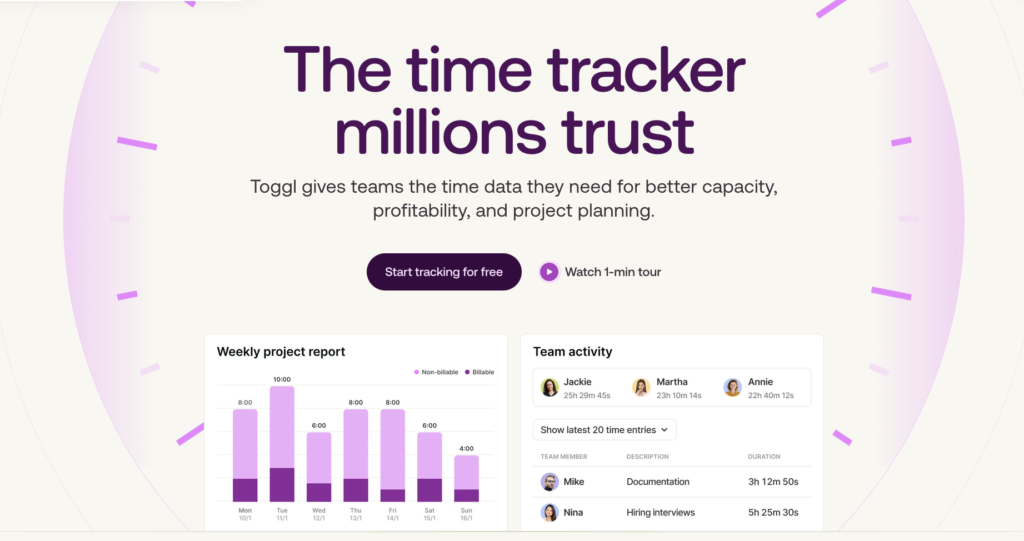
Toggl is the best monday.com alternative for teams who need visual project planning and built-in time tracking in one place, without the feature gating. While monday.com treats time tracking and dependencies as luxuries, we build these into our core experience because you can’t plan effectively without knowing your team’s real capacity.
Less clutter for busy teams
Where monday.com becomes cluttered and hard work, Toggl is all about clean, simple, and easy-to-use visual planning, combining minimal on-screen features with beautifully simple design styles.
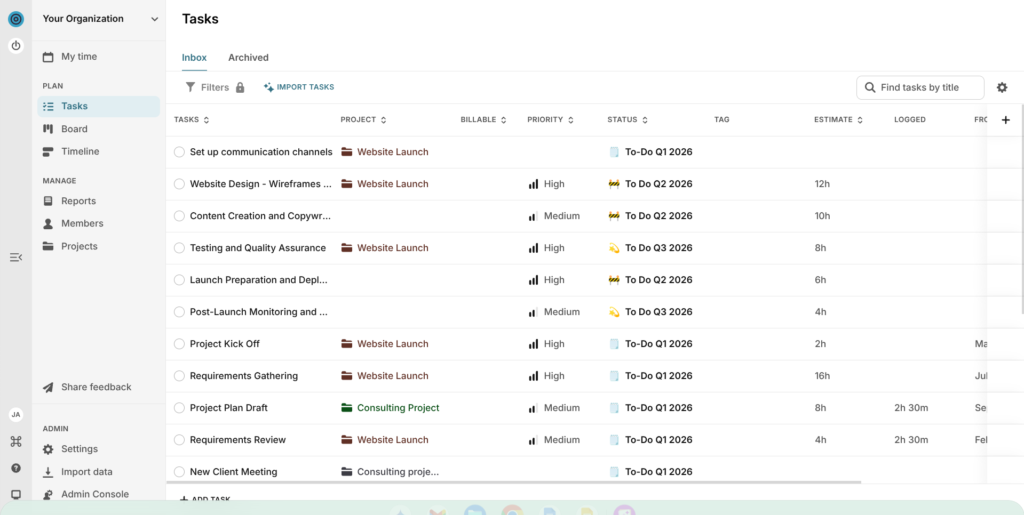
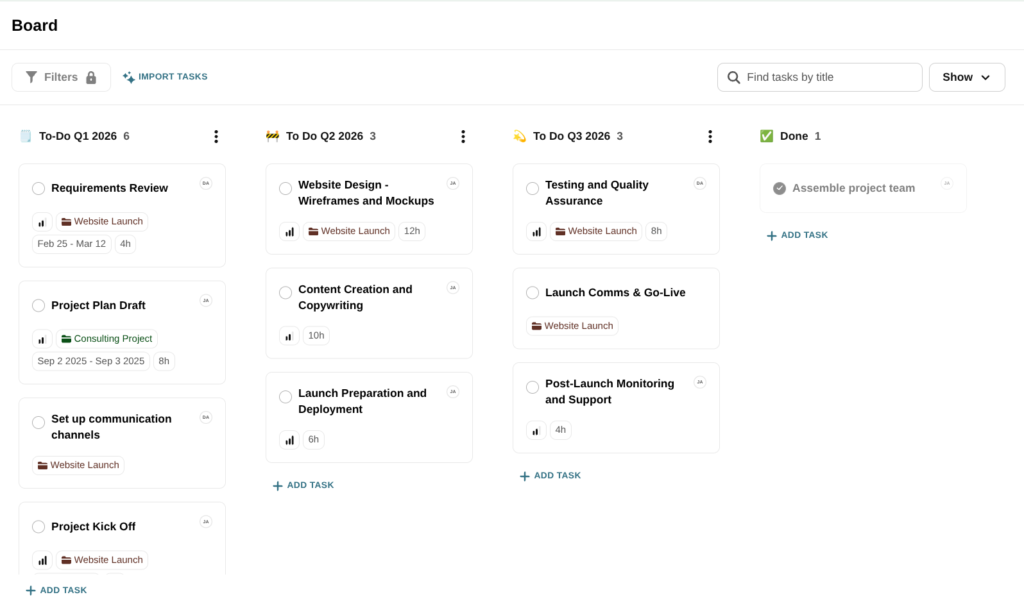
This simplicity means that teams genuinely enjoy using Toggl, making it a core part of their routine, boosting adoption and project engagement as a result. Whether it’s calendars, Gantt timelines, task lists, or boards, there’s a view in Toggl that’s right for every type of planner.
Time tracking as the foundation
Crucially, time tracking in Toggl isn’t an afterthought; it’s 100% native to the platform, allowing you to instantly start a timer and log hours against a specific task, project, or client.
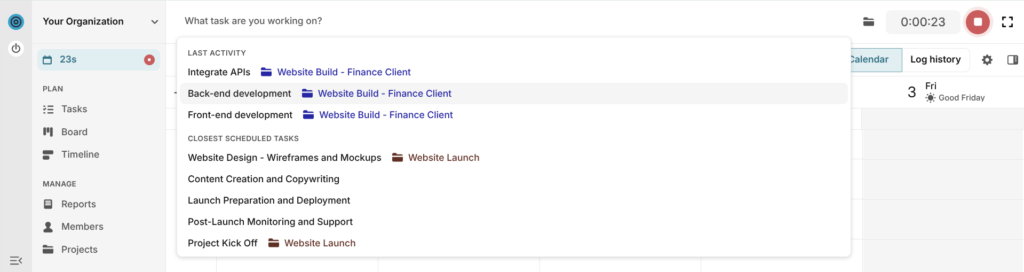
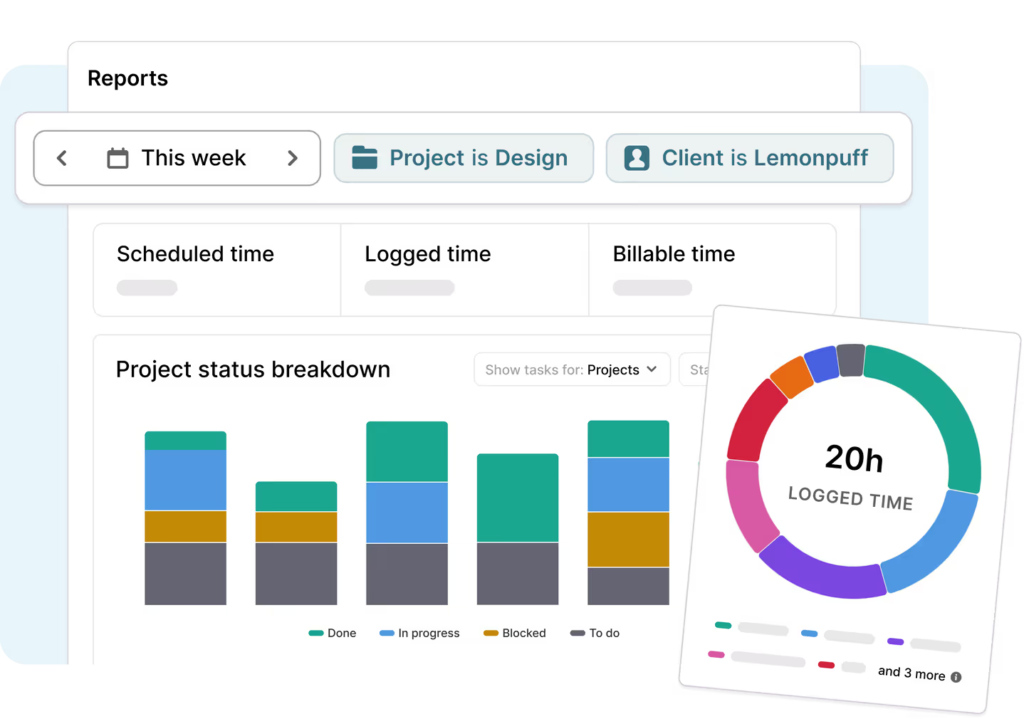
Time data provides real-time, accurate workload visibility, letting you spot burnout before it happens, with built-in capacity tools combining PTO, flexible working hours, and public holidays to ground your project tracking in reality.
Simple pricing with free time tracking
Just like the user interface, Toggl’s pricing is equally as straightforward. The free plan is generous, including planning, reporting, and full time tracking functionality as standard. Both manual & real-time timers, focus mode, and calendar integrations are all available for free. If you do want to upgrade to the Starter and Premium tiers, you’ll pay per user, not for a block of seats your team may (or may not) use.
Pricing
- Free: For up to five users with time tracking, planning, and reporting.
- Starter (from $9 per user/mo): Add in milestones, timeline views, and resource planning.
- Premium (from $20 per user/mo): Upgrades to full capacity planning and workload management reporting.
- Enterprise: Custom pricing for scalable support and personalized onboarding.
The drawback
If you need a hyper-complex CRM or deep financial accounting built into your PM tool, you might need a dedicated add-on or an integration with a 3rd party platform. Toggl is a deliberately lean platform built for clarity and speed.
2. Best for intuitive task management and cross-functional teams: Asana
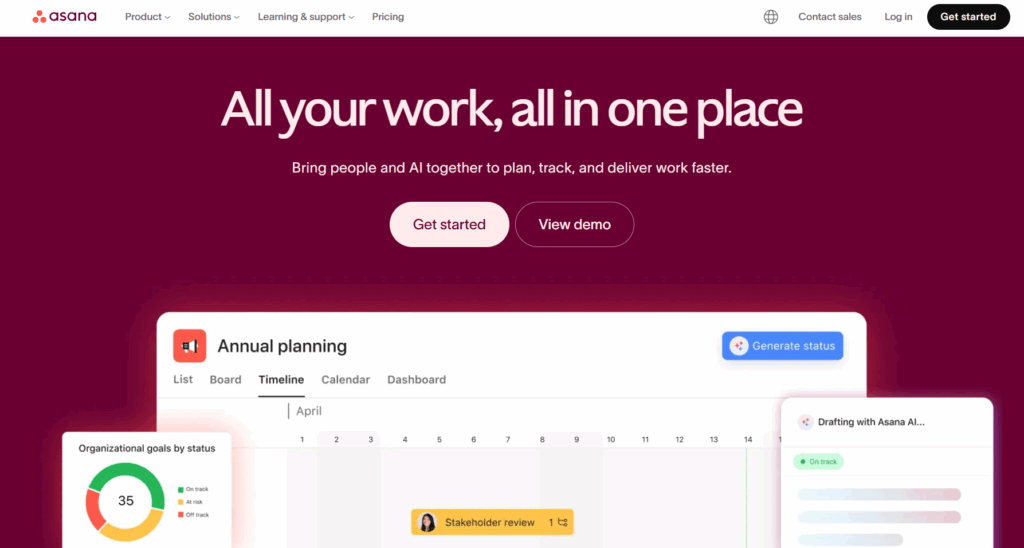
Asana is one of the world’s best-known project management tools, excelling at team collaboration, task management, and project planning. At a portfolio level, it’s also great at zooming out and connecting initiatives to goals and strategy. For teams that find monday.com a bit too “busy,” Asana offers a more structured approach to project workflows.
Key features
- The golden thread: Asana has a great ability to clearly link tasks, projects, and goals together. This makes it easier for stakeholders to see the big picture as well as align cross-functional teams.
- Workload management: Asana’s resource management dashboards make it easy to see capacity across the team, highlighting where teams are underworked or are on the edge of burnout.
- Interface clarity. While Asana packs in plenty of features, the clean interface prevents overwhelm and makes onboarding a breeze for non-technical team members.
Pricing:
- Personal (free): Lists, boards, and basic project planning for up to two users.
- Starter (from $10.99 per user/mo): Unlocks timeline view and project dashboards.
- Advanced (from $24.99 per user/mo): Adds portfolio management and workload tracking for enterprise-level project planning.
The drawback
Time tracking is very basic, with no timers, just manual estimated and actual time spent. Like monday.com, the free plan is also a little restrictive, with paid tiers required for timelines and reporting.
3. Best for power users who want maximum customization options: ClickUp
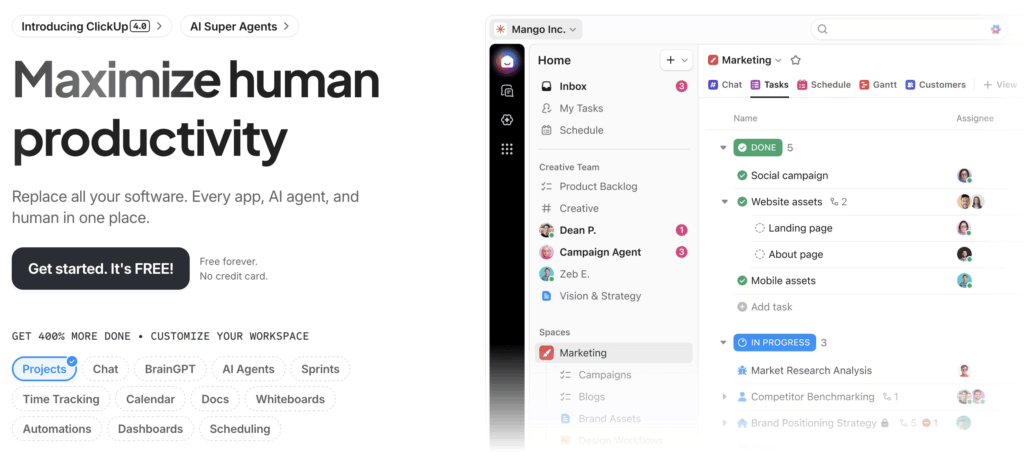
ClickUp positions itself as the “all-in-one” app for work. It’s jam-packed with advanced features that would usually require separate tools, such as docs and whiteboards. Its main selling point is its customization options available, making it a popular monday.com alternative for teams that need something more bespoke at a lower price.
Key features
- Everything view: ClickUp’s “everything view” provides a unique way to see every single task across the entire workspace in one list.
- Customization: You can customize almost anything, from due dates to priority levels and dropdowns, making it a truly flexible option for teams with bespoke workflows.
- Built-in time tracking: ClickUp includes time tracking on all paid plans via a ‘ClickApp’ which also works well on mobile devices, too.
Pricing
- Free Forever (free): Unlimited tasks, Kanban boards, docs, and basic customization.
- Unlimited (from $7 per user/mo): Add Gantt charts, time tracking, and integrations.
- Business (from $12 per user/mo): Dashboards, automations, and portfolio views.
- Enterprise: Get a quote for APIs, permissions, and dedicated team training.
The drawback
Similar to monday.com, ClickUp’s sheer scale means the interface can be easily congested, making the learning curve steep. Automations are also locked behind the business tier, which can be expensive for small teams.
4. Best for simple, visual task boards without the complexity: Trello
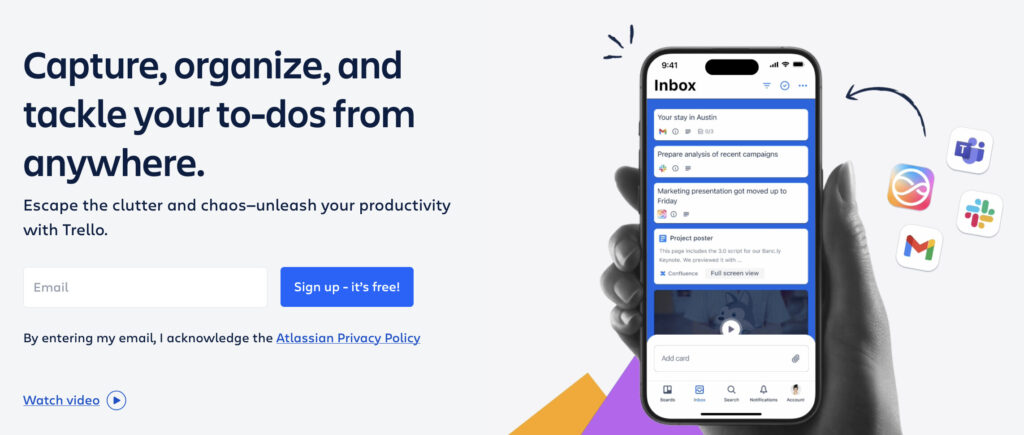
If monday.com feels like an airplane cockpit, Trello is a simple whiteboard with sticky notes. Trello popularized Kanban boards and remains the gold standard for visual planning. Trello’s Power-Ups are also great for automating task workflows, while built-in reports and ready-made templates are there to help teams adopt the platform at lightning speed.
Key features
- Simplicity: Trello prides itself on its simple, Kanban-style approach, which makes the interface simple and easy to understand. This makes project tracking a breeze for stakeholders at all levels.
- Butler automation: A very intuitive interface for setting up “if this, then that” automations, with Power-Ups also on hand to extend automations to work with other tools in your tech stack.
- Mobile app: Trello’s simplicity translates well into a mobile format, too, with both iOS and Android app options available.
Pricing
- Free: Unlimited cards and up to 10 boards with automation and mobile app included.
- Standard ($5/user/mo): Unlimited boards and checklists, with basic customization.
- Premium ($10/user/mo): Adds Dashboard, Timeline, and Calendar views.
- Enterprise ($17.50/user/mo): Higher security and unlimited features for 50+ users.
The drawback
It lacks native timeline views and resource management in its free and basic tiers. Time tracking isn’t native, with manual time logs available through a “PowerUp” add-on.
5. Best for enterprise and advanced workflow management: Wrike
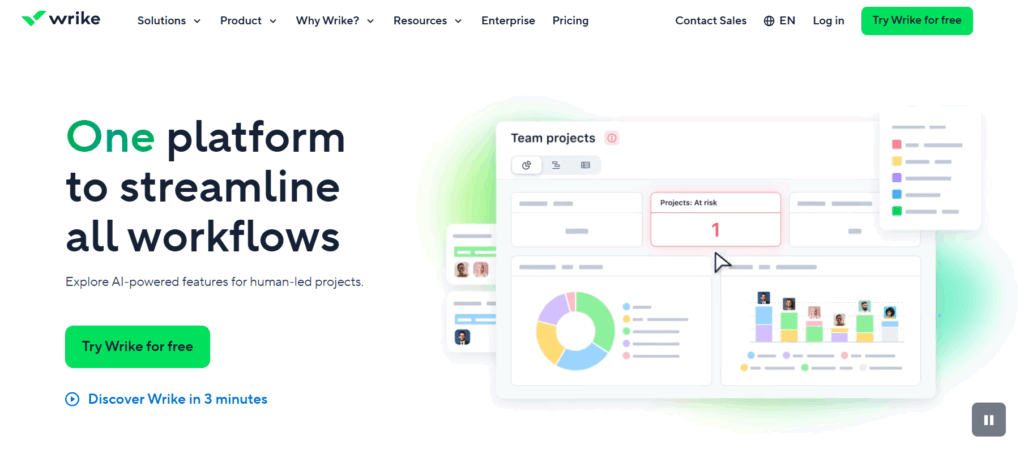
Wrike is a popular choice for large teams that need high-level advanced reporting and rigorous permissions. The software is more “corporate” than monday.com, but it handles complex projects, programs, and portfolios with much more grace, powered by an advanced AI solution (Work Intelligence) that turbocharges you through complexity.
Key features:
- Deep project planning: Wrike is undoubtedly a project management powerhouse, with features for task planning, dependencies, resourcing, and risk management (just to name a few).
- Whiteboard: For creative teams, or those who need to collaborate on big ideas with clients, Wrike’s Whiteboard would be a great standalone product, let alone bundled in as part of the overall package.
- Work Intelligence: Of all the tools covered in this list, Wrike arguably has the most powerful AI and automation engine, allowing you to streamline workflows and take a lot of the admin out of day-to-day project management.
Pricing
- Free: Entry-level board and table-view task management tools.
- Team (from $10 per user/mo): Add custom fields, Gantt, and customization.
- Business (from $25 per user/mo): Elite AI features, templates, and resource planning.
- Pinnacle and Apex: Enterprise plans that include budgeting, SSO, and whiteboards on a custom price basis.
The drawback
Users share that Wrike can have a steep onboarding curve due to the platform’s scale. The “Team” plan is also capped at 15 users, meaning teams of 16+ have no choice but to pay for the costly $25 per user/mo plan.
6. Best for spreadsheet-native teams: Smartsheet
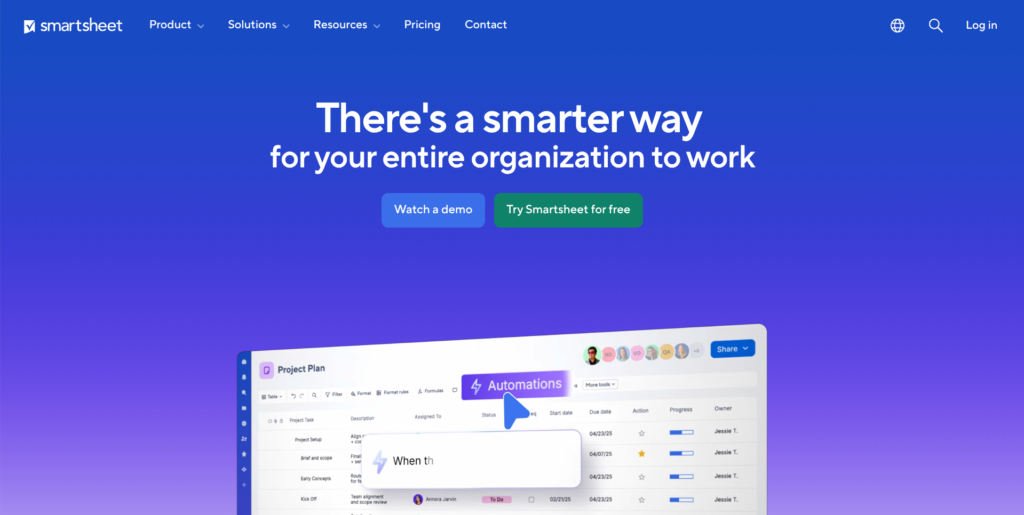
For those who’ve spent their lives in Excel, Smartsheet is the ultimate spreadsheet-based work management platform. It offers the familiar grid layout but adds automations, forms, and timeline views to create a data/project management hybrid that has many fans across the globe.
Key features
- Sheet-first logic: If you love formulas and custom fields, Smartsheet excels here (no pun intended!). This data-driven logic also enables other clean and structured views, including Gantts and calendars.
- Control Center: Smartsheet’s high-level portfolio management view, ‘Control Center’ is perfect for large program or portfolio teams that need to oversee and align hundreds of projects at once.
- No-code apps: One of Smartsheet’s USPs is its in-built no-code app builder. Build your own internal apps, whether it’s a project intake form, lessons learned library, or stakeholder feedback forum.
Pricing
- Pro (from $7 per user/mo): For small teams (10 max) that need Gantt and limited automations.
- Business (from $19 per user/mo): Add timelines, resourcing, and unlimited automations.
- Enterprise and Advanced Work Management: Two additional custom pricing tiers to add AI formulas and charts and the ‘Control Center’ for portfolio management.
The drawback
Users struggle with Smartsheet’s lack of flexibility, especially for complex workflows. The 10-user maximum on the “Pro” plan, and lack of free plan options, make it an expensive option for small teams, too.
7. Best for agencies and client-facing project management: Teamwork.com
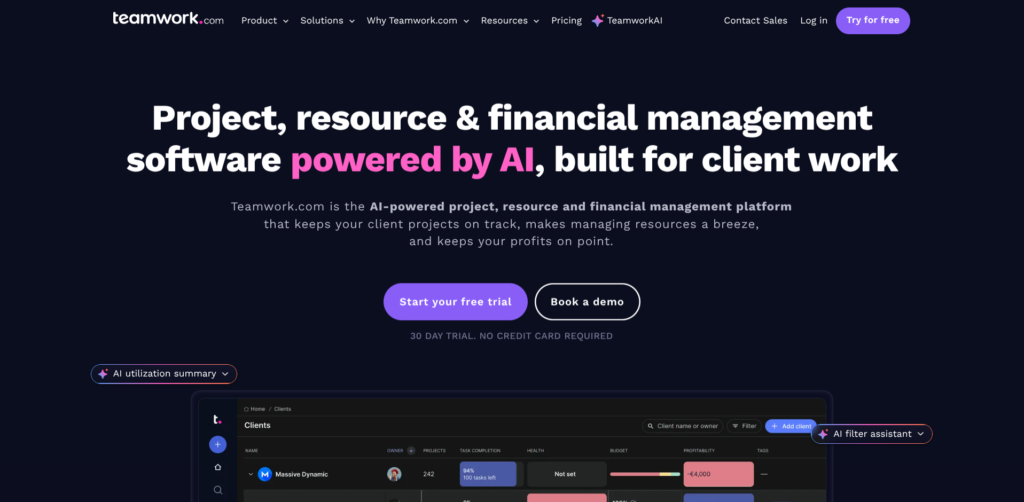
Teamwork.com is designed specifically for agencies or other companies focused on client-based work. It bundles project management basics together with native invoicing, billing, and time-tracking features, as well as agency-specific features like intake forms and retainers. This makes it a strong (and cost-effective) all-in-one solution for small and medium-sized agencies.
Key features
- Clean UI: Teamwork.com offers fantastic collaboration tools that let you invite clients into the platform with granular permissions, keeping internal chatter hidden while showcasing project progress.
- Time tracking: As it’s built for ‘bill-by-the-hour’ teams, the time tracking is one of the best, feeding into workload management trackers across multiple client accounts.
- Resourcing & capacity planning: With such small margins, many agencies live and die from their team’s utilization. Teamwork.com covers the whole resource management journey, with upfront planning, utilization reports, and real-time performance charts.
Pricing
- Free (up to five users): Perfect for project essentials and basic automations.
- Basics (from $10.99 per user/mo): Get templates, intake forms, and 5000 automations.
- Accelerate (from $19.99 per user/mo): Add budget management, resource planning, and client retainers.
- Optimize & Enterprise: Speak to Teamwork.com for advanced AI and profitability reports.
The drawback
Teamwork.com’s mobile app isn’t as strong as the desktop version, leaving mobile teams limited on functionality.
8. Best for docs and lightweight project management: Notion
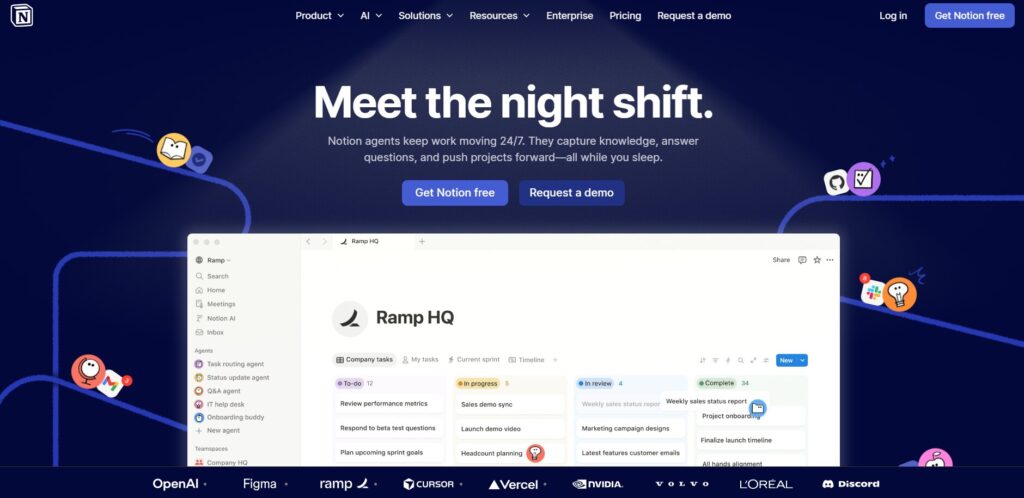
Notion is more of a flexible workspace than a standard project management tool, blending documents, wikis, and databases into one incredibly clean interface. It’s great for teams that want ultimate flexibility, creating a workspace that’s unique to their team and ways of working.
Key features
- Hierarchical pages: Notion is like one big wiki, where you nest pages within pages, to create a massive internal “Wikipedia” for your company. It’s great for software project teams who like tools like Confluence.
- Database views: Toggle the same data between a list, a gallery, a Kanban board, or a timeline, giving you and your team ultimate flexibility on how they want to see and use data.
- Templates: Notion has a massive (and we mean massive) ecosystem of user-created templates for every possible use case. This makes onboarding much faster and reduces clutter on the UI.
Pricing
- Free: Great for individuals or small teams with basic needs.
- Plus (from $10 per user/mo): Get unlimited blocks for planning customization.
- Business (from $20 per user/mo): Add private team spaces and advanced permissions for highly complex medium-sized teams.
The drawback
While you can ‘fudge it’ with templates, Notion lacks intelligent project management and time-tracking features. It can also become messy if you don’t have a strong administration to keep things up-to-date for the team.
9. Best for radical simplicity and flat pricing: Basecamp
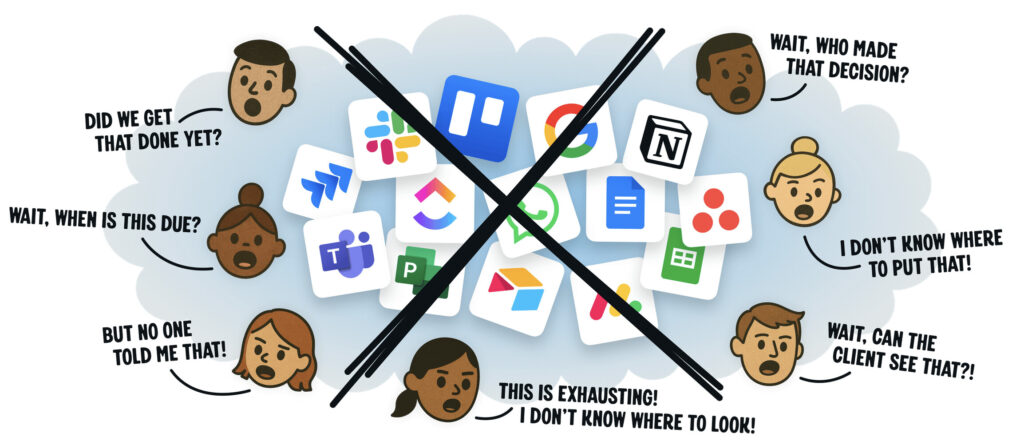
Basecamp has been around since the early days of the web and prides itself on being the “anti-bloat” project management software. It doesn’t do standard Gantt charts or dependencies; it focuses on collaboration features and communication, perfect for creative teams that like seeing things clearly on a screen. Basecamp also stands out for its flat pricing structure, which could be a good fit for rapidly scaling teams.
Key features:
- Project pages: These provide a simple, high-level way to see all your project components, such as to-dos, messages, files, and schedules. It’s all very visual, with simple metrics to show whether you’re on track or falling behind.
- Mission Control: For managers, Basecamp’s Mission Control is the single place to see every project at a glance, with a simple RAG status dial alerting you to problem projects that need your help.
- Flat pricing: Basecamp Pro comes at a flat fee of $299/month for unlimited users, which is a huge deal for large teams, or those that are scaling quickly.
Pricing
- Free: Run one project at a time for no cost.
- Plus ($15 per user/mo): Upgrade to unlimited projects and up to 500GB storage.
- Pro Unlimited ($299/month): A flat fee for unlimited users, billed annually.
The drawback
Basecamp is great for creative teams with simple project needs, but lacks advanced project management features, time tracking, or detailed reporting.
10. Best budget alternative: Zoho Projects
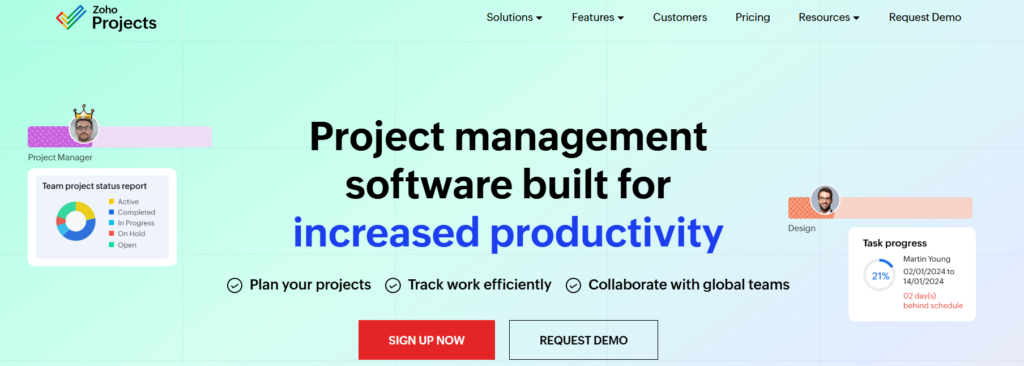
Zoho Projects is part of the wider (and very large) Zoho ecosystem, offering a reliable project management platform that delivers many of monday.com’s features at a fraction of the cost. Alongside standard PM features, Zoho Projects also has native time-tracking, customizations, and in-built AI to automate the more mundane project management tasks.
Key features:
- Templates galore: Zoho Project’s range of ready-to-go project templates help project managers get off the ground fast, whether it’s agile software development, a product launch, or employee onboarding.
- Built-in time tracking: Included even on lower-tier plans, Zoho Projects has a strong time-tracking capability, with automatic trackers, timesheets, and customizable time reporting.
- Zoho integration: If you already use Zoho CRM or Mail, it’s a no-brainer to add Zoho Projects and use real-time integrations to stitch your entire ecosystem together.
Pricing:
- Free (up to 5 users): 3 projects, and 5 GB storage.
- Premium (from $4 per user/mo): Get unlimited projects, time sheets, and all PM features.
- Enterprise (from $9 per user/mo): Add resource management, automations, and SSO
- Ultimate (from $14 per user/mo): Get added storage, read-only users, and custom dashboards.
The drawback
Like other feature-heavy tools, Zoho Projects can feel overwhelming, especially because the UI is a little more dated than its competitors.
How to choose the right monday.com alternative
Choosing the right project management software depends on where the shoe pinches most in your current setup with monday.com. Based on what we hear from real users, here’s a decision framework to guide your search.
| Your pain point | The solution |
| I need time tracking without paying $19/user/month | Switch to Toggl, Teamwork, or ClickUp. These platforms include native time tracking on their free or standard plans, making time tracking more cost-effective. |
| I’m paying too much for features I don’t use | Use Toggl, Trello, or Zoho Projects. These tools offer “lean” versions of PM that prioritize speed and clarity over an endless list of add-ons. |
| monday.com is too cluttered and complex | Consider Toggl, Asana, or Basecamp. These tools are designed with “white space” in mind, while not scrimping on features. Trello is another great option if you like working on Kanban boards, too. |
| I need task dependencies without upgrading to Pro | You’ll love Asana, which treats dependencies as a standard part of project planning, allowing you to manage complex projects without a price hike. |
| I manage client projects and need billing/invoicing | Consider Teamwork.com, which is built for agencies. The platform converts your project tracking directly into invoicing data for faster payment. |
| I want a completely free option to start | ClickUp, Zoho Projects, and Toggl are all excellent options. They all offer very generous free plans that allow you to test key features before spending a penny. |
If you are worried about the move away from monday.com, remember that switching from any tool is completely manageable.
Most of these alternatives to monday.com support a direct CSV import, meaning your data is not as locked in as you might think. There’s always some form of customer support or customer success teams on hand to guide you through the process, too.
When moving between any tool, we always recommend running a two-week pilot with a small group of team members before committing to a full migration. This gives you confidence in the process while also creating some internal ‘champions’ to spread the word across your teams.
Which monday.com alternative is right for you?
Let’s face it, monday.com is a great tool for project teams, earning its status as one of the best on the market. But, it isn’t perfect, with a cluttered interface, strange bundled pricing, and lack of time tracking cited as common complaints.
The good news? If you’re struggling with monday.com, there are loads of alternatives on the market. Whether it’s a lightweight Kanban workflow like Trello, another ‘all-in-one’ tool like ClickUp, or a creative-first setup like Basecamp, there’s plenty of choice out there.
If you’re a mid-sized agency or an SMB that needs clear visual planning and resource management without the overhead of “seat bundles” and feature gating, Toggl is built for you.
We combine the task management you love with the resource planning data you really need to deliver projects on time. We’re also big on time-tracking, making it easy for your teams to record their time without creating an annoying admin overhead.
If that sounds like you, why not kick the tires and try Toggl for free today.
Frequently asked questions about monday.com alternatives
Is there a free monday.com alternative?
Yes, several tools offer a free plan. Toggl is free for up to five users, while Asana allows up to two users on its personal plan, and ClickUp offers a generous free tier for unlimited users with some feature limits.
What is the cheapest monday.com alternative?
Looking beyond the free monday.com alternatives available, Zoho Projects is the most budget-friendly option in our list, starting at around $4/user/month. Trello is also a strong budget contender at $5/user/month if you only need simple Kanban boards.
Does monday.com have time tracking?
monday.com only offers time tracking on its Pro plan ($19/user/month billed annually) and above. For teams on the Basic or Standard plans, you must use a third-party integration or an external time-tracking tool.
What’s the easiest monday.com alternative to switch to?
Toggl and Trello will be two of the easiest tools to switch to because of their intuitive interface and general simplicity. However, most modern monday.com competitors allow you to import your data via CSV and will have support or customer success teams on hand to help with onboarding, too.
Which monday.com alternative is best for small teams?
Toggl is ideal for small teams. It doesn’t require you to pay for “seat bundles” and it’s simple and intuitive to get started with. Other great options for small teams include Basecamp for its simple flat pricing, Asana for its library of support materials, or Trello for its Kanban board simplicity.

James Elliott is an APMQ and MSP-certified project professional and writer from London. James has 8 years' experience leading projects and programs for tech, travel, digital, and financial services organizations, managing budgets in excess of £5m and teams of 30+. James writes on various business and project management topics, with a focus on content that empowers readers to learn, take action, and improve their ways of working. You can check out James’ work on his website or by connecting on LinkedIn.
![How To Make A Project Schedule? [A Step-by-Step Guide]](https://toggl.com/blog/wp-content/uploads/2024/01/project-schedule-673x404.jpg)