
How Forum Communications migrated from Harvest to Toggl in a week-and improved time tracking accuracy
Marketing & Communications
18
Premium
Gainesville, Georgia
Calendar view for daily time logging
Project budgets with recurring billing cycles
Timesheet submission and approvals
Asana integration
Reporting
Browser extension
About
“We didn't set out to look for a new tool. But the pricing change was completely out of reach for us as a small business.”
That's how Callie Flack, Account Director at Forum Communications, describes the moment their decade-long relationship with Harvest came to an unexpected end.
Forum Communications is a full-service strategic marketing and communications agency based in Gainesville, Georgia. Their team of 18 people supports a wide range of clients across small business, education, healthcare, and nonprofit sectors. Services span website design and development, content creation, digital marketing, social media, and branding and graphic design.
For a team like Forum Communications, time tracking is not a nice-to-have. It sits at the core of how the business runs. Every project is priced against a time estimate, and every estimate needs to be validated after the fact.
"When we're pricing something out, we estimate how long that's going to take, and then we get to our cost. We like to know: did we hit the mark? And if we didn't, what happened?" said Callie.
Results with Toggl
| Category | Before | After | Impact |
|---|---|---|---|
| Pricing | Harvest announced a near-10x increase | Toggl pricing brought back in line with previous spend | Avoided a major budget shock |
| Decision timeline | Less than 1 month to act | Tool selected quickly | Fast, low-risk decision |
| Migration speed | No migration plan in place | Data migrated in under 1 week | Minimal disruption |
| Team rollout | Needed a replacement fast | Team live in ~1.5 weeks | Smooth transition under pressure |
| Historical reporting | 10+ years stored in Harvest | 2 years imported, older data archived | Preserved continuity |
| Time tracking consistency | Less complete and less visual | More time tracked more regularly | Better data for pricing and planning |
| Reporting depth | Functional | More flexible and detailed | Improved estimation accuracy |
The switch in numbers:
- Near-10x price increase triggered the change
- Less than 30 days to find a replacement
- ~1 week to export, map, and import data
- ~1.5 weeks from decision to team-wide rollout
- 10+ years on Harvest before switching
- 2 years of historical data imported into Toggl
The trigger: Harvest’s near-10x price increase with less than a month’s notice
Harvest had been a reliable part of Forum Communications' stack for over a decade. Then came the pricing announcement.
“It was almost a 10-times price increase from what we had been paying - and it was going to go into effect very quickly. We had a little less than a month.”
With the deadline approaching, Callie Flack assembled a small internal team to evaluate alternatives fast. They researched several tools and narrowed the search around one central question: which option would be easiest for the team to adopt?
“Any change can be difficult. The easier we can make it, the better.”
That mattered because this was not just a software decision. It affected how the agency estimates work, tracks profitability, and understands team capacity.
“Time tracking first and foremost helps us understand our productivity as a company. It also helps us know where capacity is internally as we bring on new clients.”
The concerns: usability, data continuity, and flexibility
Before making the switch, Forum Communications had three priorities to protect.
1. Team adoption
Time tracking is only valuable when people actually do it. A complicated tool would make compliance harder.
“Time tracking can be a challenge to get people to comply with. You certainly don't want anything that's going to make it even harder.”
2. Historical data
After more than a decade with Harvest, the company had built up a valuable archive of time data used for benchmarking projects and pricing future work.
“We needed to make sure that we could keep as much data as possible.”
They chose to import the most recent one to two years into Toggl, while saving the rest as an archive from Harvest.
3. Flexibility beyond Asana
Forum Communications uses Asana, and integration mattered. But they didn't want to be locked into tracking only Asana-based work.
“Not everything we do is 100% always tied to an Asana task. We needed a way to easily track time for meetings and internal phone calls and things that we don't have Asana tasks set up for.”
Results after migrating from Harvest to Toggl
After evaluating several alternatives, Toggl stood out for one simple reason: it felt familiar and easy to use.
“It functioned the closest to Harvest of anything we looked at.”
The structure matched how the team already worked: clients, projects, tasks, then time entries.
"You have your clients, then you can create projects attached to that client, and then each project can have tasks, and you can track your time to your tasks. That is what we were used to," Callie explained.
The Asana integration also helped preserve existing workflows while allowing flexibility for non-task work.
The migration from Harvest to Toggl: fast, hands-off, and surprisingly clean
Once the decision was made, the migration moved quickly.
Forum Communications exported their data from Harvest and sent it to the Toggl team, who mapped and uploaded everything.
“It was very easy. Everything seemed to come in correctly.”
The migration itself took under a week, and the full team was live in roughly a week and a half. The rollout was phased to reduce friction, with initial internal testing followed by team-wide onboarding and a later training session.
“That way, folks had had some time to play around, and we were able to know what we needed to know when we had the team training.”
The switch also gave them a chance to clean up legacy data.
“Some of our stuff was a little convoluted in Harvest. I was able to archive projects and clients we didn't need anymore and get it really cleaned up.”
Support that matched the urgency
The speed of the rollout was supported by a highly responsive Toggl team.
“They were incredibly responsive and made it very easy.”
That responsiveness continued post-migration, especially around reporting training.
Unexpected wins: recurring projects, calendar view, and approval workflows
After the team settled in, features they hadn't specifically evaluated started paying off.
One feature stood out.
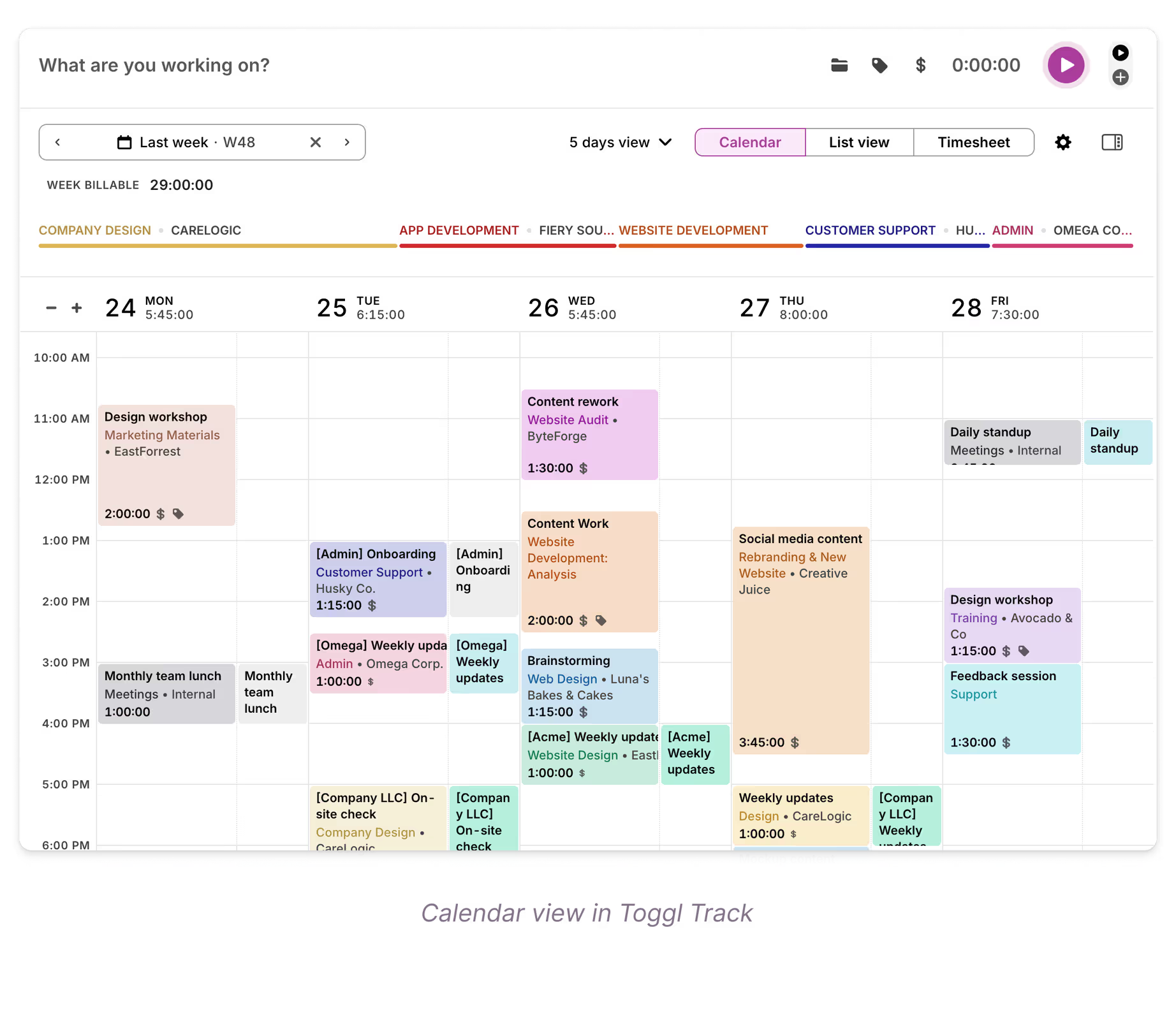
1. People have really enjoyed the calendar view.
It made time tracking more visual and intuitive.
"Sometimes you can go about your day and be like, what did I actually do? Having that calendar view where you can actually see your day chunked out is really, really helpful," said Callie.
“This led to a clear improvement: I have seen more time being tracked.”
2. Project budgets with recurring cycles turned out to be a natural fit for retainer clients.
“We have a lot of clients on an ongoing retainer — say, 10 hours a month. It was very easy to set up: the hours are 10, it recurs, and you can see each month how you're doing.”
For project-based work, task-level budgets meant they could track against their estimates with precision — not just at the project level.
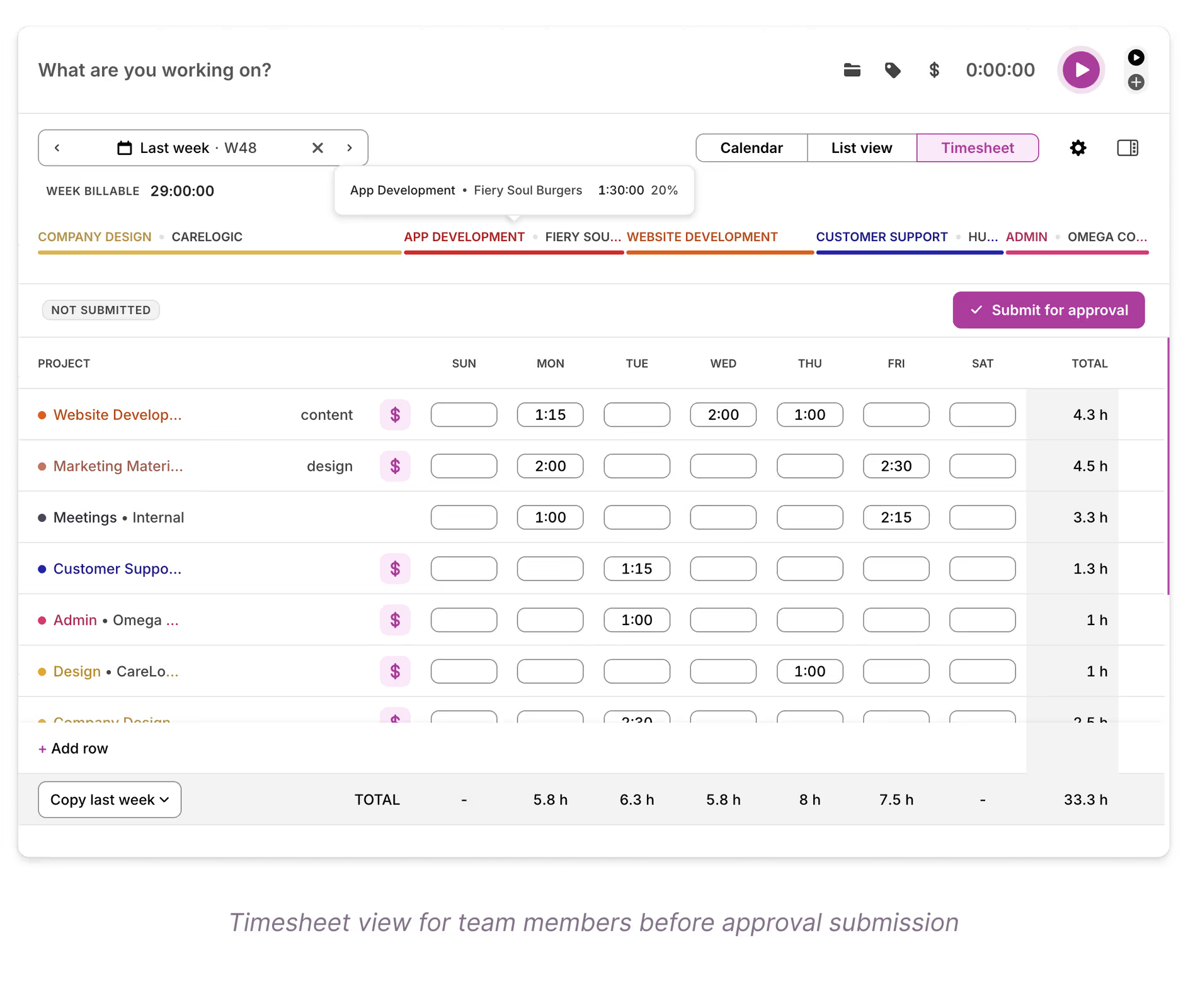
3. Timesheet submission and approvals added quiet accountability.
“People also know that they're going to be submitting their time and someone's going to be looking at it. I think that probably helps get more time tracked.”
4. Reporting turned out to be the sleeper feature.
“All of the reporting features are really amazing — probably even better than what we were able to do in Harvest. If reporting is important and someone has more time to look at things than we did, the reporting tools are really great.”
The bottom line: more time tracked, better estimates
The clearest signal of success has been a behavioral one: people are logging more time.
“I have noticed, in just the short time since we switched from Harvest to Toggl, that people are tracking their time more regularly.”
That matters because time data is only useful when it's complete. For an agency that prices projects against time estimates, every missing entry is a gap in the evidence base.
“If we're going for a new project and it's similar to one we've done before, we can say, well, it looks like it's probably going to take 15 hours — and we're able to feel confident that that is accurate. We can price and plan better.”
Why Toggl worked for Forum Communications
Forum Communications didn't need a transformation. They needed continuity-at a price that didn't break their budget, on a timeline that didn't break their team.
They got both.
Same workflow, same Asana integration, cleaner data, better reporting, and a team that's tracking more time than before. The switch that could have been a crisis became, in hindsight, an upgrade.
“I'm so glad we joined Toggl and hope we'll continue enjoying it and extracting more and more value.”