

.webp)


Agency resource planning
is often a zero-sum
game
is often a zero-sum
game
At most agencies, capacity planning is a balancing act, and the rope is thin. Leaders juggle competing agency metrics every day:
- Utilization rates vs. employee well-being
- Account profitability vs. project quality
- Client growth vs. hiring capacity
- Creative freedom vs. scope predictability
- Client customization vs. operations management
...And most of these are optimized at the expense of another. It’s a constant squeeze, and eventually, something gives: quality dips, deadlines slip, or top talent walks away.
The goal of capacity planning is to build enough breathing room to operate at your best when business is booming and survive those inevitable periods of turbulence with ample resources and cash in your coffers.
The art of purposeful capacity planning
Beth Trejo has been running her social media agency, Chatterkick, for over 13 years. Since its launch, she’s seen platforms rise and fall, algorithms shift, and markets swing — with every change rippling through her business.
“I started with a partner and bought them out a couple of years in. I had three different acquisition opportunities and ended up going with one. Then, I bought the company back… It's been a wild ride.”
What kept the business steady through the chaos? Two elements: people-first culture and smart capacity planning.
“Finding the balance between giving people space to be creative and having the data to manage effectively is the hardest thing I’ve done. It’s a mix of art and science.”
— Beth Trejo, CEO of Chatterkick
That balance starts with clarity. Chatterkick doesn’t chase every trend. Instead, Beth applies a business lens to each new opportunity: “[For us], marketing was never the lead. Business was. We’ve always focused on business growth first, then figured out how marketing and sales fit behind it.”
Without that filter, it’s easy to misstep by building excess capacity for services clients don’t value, stretching the team on unprofitable work, or chasing growth that erodes margins.
Beth asks three questions to evaluate if the new opportunity is a fit for her business:
- Will this support client outcomes or drain team capacity?
- Does it fit our service model?
- Can our current team deliver it well without risking other initiatives?
When capacity planning is rooted in purposeful growth, you build a healthier business. One that protects margins, supports the team, and deepens client relationships without burning anyone out along the way.
Benefits of capacity planning
- Improves project profitability through better resource allocation
- Establishes a methodology for work planning and prioritization
- Prevents team burnout by aligning workload with actual availability
- Reduces the odds and costs of last-moment bad hiring
- Improves project delivery quality by avoiding overcommitment
- Enables smarter decision-making with real-time capacity data
- Maintains consistent client service levels during growth
- Supports long-term scalability without sacrificing team wellbeing
- Creates space for innovation, training, and personal growth
Deciphering an effective capacity planning process
Beth Trejo uses a capacity planning process with three elements to look at the agency through a business lens:
Accurate resource data: A clear view of your team’s availability, utilization rates, and skill sets
Reliable demand forecasts: Projected workloads based on pipeline, scope, and client expectations
Real-time visibility: Ongoing tracking of hours worked vs. planned, plus historical data to course-correct early
Together, these elements (all available in Toggl) allow you to match the right people to the right projects — at the right time — while protecting your team’s bandwidth and your company’s profit margins.
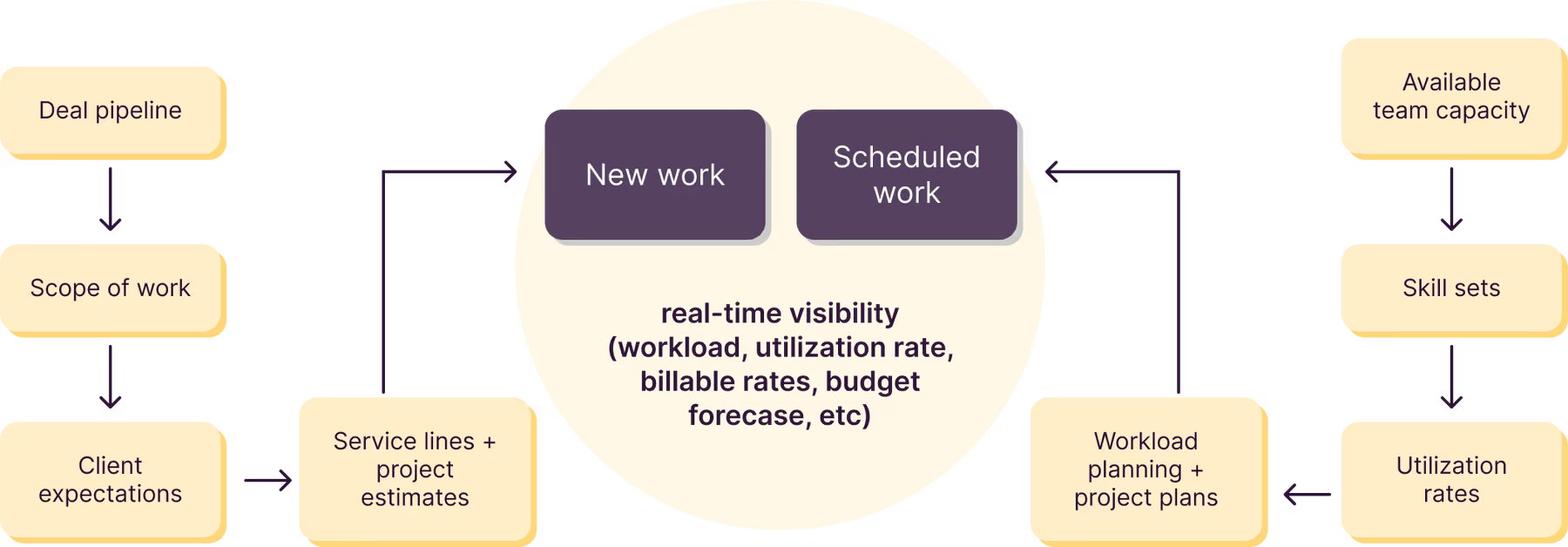
Strategic planning is where capacity management starts. Here, you scope future work based on active deals, estimated scope of work, and project requirements. Then, pre-allocate capacity based on project timelines and current resource availability. Your goal is to lock in the right skills to avoid being blindsided by demand spikes or staffing gaps.
Then comes tactical execution: you do project planning, assign tasks, and schedule available resources. It’s also where managers can spot scope creep early, streamline workloads, and empower teams to meet expectations without overextending themselves using the right project management systems.
The best agencies know they need both elements in place. Strategic foresight gives you room to grow. And tactical follow-through keeps your team sane while doing it.
3 traditional types of capacity planning
...(and why they don’t always work for agencies).
Most capacity planning frameworks were built for manufacturing, supply chain management, or IT — industries with predictable workflows and repeatable outputs. But creative and service-based businesses don’t operate on assembly lines. To plan capacity effectively, you first need to understand the traditional models, and where they start to crack under agency realities.
Lag strategy: A cautious but risky approach
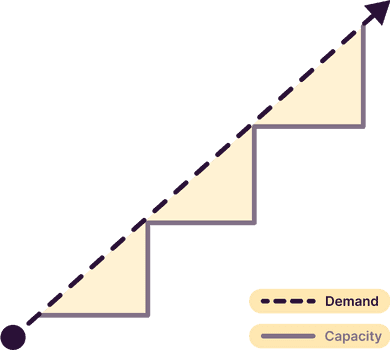
The lag strategy is a conservative approach to capacity planning where businesses wait for a clear uptick in demand before expanding their current capacity. In other words, you don't hire more people, invest in tools, or take on additional overhead until your current resources are fully stretched and actual demand consistently exceeds supply. It's designed to minimize waste and reduce the risk of over-investing too early.
Advantages
- Keeps operating costs low until there’s a clear demand
- Reduces the risk of overhiring and low resource utilization rates
- Encourages lean operations and efficient use of existing team capacity
Why it can backfire for agencies
Agencies rarely enjoy steady, predictable demand. New projects, campaigns, or client requests can swarm in overnight. Waiting to add capacity until you’re already underwater puts teams in a bind and blows up your hiring budgets.
“Our biggest problem for three years was that we couldn't hire quickly enough to meet the demand, which is an awesome problem to have — a really frustrating, awesome problem. I spent something close to like a million dollars on recruiter fees over that period.”
The lag strategy assumes talent and tools are instantly available when needed, which isn’t always the case. In a fast-moving client services environment, caution can cost you more in lost opportunities and team morale than the overhead you’re avoiding.
Lead strategy: Proactive scaling with high stakes
The lead strategy flips the lag model on its head. Instead of waiting for demand to rise, you expand capacity in advance — hiring ahead of time, investing in new management tools, and scaling infrastructure before your human resources are depleted.
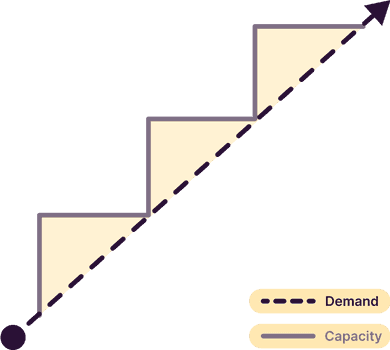
The goal is to stay one step ahead of anticipated demand so you're never caught short-handed. Lead strategy works well when demand is growing rapidly and predictably, allowing teams to innovate without constantly playing catch-up.
Advantages
- Ensures bandwidth is available for new business or last-minute client asks
- Creates space for training, experimentation, and internal development
- Signals confidence to stakeholders and team in your ability to scale
Why it can backfire for agencies
The biggest risk with the lead capacity strategy is overcommitting too early. Agency workloads fluctuate, and overestimating growth can result in underutilized talent and increased operating costs.
I think there’s a risk of moving too quickly. And there’s also a risk of moving too slowly. It’s up to you to find what pace you can go at and how much capital you have to invest in new things. A few years ago, we grew too quickly. And it was like ‘Yeah, look at all this revenue.’ Six months later, we lost a couple of clients because we couldn’t keep up.
In a service business, every new hire is a person who needs meaningful work, clear onboarding, and ongoing attention. If new revenue doesn’t land as expected, you risk sinking your profits and straining team morale (when you’re forced to let go of some talents).
For agencies without predictable revenue pipelines or long-term contracts, the lead strategy quickly becomes a liability rather than a growth enabler.
Match strategy: A responsive model
The match strategy takes a more balanced, incremental approach to resource management. Instead of betting on future demand or waiting for a crunch, you adjust resources in sync with the current demand levels and wider market trends, scaling up or down in small, timely steps.
Think of it as demand tracking in real time: you monitor deal pipeline activity, team workloads, and project scope regularly. Then, make proactive adjustments to staffing, timelines, or budgets as needed.
Advantages
- Balances cost control with delivery readiness
- Avoids drastic over- or under-staffing decisions
- Encourages regular review of team capacity and project forecasts
Why it can backfire for agencies
In theory, the match strategy seems ideal for agency life. But in practice, it requires razor-sharp forecasting, seamless communication between departments, and fast decision-making, which are difficult to maintain at scale.
Without the right capacity planning tools and processes, teams react too slowly or stretch themselves too thin before making adjustments. The match model also assumes you have access to flexible resources (freelancers, contractors, fractional hires), which require another layer of management.
But if you combine data insights with effective processes and flexible hiring, you can hit the sweet spot of capacity planning.
Somewhere, in the $1-3 million (in revenue range), you start needing full-time people. But I don't see it being on the delivery side. With fractional on the talent side, we can slot in the right people, and there's never a point where I'm like, we don't have the right person.
Mastering the strategic planning level
Strategic capacity planning requires alignment between what clients need and what your team can realistically deliver, now and in the months ahead. Here’s how.
1. Create a discovery process for forecasting capacity requirements
At Chatterkick, Beth Trejo's team uses a discovery-first process to map out client needs, expectations, and realities long before the work begins.
“We develop a pretty straightforward, customized scope of work. It’s strategic — here’s what you say your problems are, and here’s how I think we can solve them within this budget, timeline, and your business category.”
— Beth Trejo, CEO of Chatterkick
Next, her team scopes projects using modular pricing and past delivery data:
“We built our pricing in modules — number of content pieces, platforms, and so on. Then we lay out our proposals as clearly as possible, so clients know exactly what they’re getting.
“If I know we have the capacity and capabilities, I’m super open to saying yes. But we don’t say yes to everything. And as we’ve gotten older and bigger, you can say no to a lot more.”
By vetting projects early, Chatterkick avoids mismatched expectations and hidden resourcing gaps — two of the biggest threats to profitability and client trust.
Know your limits (before clients do)
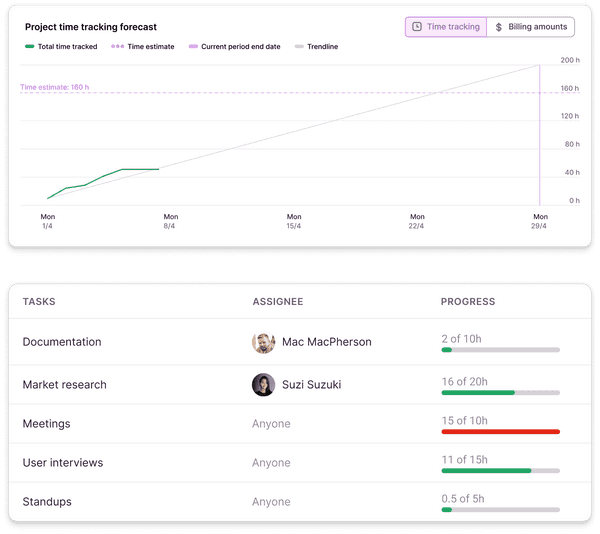
Resource capacity planning decisions shouldn’t rely on guesswork. Toggl Projects Dashboard delivers real-time visibility across all client accounts — billable rates, budgets, and team allocations.
With that view, you can see how resources are being used — and whether your available capacity matches upcoming demand. No more surprise overruns. No more constant team stress. Just realistic plans built on actual data.
2. Standardize your service lines
To manage capacity without constant firefighting, you need consistency. For many agencies, that starts with well-scoped, repeatable service lines. When your offerings are productized, they’re easier to estimate in both effort and profitability. You know how many hours a project takes, what skills it requires, and how to price it without eroding margins. Beth Trejo leans heavily on this approach:
We have monthly retainer services that run on a cadence, small business websites, influencer marketing, and executive social media service lines. We usually give clients ranges to start, then build a foundational scope.
Rather than pricing on hopeful assumptions, she scopes based on client requirements and past delivery data, ensuring capacity is aligned from the outset.
When your baseline delivery is consistent, your team has more headspace to focus on the strategic or custom elements that make each client engagement shine.
Pro tip: Anchor your pricing in data
Many agencies price on gut feel (or vague competitor benchmarks). But if your pricing is off, your entire capacity plan falls apart. You can’t fund the people or skills to meet customer demand. Price based on how your team actually works. For that, you’ll need three inputs:
Time tracking data: how long specific deliverables take across real projects
Resource utilization: how your team’s time is split between billable work, non-billable work, and overhead
Historical delivery data: what it really costs to deliver services at the quality level your clients expect
You can get all of this data (and more!) from Toggl. Time tracking charts automatically calculate project completion rates, while billing reports track your cash flow against fixed fees. With both, you can design pricing models that accurately reflect your capacity and protect your profitability.
3. Structure your team to flex with demand
Many agencies assume the path to success is hiring niche specialists for every channel — a Facebook team here, an Instagram squad there. But Chatterkick took a different route: building teams around core skill sets, not platforms.
We don’t have a TikTok specialist. Instead, we have someone in charge of audience, engagement, account management, or creative.We expose our people to multiple parts of the business so they can see different problems — and learn how to give better client advice.
The payoff? More engaged employees, higher retention, and a stronger culture of growth. “We’re helping people grow in their careers. It also keeps them at Chatterkick longer — and honestly, makes the work more interesting.”
This model also gives Chatterkick a secret edge in workforce capacity planning. When teams are built around skills, not silos, it’s easier to reallocate talent as demand shifts. If Instagram content slows and executive LinkedIn support spikes, team members flex between projects without causing bottlenecks or burnout.
Tactical capacity planning strategies
Once your strategy is set, you need to assign the right people to the right tasks, set expectations, and create workflows your team actually wants to follow. Without grassroots adoption, your strategic vision stays stuck on a slide deck, and resource chaos creeps right back in. Here’s how to bring tactical capacity planning to life.
Make capacity planning a team sport
Top-down workload decisions often feel arbitrary without context. Overcome this by explaining what “good work” looks like — and why you make certain choices. The goal is mutual clarity. By clearly defining expectations and communicating capacity guidelines, Chatterkick is helping its people self-manage more effectively.
“As a business, we need some idea of time for pricing, scope creep, and other planning. We give our teams general frameworks — what utilization should look like, what the purpose of their meetings should be.”
“We're not trying to catch anyone out. We want to better price our services and understand workloads. We bring up the metrics at coaching meetings, but we don’t obsess over them. It’s important that our team tracks their time and tries to hit utilization targets, because it gives us better data to manage workload and planning. We want to give people a sense of organization without it feeling like handcuffs.”
— Beth Trejo, CEO of Chatterkick.
Pro tip: Get team buy-in with Toggl
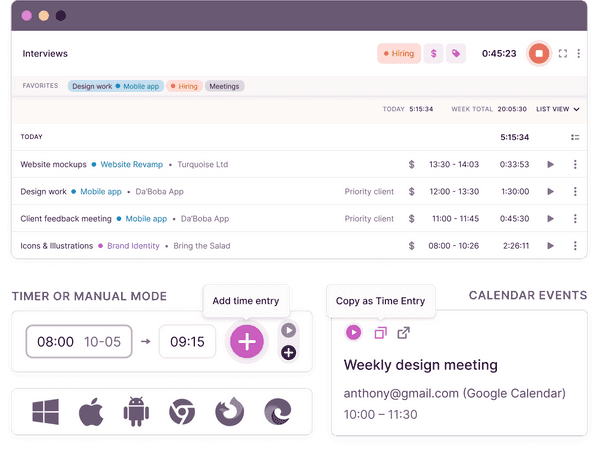
Building a time-tracking habit among your workforce is a job made easy with Toggl. Our platform has a roster of manual and automatic time logging options, available across every device and inside your favorite business tools, thanks to 100+ integrations.
With Toggl's extensions, users can track time in browsers and in the UI of pre-selected online apps. Thanks to the seamless design and a non-negotiable stance on anti-surveillance, our tool has achieved 100% adoption rates in teams of five to 500.
Use data to drill down to the bottlenecks
Tactical capacity planning starts with knowing where time goes, and why it gets lost. Beth Trejo uses a mix of project management tools and internal metrics to uncover Chatterkick’s bottlenecks, inefficiencies, and hidden productivity killers:
“There’s often a gap between how you feel and what the actual workis showing. If you feel like you have a million projects that aren’t actually due or don’t even exist yet, it can create a mind mess.”
Her goal? Ease those tensions through candid conversations. “I’ll ask: What’s taking you an absurd amount of time that shouldn’t? What’s annoying you right now?” Beth says.
Often, simple fixes resolve what feels like insurmountable workload issues.
“Sometimes it’s a glitch, like when Instagram won’t post through our scheduling system, forcing people to post natively. Small things like that can disrupt someone’s day, throw them mentally, and kill pricing and efficiency.”
With the right data and dialogue, you can turn invisible team pain points into tangible improvements.
Make workload chaos visible with Toggl
When teams swing from idle to overloaded, the root cause is often hidden in plain sight: uneven workload distribution. Toggl's Workload Reports make those blind spots visible. Learn how time is spent — by person, project, client, task, or even custom tags.
Want to know who’s over capacity this week? Or which client is eating up time without driving revenue? Workload Reports let you visualize time-based and revenue-based workloads side by side, so you can spot gaps, rebalance tasks before burnout sets in, and make smarter staffing and pricing decisions.

When work is distributed fairly and strategically, people perform better, stress less, and stick around longer. And when you consistently pair the right resources with the right work, profitability follows.
Tell your team how the business really works
No one is at 100% all the time. Agency work moves fast, gets messy, and often throws curveballs no amount of planning can predict. That’s why sustainable capacity planning must account for your team’s energy, not just their availability.
Because without balance, the progression is all too familiar:
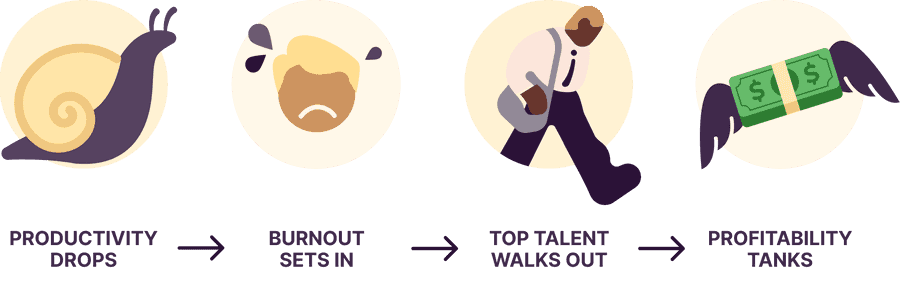
Beth Trejo bakes this understanding into Chatterkick’s operating model.
“We offer ‘responsible time-off.’ It’s not the fake selling of unlimited PTO. It’s an uncapped perk with a few frameworks and policies. We also offer a ‘flexible day,’ so people can shift their workload throughout the day.”
But balance doesn’t mean a free pass.
“You can’t just take off your entire job and still get paid for it,” Beth adds. The goal is a workplace where autonomy and accountability coexist. And transparency is key.
We do put our people first, but we also need our customers in the same mix. If we don’t have our customers, we don’t have our people. There has to be a balance between what’s critical to the business and what’s critical to the team.
That kind of clarity builds trust. When people understand how the business runs — and why certain workload dynamics exist — they’re more likely to stay engaged, show flexibility when it matters, and invest in the team’s long-term success.
Pro tip: Build transparency with data
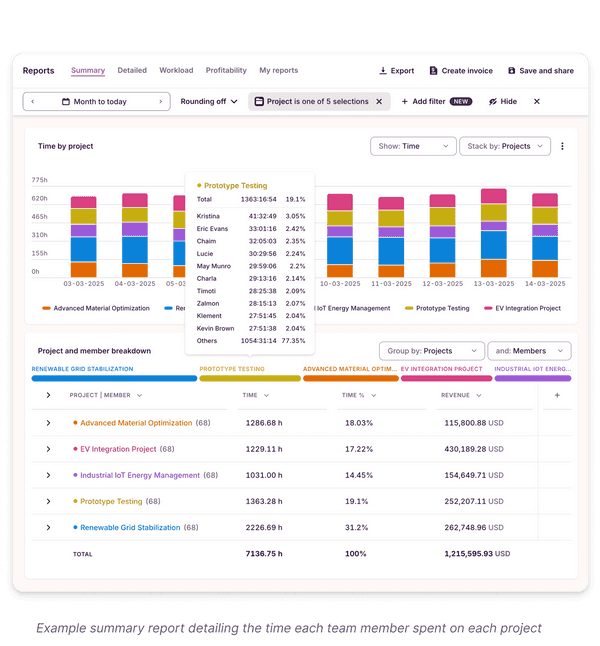
Give your people greater visibility into their goals and contributions through custom Toggl Reports. In a few quick clicks, you can build fully custom reports from available data points (project, team member, individual workloads, capacity totals, etc) to share in one click.
By making more team data public, you can avoid ambiguities about planning, staffing, and prioritization. So that people don’t get the wrong perception that James “isn’t working as hard as I do” or that Manon “obviously has fewer tasks on her plate.”
Stop guessing — start planning with data
In the end, smart capacity planning is about alignment, not aimless hustle. The clearer your deal pipeline, scope of work, team capabilities, and real-time availability, the better you can allocate resources and deliver quality work on time without fueling burnout cycles.
Toggl provides that visibility — from time tracking to project forecasting to workload reports — so you can grow with intent, not by accident. Speak to sales to see how Toggl helps agencies grow sustainably.